49 works in this view — arrow keys or swipe to move between them.
Dance in Art
Frieze of Children Dancing to a Bag-pipe
Giorgio Reverdino (Italian, active c. 1531–1564/70)
- Medium:
- engraving
- Collection:
- Prints
- Source:
- Cleveland Museum of Art
- Rights:
- Public domain — free to use, share and adapt.
- Recorded as:
- CC0
This work documents recreational and folk dance as lived practice rather than as staged performance or courtly ritual—a perspective rarely visible in Renaissance art. For dancers and historians, it offers concrete evidence of how movement, music, and celebration functioned in non-aristocratic contexts, and it demonstrates that the Renaissance understanding of the dancing body extended beyond court etiquette to include the joyful, spontaneous physicality of children at play.
What you are looking at
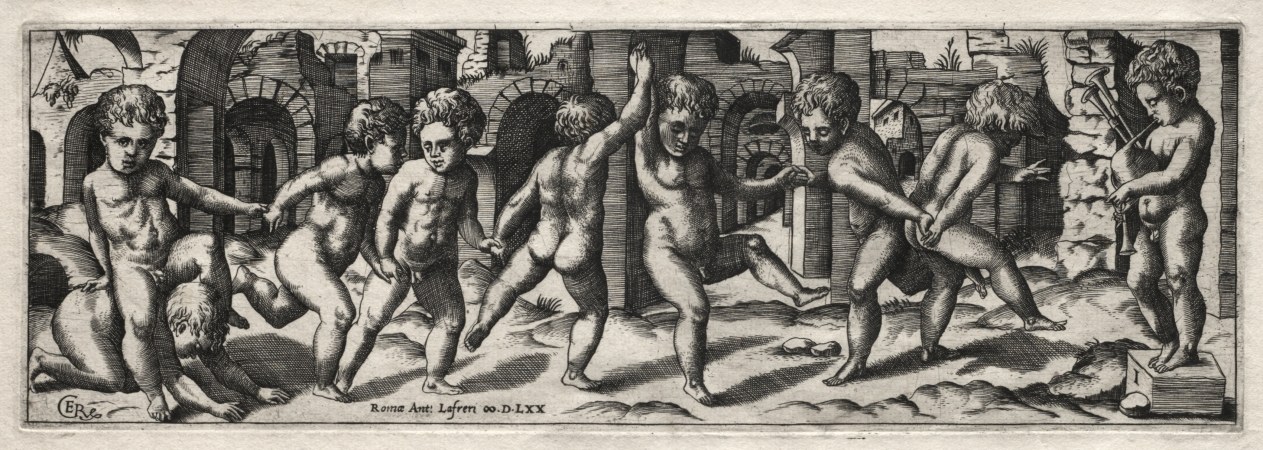
A frieze of approximately twelve nude or lightly draped children cavorts in an open architectural setting—a series of arched columns and stone walls receding into the background. The composition reads left to right across the horizontal rectangle, a processional or gathering rather than a focused group. In the foreground, children leap, gesture, and move with exuberant abandon; some face the viewer directly, others turn or look sidelong. Several reach upward with raised arms. At the center-right, a child plays a bagpipe—the single musician anchoring the scene. The ground is bare; a few scattered objects (a shoe, a small rectangular form) rest on it, suggesting outdoor play in an everyday rather than ceremonial space. The children's hair is rendered in delicate curls; their bodies are youthful and proportioned with Renaissance anatomical care. The light is even and frontal, typical of print media, with the architecture and figures defined by fine cross-hatched lines.
The dancing
The bodies are unclothed or seminude, rendered with careful anatomical observation and idealized proportion—characteristic of Renaissance humanism applied to childhood. The children's poses are varied and energetic: some stand with feet planted, arms raised or gesturing outward in celebratory attitudes; others appear mid-leap, with weight on one foot and the other extended; several reach toward neighbors or upward toward nothing in particular, suggesting spontaneous joy. The holds are open and individual rather than partnered or formalized; there is no closed frame or ballroom positioning. Movement radiates outward from the bagpiper at center, creating a sense of circling or gathering around the musician rather than linear progression.
The dance depicted
This is a depiction of children's play-dance or folk recreation, very likely to a bagpipe, one of the period's most common peasant and vernacular instruments. The children are not executing a recognizable court or theatrical dance form; the lack of formality, the nudity (a convention of Renaissance art for depicting children and innocence), and the open, spontaneous gestures all point to recreational or festival dancing outside aristocratic convention. The bagpipe was associated with shepherd culture, folk celebration, and rural entertainment across Renaissance Europe. The work documents dance as a social and joyful practice of childhood rather than as learned technique, making it invaluable evidence of how ordinary people—or how the educated classes imagined ordinary people—moved for pleasure.
How it was made
This is an engraving, a printmaking technique in which an image is incised into a metal plate (typically copper) with a sharp tool called a burin, then inked and printed. The fine, parallel lines visible throughout—especially in the architectural background—are characteristic of the engraver's hand. Engraving permitted wide circulation and relatively inexpensive reproduction compared to painting, making it an ideal medium for disseminating images of daily life, morality, and entertainment to educated audiences across Europe. The technique's requirement for clear, linear definition encouraged the artist to define gesture and movement with precision; bodies and faces read distinctly even at small scale.
About this work
This is a Renaissance engraving showing a group of children dancing or playing to the music of a bagpipe, rendered in the idealized anatomical style of the period. The work is likely Italian, from the middle of the sixteenth century, and belongs to a tradition of prints documenting social life, folk customs, and childhood. It sits at the intersection of humanist art (the careful study of the body) and vernacular documentation (recording how ordinary people actually moved and celebrated).
The print is important to dance history because it offers rare visual evidence of non-courtly, non-theatrical movement in the Renaissance period. Where other art of the era depicts formal court dances, pageantry, or allegorical performances, this image shows spontaneous, joyful, body-centered play accompanied by a folk instrument. The children's unrestrained gestures and varied, individual movement vocabularies stand in sharp contrast to the synchronized, hierarchical dancing of the nobility.
How to look at it
Attend to the variety and spontaneity of the children's postures: no two bodies mirror each other, and few adopt formal or symmetrical positions. Notice how the bagpiper anchors the scene—the children's gazes and gestures orient loosely toward the music, but no rigid formation constrains them. Observe the contrast between the careful, architectural setting (suggesting a court or public space) and the unconstrained, almost chaotic movement within it. The artist has captured not a moment of synchronized execution but rather the lived experience of music prompting multiple, simultaneous, individual responses—a scene closer to social improvisation than to choreography.
The artist
Giorgio Reverdino (also recorded as Georges Reverdy or Reverdin) was an Italian or possibly Franco-Italian printmaker active in the mid-sixteenth century, approximately 1531–1564/70. Little is documented about his life or training, but his prints circulated in northern Europe and suggest a practice focused on genre scenes, moral or satirical subjects, and documentary images of daily life. His style shows the influence of Renaissance print culture associated with Antwerp and the Low Countries, where such subjects were particularly popular. The signature or monogram (CRV or similar) visible in the lower left corner is consistent with printmaker conventions of the period.
The period
In the sixteenth century, Renaissance humanists were intensely interested in childhood, the body, and the recovery of classical themes and forms. At the same time, Northern European printmaking was developing a robust tradition of documenting vernacular life—peasant dances, festivals, children's games—as subjects worthy of artistic attention. The bagpipe, while sometimes depicted in elite courtly contexts, was primarily associated with rural and pastoral life; its appearance here signals folk culture rather than noble entertainment. This engraving also reflects a moment when print technology made images of daily life accessible to educated middle-class audiences, creating a market for works that satisfied curiosity about how "ordinary people" moved and celebrated. The idealized nudity of the children recalls classical precedent and suggests that even folk play was understood through a lens of humanist aesthetics.
Where it lives
The work is held in the Prints collection (accession 1928.771) at the Cleveland Museum of Art, gift of Leonard C. Hanna, Jr. in 1928. It is a single engraving, likely from a series or set of prints documenting social life and customs—a common format for circulation among Northern European print collectors of the period.
Dance in this work
Questions about this work
Who is the artist, and why is there confusion about the name?
The artist is recorded as Giorgio Reverdino (Italian form) or Georges Reverdy/Reverdin (French forms). The variation reflects sixteenth-century naming practices and the international movement of printmakers between Italy and Northern Europe. Records are sparse, and orthographic variation was routine. The monogram on the print offers the most reliable identification.
Are the children really nude, or is this a convention?
Nudity in Renaissance depictions of children was a convention inherited from classical art and used to signify innocence, purity, or the natural state. It does not necessarily indicate that children actually danced unclothed in folk contexts; rather, the artist employed a humanist visual language to elevate and idealize the subject. The bagpipe and architectural setting are realistic; the nudity is the period's visual vocabulary.
What is a bagpipe doing in a Renaissance print?
The bagpipe was one of the most widespread folk instruments in medieval and Renaissance Europe, associated with shepherds, rural celebrations, and vernacular music-making. It appears frequently in prints documenting peasant life, festivals, and dances. Its presence here signals that the artist is deliberately documenting folk rather than courtly culture.
Is this a specific dance or just children playing?
It is children dancing or playing to music—likely no named or codified dance form, but rather spontaneous movement in response to music. The varied postures and absence of synchronization suggest recreational play rather than learned steps. This makes it valuable evidence for understanding how dance functioned outside the court or theater.
More dance artwork





