49 works in this view — arrow keys or swipe to move between them.
Dance in Art
Dancing Pan
Unknown artist
- Medium:
- limestone with traces of red polychromy
- Collection:
- Medieval Art
- Source:
- Cleveland Museum of Art
- Rights:
- Public domain — free to use, share and adapt.
- Recorded as:
- CC0
This relief preserves evidence of how pagan religious imagery persisted in Christian contexts and continued to be aesthetically valued even after theological change. For those studying ancient dance and music, Pan's raised arm and animated torso capture a moment of inspired movement associated with wild nature and ecstatic music-making—visual testimony to how the Greeks imagined divine inspiration manifesting in the body. The survival of such openly mythological work in a medieval collection reveals the incomplete rupture between classical and Christian visual cultures.
What you are looking at
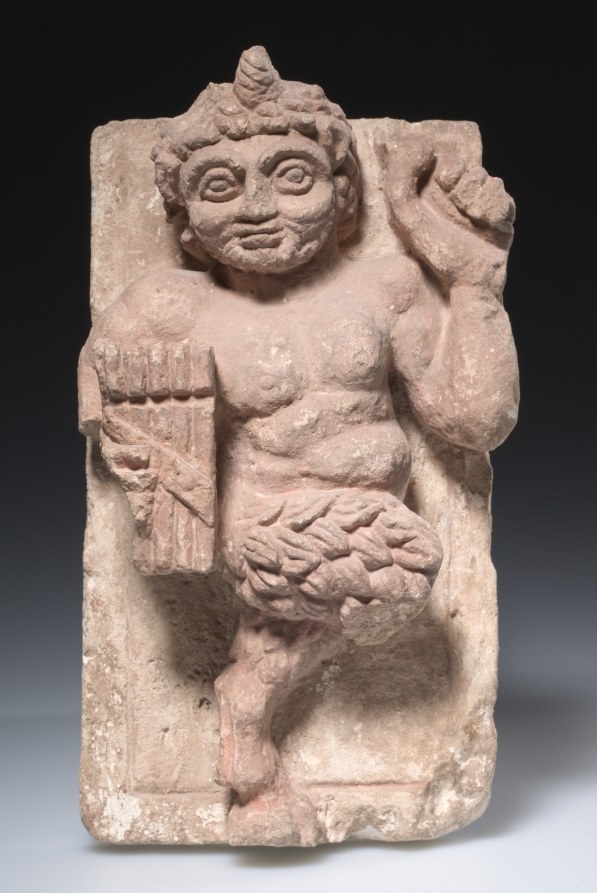
A limestone relief sculpture carved in shallow relief shows a single figure occupying the full height of a rectangular stone panel. The figure is rendered frontally with the torso facing forward and the head tilted slightly, gazing out with wide-set eyes and a full face framed by curled hair piled high with what appears to be a knot or crown of hair at the top. The body is nude and well-developed, with defined musculature across the chest and abdomen. The figure's right arm (viewer's left) is raised and bent, the hand held near the head in a gesture suggesting animation or gesture-speech. The left arm is lowered and holds what appears to be a cornucopia or horn of plenty, a vessel overflowing with fruit or produce. The figure stands in a contrapposto stance on a ground line marked by shallow carving. The stone surface retains traces of red pigment, indicating the relief was originally painted. The background is flat, making the figure advance strongly from the panel.
The dancing
The single figure displays an active, engaged posture rather than a static stance. The raised right arm and relaxed hand position suggest animation or the moment of gesture—possibly addressing an audience or making an emphatic movement. The weight appears to rest equally on both legs, though the contrapposto arrangement (one leg bearing weight, the other relaxed) creates the illusion of forward momentum. The body is unclothed and classically proportioned, typical of pagan deity representation. The horn of plenty held in the left hand grounds the figure as a provider—a role consistent with fertility and abundance deities.
The dance depicted
Pan was the Greek god of woods, fields, flocks, and herds, recognizable by his goat's legs (not fully visible in this relief), pointed ears, and reed pipes. According to the catalogue, Pan invented the reed pipes and used them to charm the nymphs. The raised arm and animated torso suggest Pan mid-gesture, possibly in the act of playing music or engaging in the wild, uninhibited movement associated with him in classical sources. However, this is not a depiction of organized social dance in the modern sense; rather, it captures a deity associated with music and fertility in a gesture of animation. The work represents the Greek mythological tradition rather than a danced form. The sculpture commemorates Pan's mythic role as musician and enchanter rather than documenting any specific dance practice.
How it was made
This is a limestone relief sculpture, a subtractive carving technique in which the image is cut into the flat surface of the stone block. The shallow relief technique (low carving) creates shadows that define form without undercutting deeply, a practical approach that prevents damage and allows the work to be read from many angles. The preservation of red pigment traces indicates the sculpture was originally painted, with color enhancing the carved details and the figure's visual impact. Relief sculpture was the primary means of narrative representation in architectural and architectural-decorative contexts before painting became dominant. The technique required considerable skill in understanding anatomy and three-dimensional form translated onto a compressed spatial field.
About this work
This limestone relief depicts Pan, the Greek deity of nature and music, in an animated pose suggesting gesture or dance-like movement. Dated to 350 CE, it is a rare survival of purely pagan mythological subject matter within the context of Christian Egypt—a testament to the persistence of classical imagery even after the region's religious transformation. The work demonstrates how pagan deities remained culturally resonant and aesthetically vital centuries after the rise of Christianity. The sculpture is housed in the Medieval Art collection, where it serves as evidence of cultural continuity and the complex religious landscape of late antique Egypt.
How to look at it
Observe the raised arm and the posture of the torso: the figure is not standing passively but is caught in a moment of expression or animation. The sculptor has chosen to depict Pan not at rest but in the act of gesture, suggesting the moment music and inspiration flow through him. Note how the cornucopia in the lowered hand balances the raised arm, creating a sense of dynamic equilibrium. The carved details of the hair and facial features are shallow but precise, and traces of the original red pigment remain visible—imagine the figure as it appeared when newly painted, with enhanced definition and presence.
The period
By the fourth century CE, Egypt had undergone significant Christianization, yet pagan classical traditions remained embedded in artistic practice and education. Artists continued to draw on Greco-Roman iconographic vocabularies for religious and civic imagery. Pan, familiar from classical poetry and visual art as the god of music, wilderness, and fertility, represented a strand of cultural continuity that could coexist with Christian practice. The placement of such imagery in a Christian building does not indicate syncretism so much as the persistence of classical learning and aesthetic tradition among educated elites. Limestone relief was a well-established medium in Egypt by this date, adapted from earlier pharaonic and Greco-Roman sculptural practices.
Where it lives
The work is held in the Medieval Art collection and comes from a corpus of late antique sculpture. It is catalogued as a relief sculpture from the period of Christian Egypt, where such pagan imagery, while theologically distinct from Christian doctrine, continued to be produced and valued for its classical associations and artistic merit.
Dance in this work
Questions about this work
Why is a pagan god depicted in a medieval Christian context?
Classical learning and aesthetics remained influential among educated elites in late antique Egypt, even after Christianization. Pagan mythological subjects were not necessarily seen as spiritually threatening; instead, they represented cultural continuity and artistic sophistication. This relief demonstrates that the transition to Christianity was gradual and that classical imagery could persist within Christian communities for aesthetic and educational reasons.
What is Pan holding in his left hand?
Pan holds a cornucopia, or horn of plenty, an attribute of abundance and fertility. This symbol reinforces Pan's role as a god of nature and generative power. The balance of the cornucopia below with the raised arm above creates a compositional equilibrium that suggests the figure's active engagement with the world.
Is this sculpture a record of actual dance practice?
Not in a direct sense. Rather, it captures the mythic association of Pan with music and inspired, uninhibited movement. Ancient sources describe Pan as playing reed pipes to enchant nymphs, and the animated posture here evokes that tradition. The sculpture preserves the classical image of divine inspiration manifesting through the body, which influenced how movement and music were understood.
What do the red traces on the surface indicate?
These are remnants of the original polychrome paint that covered the limestone. Ancient relief sculptures were typically painted to enhance legibility and visual impact. The paint would have made the carved details crisper and the figure more vivid—a far cry from the plain stone we see today.
More dance artwork