49 works in this view — arrow keys or swipe to move between them.
Dance in Art
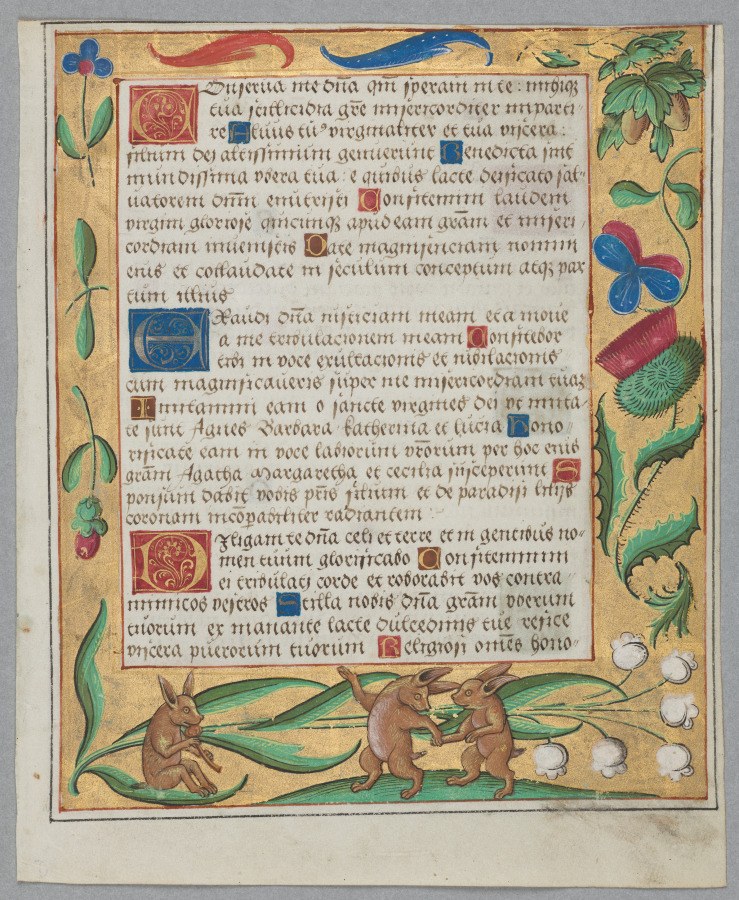
Leaf from a Psalter and Prayerbook: Rabbits Dancing (recto)
Unknown artist
- Medium:
- Ink, tempera and liquid gold on vellum
- Collection:
- Medieval Art
- Source:
- Cleveland Museum of Art
- Rights:
- Public domain — free to use, share and adapt.
- Recorded as:
- CC0
The rabbits dancing or gesturing on this psalter leaf preserve a visual convention—animals performing human social movement—that appears across medieval and early modern popular culture (prints, broadsides, carnival masks) but has largely been read as marginal decoration rather than intentional documentation of social dance and play. For a historian of dance, the image is valuable precisely as evidence of how dance and dance-like movement were understood to be part of social mimicry and animal burlesque. The manuscript also documents the devotional and domestic context in which such playful imagery was consumed by the educated and wealthy.
What you are looking at
This is a leaf from an illuminated manuscript psalter, its text block framed by an elaborate border of botanical ornament rendered in gold leaf, tempera, and ink. The vellum page is dominated by dense Latin text in a Gothic hand, arranged in justified columns. Along the margins run delicate vine-scrolls bearing realistically rendered flowers and leaves—roses, columbines, and other medicinal or symbolic plants characteristic of Northern European manuscript decoration around 1500. At the foot of the page, beneath the text, two rabbits occupy a verdant ground line. Both animals are depicted in mid-movement: one rises up on hind legs in a posture approaching anthropomorphic uprightness, while the second rabbits sits or crouches nearby, its body angled toward its companion. The space between them is animated and intimate. Above this paired gesture, the manuscript text references Saint Godehard, suggesting devotional and regional purpose. The page is a complete visual and textual object—word and image arranged to speak together.
The dancing
Two lagomorphs occupy the lower margin in active relation to one another. The standing rabbit achieves significant height on hind limbs, forelimbs raised or extended in a manner that reads as upright and gestural rather than merely postural. Its companion, seated or rearing less dramatically, orients its body toward the standing figure. Both animals' ears are alert and prominent. The staging suggests mimicry of human social interaction—a confrontation, a greeting, or play. The poses are not naturalistic repose; they are chosen to convey encounter and mutual attention. The artist has worked to make the animals' bodies legible as agents in relation to one another.
The dance depicted
These rabbits are likely engaged in a folk dance or social mimicry rather than a named or codified dance tradition. The marginal placement and anthropomorphic posing are typical of late medieval manuscript ornamentation, where animals perform human social rituals as satire, moral commentary, or pure visual wit. Rabbits performing upright postures and facing gestures in manuscript margins and printed broadsheets of the period frequently referenced social dance, courtship, or folk festivity. The two-figure, standing-and-facing composition resembles the basic formation of a dance encounter. Without inscription or clearer cultural context, the dance cannot be identified with confidence, but the image documents a visual convention in which animals mime human social movement and the play-like, rule-bound character of dance.
How it was made
The work is tempera and liquid gold on vellum, handmade in the early sixteenth century as a single leaf from a bound manuscript psalter and prayerbook. The technique required the application of gold leaf to prepared gesso, followed by painted detail, then the laying of colored tempera and ink. This was a labor-intensive process reserved for patrons of significant means. The richness of the gold and the precision of the botanical ornament indicate a sophisticated urban scriptorium, likely in or near the Lower Rhine region (Hildesheim, Northern Germany). Such pages circulated as functional liturgical and devotional objects for private noble households rather than as art for public display.
About this work
This leaf is a fragment of devotional practice and manuscript culture in early sixteenth-century Northern Europe. It is simultaneously a text page (containing liturgy and saint commemoration) and a work of visual art, its margins occupied by ornament and narrative gesture. The dancing or playing rabbits at its foot are characteristic of the playful, moralizing use of animals in late medieval manuscript margins—a tradition of inserting social satire and humor into sacred texts. The work documents both the persistence of folk and social animal imagery in high medieval art and the integration of such imagery into the intimate devotional objects of the nobility. It witnesses the moment before the Reformation, when such elaborately decorated manuscripts remained central to private religious practice.
How to look at it
Attend first to the page as an integrated object: word and ornament and image are not separate but coordinate. The rabbits are not incidental drolleries but deliberate choices placed to activate the lower margin. Notice the posture of the standing rabbit—it achieves a formal uprightness on hind legs that is not biologically natural but socially legible as 'dance-like' or 'human-like.' Observe the facing or turning gesture of both animals; they are oriented toward each other, suggesting encounter or play rather than mere repose. The artist has chosen a moment of animated social relation. Consider what the image suggests about how the viewer of this manuscript—a noble or wealthy household member—was expected to derive pleasure from the juxtaposition of sacred text and animal social mimicry: the transgressive humor of animal behavior, and the recognition of social convention in animal form.
The period
In the early sixteenth century, the manuscript psalter remained a central luxury object for private devotion among the nobility and wealthy merchant class of Northern Europe, particularly in regions that had not yet adopted the Reformation. The decoration of such texts with naturalistic botanical ornament and moralized or satirical animal imagery was a well-established tradition dating to the fourteenth century but reaching new refinement in the late fifteenth and early sixteenth centuries. The presence of Saint Godehard, an eleventh-century bishop of Hildesheim, suggests this particular leaf was produced for use in that diocese or by patrons with ties to it. Simultaneously, the culture of dance—both courtly and folk—was being documented, codified, and increasingly criticized in print and performance across Northern Europe. The animal dancers in manuscript margins occupy a liminal space between sacred text and secular entertainment, between moral teaching and pure visual pleasure.
Where it lives
This leaf is held in the Medieval Art collection of the Cleveland Museum of Art (CMA). It is catalogued as a single leaf from a psalter and prayerbook produced in the early sixteenth century, likely in the diocese of Hildesheim (Northern Germany). The leaf's survival as an isolated object suggests either the dispersal of a manuscript after its use, or deliberate extraction for sale or collection purposes—a common practice in the nineteenth and twentieth centuries for individual pages of medieval manuscripts.
Dance in this work
Questions about this work
Are these rabbits actually dancing?
The rabbits are depicted in upright, anthropomorphic postures and in animated relation to each other, which suggests social play or mimicry of human dance and courtship behavior. Whether they represent a specific named dance is impossible to determine from the image alone. The convention of animal performers enacting human social rituals—including dance—was widespread in medieval and early modern European visual culture, and this image participates in that tradition.
Why are animals dancing in a religious manuscript?
Medieval and early Renaissance psalters and prayerbooks frequently included marginal decorations (called 'drolleries') depicting animals, humans, or hybrid creatures in comical, satirical, or transgressive situations. These images were thought to provide moral instruction (through satire or reversal of social norms), visual pleasure, and relief from the solemnity of sacred text. The dancing rabbits likely amused the manuscript's owner while also functioning as a visual pun or commentary on human social behavior and vanity.
What region was this made in?
The manuscript leaf was produced for use in or near the diocese of Hildesheim in Northern Germany (Lower Rhine region), as indicated by the prominence of Saint Godehard in the text. Hildesheim was a major center of manuscript production and a seat of episcopal power. The style of the ornament, script, and illumination are consistent with early sixteenth-century Lower Rhine workshops, which were among the finest in Northern Europe.
Is this page still part of a complete manuscript?
This is now an isolated leaf; it is not known whether the original manuscript survives elsewhere or has been lost or dispersed. The practice of selling individual leaves from medieval manuscripts was common in the nineteenth and twentieth centuries, and many once-bound manuscripts have been separated and distributed to different collections.
More dance artwork





