49 works in this view — arrow keys or swipe to move between them.
Dance in Art
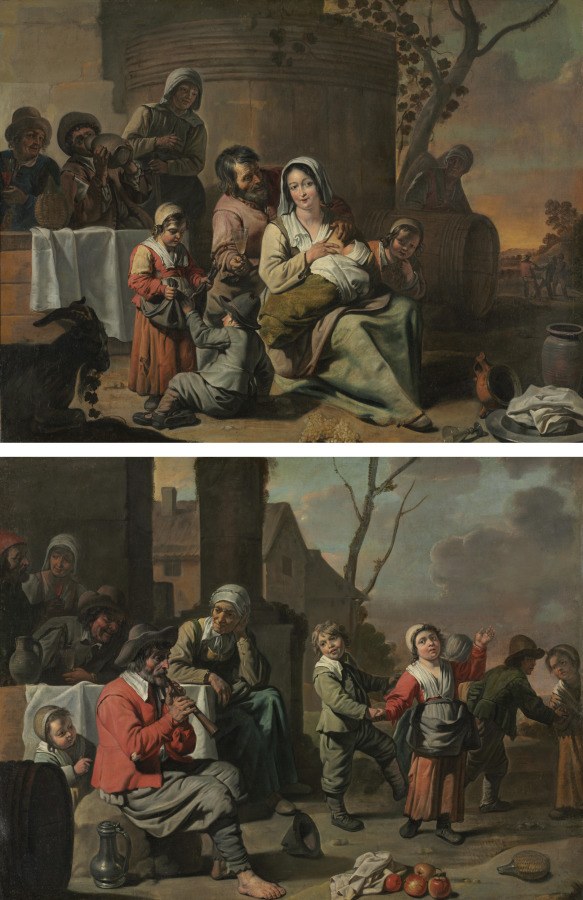
Vintage Scene and Peasant Children Dancing (painting pair)
Le Nain (French)
- Medium:
- oil on canvas
- Collection:
- European Painting and Sculpture
- Source:
- Cleveland Museum of Art
- Rights:
- Public domain — free to use, share and adapt.
- Recorded as:
- CC0
This work matters because it documents vernacular children's movement and festive play in a period when most visual art focused on court dance, aristocratic leisure, or allegorical display. It shows that 17th-century artists were interested in recording actual, unstructured human movement—how children actually moved during celebration—rather than only idealized or formalized dance. For dance historians and dancers, it is evidence that popular, informal movement cultures existed alongside the theatrical traditions and that they were recognized as visually interesting enough to paint and preserve.
What you are looking at
These are two paintings presented as a pair, likely by the Le Nain circle or their Flemish contemporaries. The upper canvas shows a wine harvest or vintage scene set beside a large wooden barrel, with a woman in pale linen seated centrally and surrounded by children—some standing, some sitting at her feet. She wears a white headdress and holds an infant; her expression is direct and knowing, almost conspiratorial with the viewer. Behind her, men in darker clothing drink in shadow beneath the barrel's overhang. A black dog sleeps in the foreground; a bare tree and warm, fading light suggest late afternoon in rural countryside. The lower canvas repeats and elaborates this composition: the same seated woman appears in a village setting before rustic buildings, again ringed by children in various attitudes of play and movement. Here more figures populate the middle ground, some dancing or in motion, others watching. The light is cooler and grayer, the mood more chaotic and festive. Scattered on the ground are apples and other produce. Both paintings are rendered in muted earth tones and soft modeling that emphasizes the textures of linen, weathered wood, and rural poverty rendered without sentimentality.
The dancing
The central woman in both canvases sits with an upright, almost formal posture despite her peasant dress, commanding the composition through stillness rather than movement. The children surrounding her are in unstable, asymmetrical positions—some crouched, some standing with weight on one leg, one appears to skip or hop. Their bodies are rendered with attention to actual childhood proportions and the awkwardness of small bodies in motion or repose. In the lower canvas, one child in the middle distance appears to leap or skip, arms free, while others cluster or disperse. The men in the background of the upper canvas are seated or reclining, forms sagging under drink. No formal dance hold or frame is visible; any dancing is the unstructured, natural movement of children at play.
The dance depicted
Neither canvas depicts formal, choreographed dance. The children's movements in the lower composition—hopping, skipping, clustering, dispersing—suggest spontaneous children's games or play-dances that would have occurred during harvest festivals or village celebrations. This is vernacular movement, not court or theatrical dance. The rural harvest setting and the casual postures of the figures suggest the artist was depicting the actual festive behavior of peasant communities during agricultural celebrations, where music and movement would be present but not formally arranged. The woman's central position and knowing expression suggest she is a witness or elder figure present at these festivities rather than a participant in structured dance.
How it was made
Both paintings are oils on canvas in a mode characteristic of the Le Nain brothers or their Flemish imitators working in Paris in the mid-17th century. The technique is restrained and naturalistic: thin glazes over careful underpinning allow for soft modeling of flesh and fabric, while muted color (ochres, umbers, pale linens, dark greens) avoids theatrical drama. The brushwork is precise but not highly finished, particularly in the backgrounds where buildings and figures dissolve into shadow. This technique was well-suited to the intimate scale of these works and their intended audience—bourgeois collectors interested in scenes of rural life and moral complexity rendered without satire or excessive sentiment.
About this work
This painting pair records peasant life during a harvest celebration, likely in rural France in the mid-17th century. The compositions are centralized around a single composed woman surrounded by children whose movements range from stillness to playful activity, set against backgrounds of harvest plenty and village communal life. Neither painting depicts formalized dance, but rather the ambient festive movement—skipping, hopping, clustering—that would characterize children's play during seasonal celebrations. The artist demonstrates close observation of actual childhood movement and rural social life.
The work belongs in a dance history not because it shows choreographed dance, but because it captures a crucial distinction in dance history: the difference between vernacular play-movement and formal dance traditions. By the mid-17th century, when court ballet was becoming increasingly codified and distant from popular practice, these paintings document what actual movement looked like in rural communities. They are evidence of dance cultures that existed outside the theatrical or ballroom traditions that dominated written dance history, and they show how children's movement and festive play were understood as natural and observable phenomena worthy of artistic record.
How to look at it
Watch the stillness of the central woman and the restless energy of the children around her: the composition's power comes from this contrast. In the lower canvas especially, trace the scattered positions of the children—some stable, some in mid-motion—and notice how the artist has captured the actual asymmetry and awkwardness of childhood play rather than idealizing it into a formal composition. Look at the hands and arms: they are free, unstretched, held in the postures that come naturally during running, hopping, and play rather than in any dance frame. The woman's direct gaze at the viewer, combined with the knowing expression, creates a complicated relationship between the viewer and the scene: we are both witnessing the festivities and implicated in the woman's knowledge. The harvest setting (the barrel, the apples, the vine) anchors the movement to seasonal labor and celebration, not to leisure or performance.
The artist
The Le Nain brothers—Antoine, Louis, and Mathieu—worked in Paris in the 1630s–1640s and became known for their paintings of rural and peasant life, a subject that revived interest among Parisian collectors during the mid-17th century. They drew on Renaissance traditions of pastoral and rustic imagery while depicting contemporary rural France, particularly scenes from their own childhood in Laon. The catalogue record attributes this work to the Le Nain circle or possibly the Master of the Béguins, a Flemish artist who worked in their manner in Paris. The stylistic similarities to documented Le Nain works (the muted palette, the domestic scale, the moral complexity of the scenes, the precise rendering of textures) support this attribution, though the exact hand remains uncertain. Their paintings of peasant life were influential in establishing a new genre of European art.
The period
By the 1650s, European court ballet had become a highly formalized, allegorical art form, featuring nobility in mythological narratives and demanding years of training in a codified vocabulary. Simultaneously, a fascination with rural and peasant life emerged among urban collectors and artists—partly as a reflection of curiosity about distant social worlds, partly as a nostalgic response to classical pastoral literature. Paintings of peasants at harvest, drinking, and celebrating offered a counterpoint to court culture: they showed movement as natural, unschooled, and embedded in agricultural life rather than divorced from it. This pair of paintings sits at the intersection of these interests: they are paintings of rural festivity made for educated urban collectors, yet they depict movement and social life with genuine attention to observable detail rather than moralizing condescension or fantasy.
Where it lives
This painting pair is held in the European Painting and Sculpture collection at the Cleveland Museum of Art (CMA). It is catalogued as oil on canvas, mid-17th century, and attributed to the Le Nain circle or the Master of the Béguins. The lower canvas is catalogued separately as "Peasant Children Dancing" (accession 1958.175.2), indicating that the pair has been recognized as a related composition.
Dance in this work
Questions about this work
Is this actually showing dance?
Not in the formal sense. The children's movements—hopping, skipping, clustering—are festive play-movement rather than choreographed dance with a defined vocabulary or structure. For dance historians, however, this distinction is important: the painting documents vernacular movement cultures that existed outside court or theatrical traditions, and shows how such movement was observed and valued visually by 17th-century artists. It is dance history precisely because it captures what unstructured, celebratory movement looked like in rural life.
Who is the woman in the center, and why is she so composed?
Her identity is not specified in the catalogue record. Her stillness and direct gaze, combined with her central position and the children clustering around her, suggest she may be a mother figure, an elder, or a presiding presence at the harvest celebration. Her composed posture contrasts sharply with the children's movement and the men's drinking, making her a kind of anchor or witness to the festivity. The knowing expression creates a subtle moral or social commentary: she appears aware of the viewer, aware of the scene, aware of its meanings in a way that complicates any simple reading of peasant innocence.
Why are there two versions?
The catalogue record indicates these are companion pieces, likely conceived as a pair. They show the same composition and figures repeated and elaborated: the upper canvas emphasizes the harvest and wine-drinking (the barrel, the men), while the lower emphasizes children's movement and festive play. This pairing may reflect different aspects of the same celebration, or the artist may have offered collectors the choice of subject emphasis while maintaining formal and tonal consistency. The repetition with variation was a common practice in 17th-century studio production.
What does this tell us about peasant life and celebration?
These paintings suggest that rural celebrations integrated children, adults, drinking, harvest produce, and informal music or dance into a single social event. The paintings avoid moralizing and render the scene without obvious satire, suggesting genuine interest in how these communities organized festivity. The children's unschooled movement, the adults' communal drinking, and the seasonal setting all point to celebration as embedded in agricultural labor and collective community life rather than as a separate leisure activity.
More dance artwork





