49 works in this view — arrow keys or swipe to move between them.
Dance in Art
Red-Figure Bell Krater (Mixing Vessel): Aphrodite and Eros
Graz Painter (South Italian, Apulian, active c. 380–360 BCE)
- Medium:
- ceramic
- Collection:
- Greek and Roman Art
- Source:
- Cleveland Museum of Art
- Rights:
- Public domain — free to use, share and adapt.
- Recorded as:
- CC0
For dancers and historians, this image documents the ritual and social framework within which Greek women danced—not as performers in the modern sense, but as participants in ceremonies that marked their transition from one status to another. The scene also reveals the visual conventions by which ancient artists represented feminine attention, vulnerability, and the male gaze, questions that remain central to how we understand the body in motion and at rest. The vessel itself demonstrates that elite Greek pottery was as much about narrative and psychology as about form, and that dance and ritual were inseparable in the ancient imagination.
What you are looking at
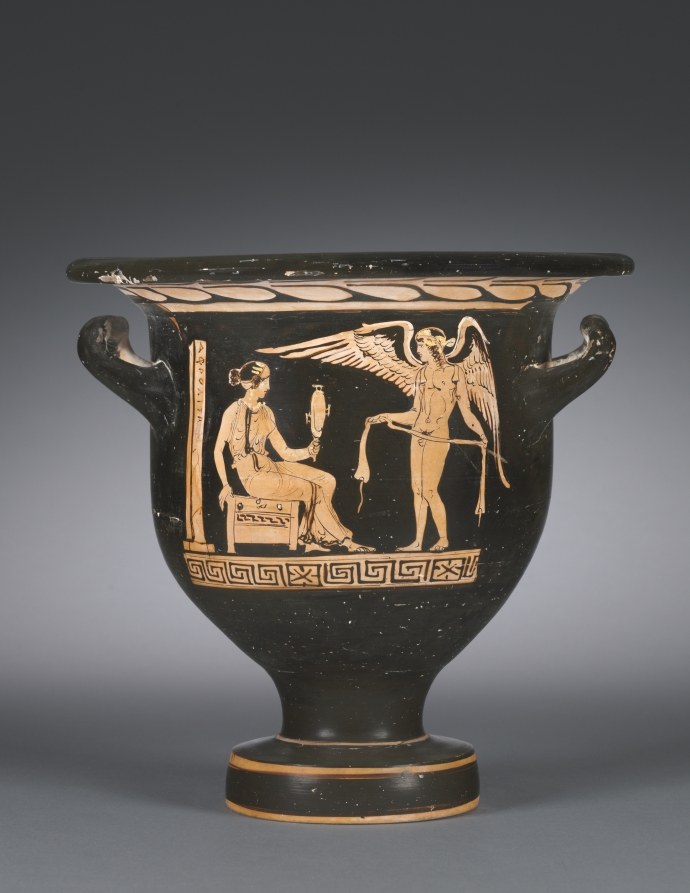
A red-figure bell krater shows a scene of divine beauty and desire rendered in terracotta clay. On the left sits a woman in a white chiton, her body angled slightly forward, absorbed in gazing at her reflection in a mirror held up before her face. She is perched on a low chest or altar, her posture one of composed contemplation. To her right stands a winged figure—Eros, identifiable by his large feathered wings—leaning forward with animated engagement. He holds what appears to be a ribbon or sash in his hand, gesturing toward the seated woman. A tall pillar inscribed with the Greek letters ΑΦΡΟΔΙΤΗ (Aphrodite) rises behind the woman's shoulders. Below the figural scene runs a meander pattern in contrasting red-orange clay. The vessel's dark gloss black background throws the figures into sharp relief, while the reserved clay body creates a luminous effect that draws the eye to the psychological moment: the goddess or bride contemplating her own desirability, attended by the god of love.
The dancing
The woman's upper body bends slightly into the mirror; her arm extends to hold it steady, a gesture of intimate absorption. Eros leans forward with both feet planted, his posture energetic and responsive rather than static. His wings are rendered with careful parallel lines, and his arm reaches forward with the ribbon as if offering or presenting something to her attention. Their spatial relationship is clear but not physically connected—they occupy the same intimate space without touching. The composition creates a narrative dialogue: her withdrawal into the mirror meets his forward-leaning witness.
The dance depicted
This vessel does not depict dance in the conventional sense. Rather, it captures a moment of preparation or presentation that would have preceded social or ritual dances in ancient Greek culture. The scene likely represents a bride being adorned and attended before her wedding—a crucial moment in Greek women's lives when they would have danced and been presented to the community. Eros and the mirror speak to the erotic and social dimensions of that transition. The image belongs to a broader corpus of Greek vase imagery concerned with feminine beauty, ritual, and the ceremonies surrounding marriage.
How it was made
This is a red-figure bell krater, a mixing vessel for wine and water, made from terracotta clay and fired. The technique—red figures reserved against a glossy black ground achieved through a three-phase firing process—was dominant in Athenian pottery from c. 480 to 320 BCE and was adopted and adapted by South Italian workshops like the Apulian tradition to which the Graz Painter belonged. The medium allowed for fine linear detail (visible in the feather work of Eros's wings, the pattern of the woman's garment, the meander border) and created vessels designed for display and use in elite symposia. Such kraters were prestigious objects, valued for their combination of functional form and elaborate figural decoration.
About this work
This red-figure bell krater by the Graz Painter presents a moment of feminine preparation and divine attendance that frames the social and religious rituals surrounding Greek marriage and female beauty. The woman gazing into the mirror is either Aphrodite herself with her son Eros, or a mortal bride envisioning herself as the goddess—a deliberate ambiguity that speaks to how Greek women were positioned within the culture of eros and display. The vessel is both a functional object for a symposium and a statement about desire, divinity, and the rituals of passage that structured women's lives. The careful rendering of gesture and the intimate scale of the scene invite close viewing and conversation about what beauty and readiness meant in ancient Greek culture.
How to look at it
Attend to the woman's face and hands: though she gazes downward into the mirror, the artist has rendered her with a composed, almost meditative expression. Notice how the Graz Painter has differentiated the two figures by their postures—her stillness contrasts with Eros's forward lean and active gesture. The ribbon in Eros's hand is the interpretive crux: is he offering it to her, or has he just given it? The meander pattern at the base grounds the scene in a formal, ritualized moment rather than a casual one. Finally, observe how the dark gloss background makes the reserved clay figures luminous; this is a technique that asks the viewer to look closely at facial expression and hand position to read the psychological narrative.
The artist
The Graz Painter was an active South Italian (Apulian) vase painter working in the mid-fourth century BCE, during the flourishing of Apulian red-figure pottery. This was a regional tradition that inherited and transformed Athenian red-figure techniques, developing a distinctive style marked by larger vessels, more elaborate ornament, and dramatic figural narratives often drawn from myth and ritual. The Graz Painter's work exemplifies the careful draftsmanship and narrative sensitivity of mid-Apulian production, when Greek vase painting was at its height of technical refinement even as it was beginning to lose ground to other media.
The period
This krater dates to c. 375 BCE, a moment of cultural transition in Greece. In the Athenian tradition from which Apulian potters derived their techniques, red-figure vase painting had already been the dominant form for over a century. By the mid-fourth century, however, the tradition was entering its final phase; the invention of metal vessels and changes in drinking customs would soon displace pottery from its central role in elite display. In this same period, Greek drama and symposium culture were at their height, and the rituals of courtship and marriage—the subjects of much vase imagery—remained vital both as lived experience and as artistic theme. South Italian workshops like Apulia's were thriving precisely because they catered to wealthy colonial Greek populations and Italic clients who valued the prestige of Greek-style pottery.
Where it lives
This krater is held in the Greek and Roman Art collection at the Cleveland Museum of Art (cma). It is documented as a red-figure bell krater by the Graz Painter, dated to c. 375 BCE. Such vessels were among the most prestigious pottery objects of the ancient Mediterranean world and are typically found in museum collections devoted to classical art.
Questions about this work
Is this a scene of a goddess or a mortal woman?
The inscription ΑΦΡΟΔΙΤΗ identifies the standing pillar, but ancient Greek convention permitted ambiguity: the woman might be Aphrodite herself with Eros, or a mortal bride envisioning herself as the goddess on her wedding day. This deliberate ambiguity was common in Greek vase painting and reflected how women's beauty and desirability were understood as a kind of divine role they temporarily embodied. The context of the object—a krater meant for elite male symposia—suggests the image invited speculation and conversation.
What is the woman doing with the mirror?
She is gazing at her reflection, a gesture that in Greek culture could signify vanity, self-awareness, or preparation for a public or ritual role. The mirror was a standard attribute of feminine beauty and was often associated with Aphrodite. In the context of marriage ritual, the mirror would have been part of the bride's preparation and adorning process.
What is the ribbon or sash that Eros holds?
The ribbon (or possibly a fillet, a type of binding worn in the hair or around the body) was a conventional ornament and gift in Greek courtship and marriage ritual. In the hands of Eros, it suggests the ritual of adorning—the moment when a bride is dressed and decorated for her public presentation. It may also signal the binding of desire itself.
Why was this vessel used for mixing wine?
A krater was a large vessel used in Greek symposia to mix wine with water (wine was drunk diluted in antiquity). The decoration served both practical and social purposes: it displayed the owner's wealth and taste, and the narrative imagery sparked conversation among the male guests. The subject matter—beauty, desire, and ritual—would have been relevant to the social dynamics of the symposium itself.
More dance artwork





