49 works in this view — arrow keys or swipe to move between them.
Dance in Art
Dancing Cripples
Cornelis Massys (Flemish, 1510/11–1556/57)
- Medium:
- engraving
- Collection:
- Prints
- Source:
- Cleveland Museum of Art
- Rights:
- Public domain — free to use, share and adapt.
- Recorded as:
- CC0
This work preserves evidence of a performance tradition that was popular but morally fraught, offering modern viewers a confrontation with Renaissance attitudes toward disability, comedy, and the body. For dance historians, it complicates the narrative of Renaissance dance as primarily courtly and refined, revealing instead a parallel world of improvised, satirical, and often cruel bodily spectacle. It also testifies to the power of engravings as windows onto performance modes that left no other trace.
What you are looking at
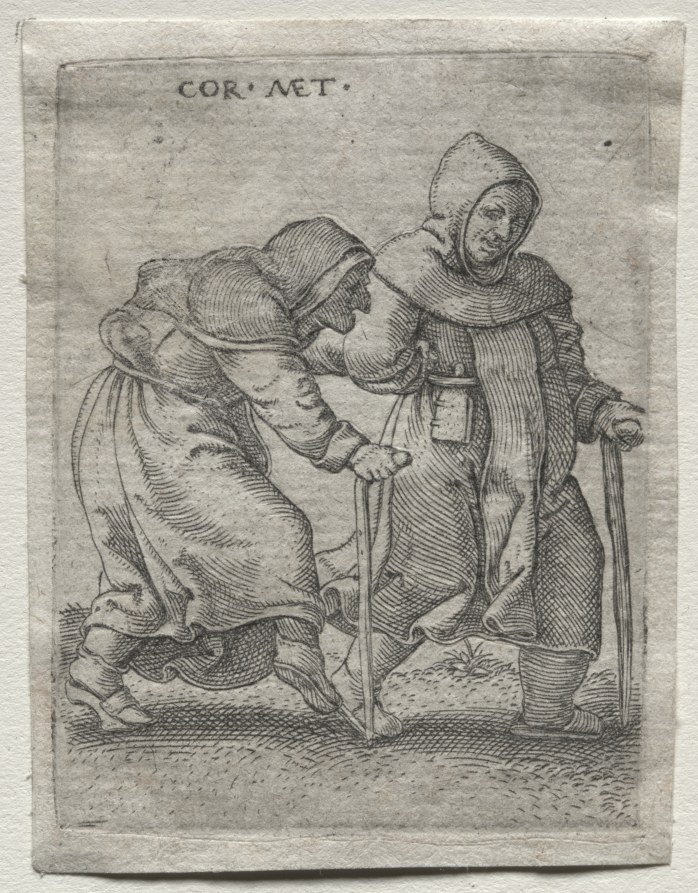
Two figures occupy a modest earthen stage in this Northern Renaissance engraving. On the left, a woman in a voluminous pleated dress and close-fitting hood leans forward sharply at the waist, her body folded almost double in an exaggerated bow or genuflection. Her posture is grotesquely contorted, with her weight pressed downward through bent legs. On the right stands a younger woman in similar period dress—a long gown with vertical pleating and a linen coif—who watches with apparent amusement or concern. She holds a long stick or staff in her right hand, planted in the ground beside her. The ground is rendered as rough hatching; the background is blank. The composition is tightly framed, with no architectural or scenic detail. The title inscribed at top reads 'COR·AET·' (or similar), establishing the subject as deliberate rather than incidental.
The dancing
The left figure's movement is the centrepiece: her torso folds forward in an inverted V, her legs remain relatively straight and planted, creating the effect of a forced or parodic bow. Her arms hang loosely. The right figure stands upright in a neutral posture, offering no reciprocal movement—she is a witness or conductor, not a partner. The stark difference in body position and stillness emphasizes asymmetry and hierarchy. This is not social dance exchange but demonstration or spectacle viewed by an observer.
The dance depicted
This depicts a deliberate humiliation or mockery of physical movement, most likely a 'dance of the cripples'—a popular Northern European satirical or carnival performance mode in which able-bodied performers mimed the movements of people with physical disabilities or deformities. The contorted posture, the stick (possibly a crutch or prop), and the observing figure all support this interpretation. The dance was not learned technique but improvised mimicry, performed for comedy and social commentary. Such performances were documented in prints and woodcuts of the 16th century and appear in the marginal cultures of carnival, street performance, and courtly entertainment, though always with an edge of cruelty.
How it was made
This is an engraving on metal plate, evidenced by the fine parallel hatching used to model form and shadow, the crisp linear definition, and the absence of tone washes. Engravings were expensive to produce and distribute but far cheaper than paintings; they circulated widely among educated viewers in cities across Northern Europe. The technique's precision allowed for fine detail in costume and physiognomy, but also for the kind of unflinching clarity that makes the subject's distortion unmissable. Engravings of satirical or moralizing subjects were popular merchandise in 16th-century Flanders and the Low Countries.
About this work
This is a Northern Renaissance engraving by Cornelis Massys, a Flemish artist active in Antwerp in the mid-16th century, depicting a scene of parodic or carnival movement. The work captures a moment of social spectacle in which one figure's exaggerated physical contortion is made an object of observation and, implicitly, amusement. The 'dance of the cripples' was a real performance mode, a strand of popular entertainment that exploited disability as comedy. This engraving documents not high court dance or liturgical movement, but the rougher, more transgressive edge of Renaissance performance culture—the street, the market, the carnival threshold where bodies became vehicles for satire and social mimicry.
How to look at it
Attend first to the extreme forward bend of the left figure and ask what body part or posture is being mimicked or exaggerated. The stick in the right figure's hand may be a crutch, reinforcing that a disability is being performed rather than experienced. Notice the non-participation of the watching figure—she is not dancing with the other, but observing or directing. The composition's isolation of these two figures on bare ground, with no narrative context, makes the performance itself the subject: this is a print about what bodies do for an audience's entertainment, and about the relationship between performer and observer.
The artist
Cornelis Massys (c. 1510–1556/57) was the son of the painter Quentin Massys and worked in Antwerp as an engraver and printmaker. He was known for satirical and moralizing prints depicting folly, vice, and social dysfunction—works that appealed to a growing market of literate, urban collectors. His subjects ranged from alchemists and quacks to beggars, fools, and soldiers. He participated in the Northern Renaissance tradition of social satire through print, influenced by Hieronymus Bosch and Pieter Bruegel. His engravings are characterized by sharp observation of human behaviour and deformity, rendered with anatomical clarity but often with an unsettling lack of sentimentality.
The period
In 16th-century Northern Europe, dance existed in multiple registers. At court, the pavane and galliard were being codified as noble pursuits. But in streets, markets, and carnival spaces, improvised or semi-improvised performances flourished: mummery, fool's play, satirical acting, and the miming or exaggeration of social types, including people with disabilities. Engravings and woodcuts by Massys, Bruegel, and others document this lower stratum of performance. The Renaissance fascination with the grotesque—visible in art, literature, and spectacle—often turned disability into material for comedy and moral instruction. At the same time, the Reformation was beginning to reshape attitudes toward carnival and popular culture, creating a record (partly through prints) of practices that reformers increasingly condemned.
Where it lives
This work is held in the Prints collection of the Cleveland Museum of Art. It is a Northern Renaissance engraving and a surviving example of the genre of satirical and moral prints that were produced and circulated in 16th-century Flanders.
Questions about this work
What does 'dancing cripples' mean?
It refers to a performance mode in which able-bodied performers mimed or exaggerated the movement of people with disabilities or deformities for comic effect. It was a real entertainment tradition in Renaissance street culture and carnival, and often cruel. This engraving documents the type.
Was this performance actually danced, or just mimed?
It was likely semi-improvised mimicry rather than learned or codified dance. The performer would exaggerate posture, gait, or movement as comedy. It was closer to comic acting or buffoonery than to the ballroom dances being refined at court in the same period.
Why did Massys make this print?
Massys specialized in satirical engravings documenting human folly, vice, and social dysfunction. These prints were popular merchandise for educated urban collectors. Whether this print was intended as moral critique, entertainment, or both is unclear—the artist's attitude toward his subject is not stated.
Is there a dance style code for this?
No standard Renaissance or historical dance category covers carnival miming or satirical body performance. This work falls outside the taxonomy of learned or codified dance styles, documenting instead the improvised and transgressive performance culture that existed in parallel.
More dance artwork





