49 works in this view — arrow keys or swipe to move between them.
Dance in Art
Vintage Scene
Le Nain (French)
- Medium:
- oil on canvas
- Collection:
- European Painting and Sculpture
- Source:
- Cleveland Museum of Art
- Rights:
- Public domain — free to use, share and adapt.
- Recorded as:
- CC0
This painting is essential evidence for understanding how dance and festivity were embedded in the social lives of rural working people, and how gender and power operated within those celebrations. The woman's knowing gaze tells us as much about early modern rural sociability as any depiction of the dance itself could—it shows us who controlled the narrative, who observed, and who became the subject of the gaze. For historians of dance, the companion relationship between this work and *Peasant Children Dancing* is crucial: it suggests that the Le Nain saw movement and stillness, festivity and its contexts, as related subjects that together constitute the experience of rural celebration.
What you are looking at
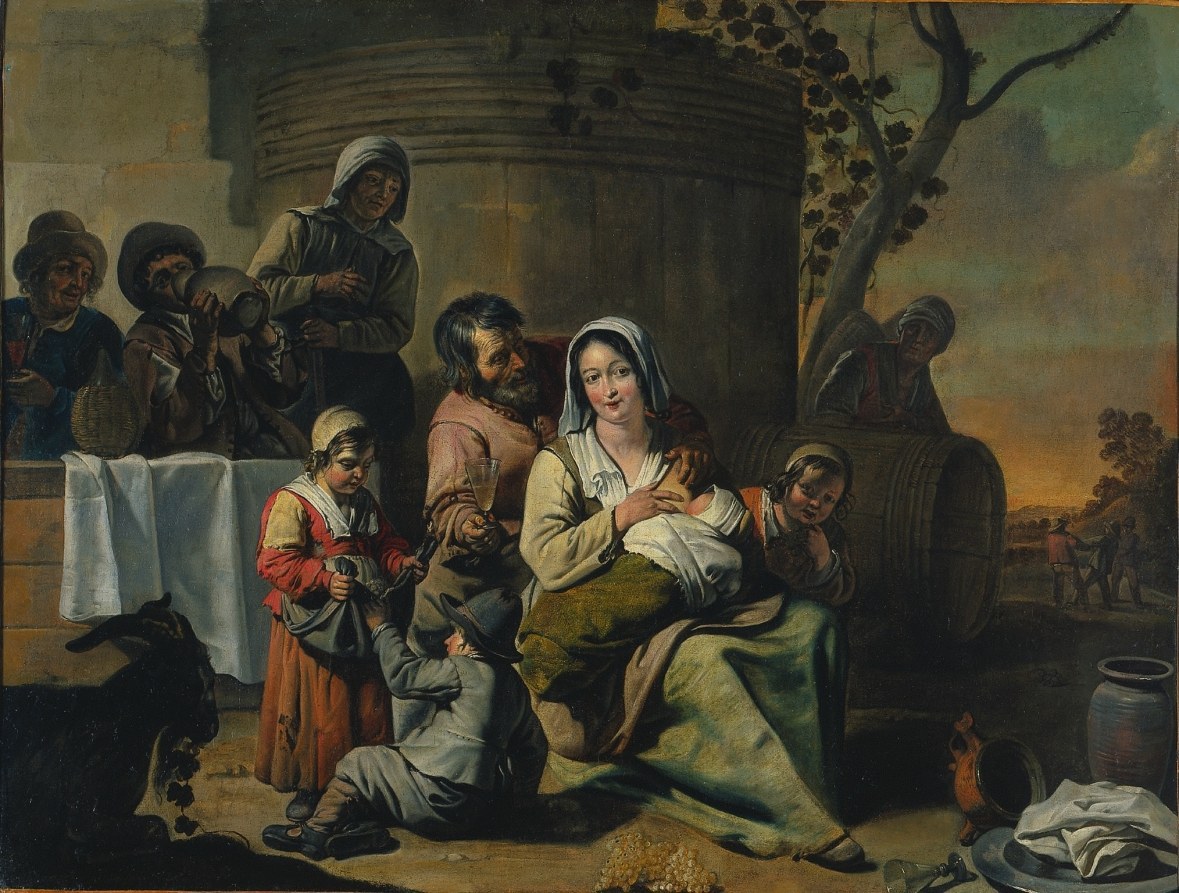
A rustic interior, likely a wine cellar or tavern, centers on a young woman seated with a child in her lap while a bearded man leans toward her with the intimacy of a drunk. She meets the viewer's eye with a conspiratorial smile, aware of his creeping hand on her shoulder. Around them, the social chaos of a vintage or harvest celebration unfolds: in the background left, men drink in the shadows; on the right, another woman tends to children; a large ceramic vessel dominates the upper left. The lighting pools around the central group, leaving the periphery in warm shadow. The palette is earthy—ochres, greens, browns—with white linen catching the light. The scene captures a moment of social transgression observed rather than interrupted, the viewer positioned as a knowing accomplice to the woman's awareness.
The dancing
The central woman sits upright and composed, framing her awareness through direct eye contact with the viewer while the man beside her bends inward in a posture of drunken intimacy. Her body remains still and controlled; his is loose and forward-leaning. She holds a child firmly in her lap. The surrounding figures are scattered in attitudes of ease—standing, crouching, conversing—with the loose, grounded weight of rural people at leisure rather than in formal arrangement. No two figures share a synchronized frame or hold.
The dance depicted
This is not a depiction of dance, though it is a depiction of a harvest or vintage celebration—a context in which dance would occur but is not shown here. The existing catalogue description identifies this as a companion to *Peasant Children Dancing* (1958.175.2), suggesting the Le Nain brothers sometimes paired festive and quotidian scenes. This painting emphasizes the social and sexual dynamics of rural festivity rather than the movement itself. What unfolds is flirtation, drinking, and the social permission granted by festival, not choreography or organized movement.
How it was made
Oil on canvas, worked in the Le Nain manner with careful attention to light falling through a confined interior space. The painter builds atmosphere through warm, translucent glazes and the selective deployment of bright linen and flesh tones against darker drapery and shadow. This technique allows for psychological depth—the woman's awareness and the viewer's complicity can be read in the subtlety of her gaze—in a way that prints or drawings of the period could not achieve. The finish suggests a painting made for a patron of some means, circulated within a collecting circle rather than a popular market.
About this work
This is an oil painting of rural festivity in 17th-century France, attributed to the Le Nain brothers or the Master of the Béguins. It captures the social rituals and transgressions of a harvest celebration—drinking, flirtation, and the permission that festival grants for physical familiarity. Unlike its known companion piece *Peasant Children Dancing*, this painting depicts the context of festivity rather than its movement. It belongs in a gallery about dance not because dance is shown, but because it documents the social space in which peasant dance occurred and the gender dynamics of celebration that dance both expressed and negotiated. The work is notable for its psychological observation: the painter stages the viewer as a witness to the woman's knowing smile, making complicity with transgression part of the aesthetic experience.
Within the Le Nain oeuvre, this reflects a documentary interest in rural life that reached back to Renaissance traditions of peasant imagery while claiming contemporary specificity. The brothers painted rural France as they remembered it from their childhood in Laon, creating a market for paintings of "authenticity" and social observation among urban collectors. This work exemplifies that practice: it presents rural sociability—drinking, courting, child-rearing—as subjects worthy of careful observation and fine painting.
How to look at it
Attend first to the woman's gaze: the painter has positioned her to meet your eye directly, creating a moment of psychological connection that is rare in 17th-century painting. Her smile is neither fearful nor purely acquiescent; it is knowing, even complicit. This gaze convention—the figure aware of and engaging the viewer—was developed in allegorical and erotic prints but appears here in a genre scene, suggesting that the painter understood the political force of the woman's awareness. Second, notice the composition: the central group is tightly framed and brightly lit, while the periphery recedes into shadow and bustle. This technique pulls the viewer into intimacy with the transgression while acknowledging it as one moment within a larger social world. The painter has chosen to freeze not movement but stillness, and the psychological charge that stillness carries.
The artist
The Le Nain brothers—Antoine, Louis, and Mathieu—were active in Paris in the mid-17th century and became known for paintings of rural and peasant subjects at a moment when such scenes were gaining market value among urban collectors. They are documented as the sons of a merchant family and claimed to have spent their childhood in Laon, in northern France, which they represented as the source of their authentic knowledge of rural life. The brothers' practice aligned with a broader mid-century European interest in peasant imagery, which revived Renaissance traditions while claiming documentary realism. Their work was distinctive in its sympathetic observation of rural people without caricature, and in its formal sophistication—these are not folk paintings but fine paintings of folk subjects, created for educated patrons. Attribution among the three brothers remains uncertain; contemporary and later sources used their names interchangeably. The work has also been attributed to the Master of the Béguins, a Flemish painter working in the Le Nain manner in Paris, indicating how influential their approach became.
The period
In the mid-17th century, representations of the lower classes were undergoing significant change. The Renaissance had developed a tradition of peasant imagery, often comic or moralizing; by the 1640s–1650s, a new market had emerged for paintings that claimed sympathetic observation of rural life. This shift occurred partly through Flemish influence on French painting, and partly through the consolidation of urban wealth and the curiosity of urban collectors in their rural counterparts. The harvest and vintage season were conventional subjects in both high art (as symbols of abundance and rural productivity) and in popular culture (as moments of collective celebration, relaxation of social hierarchy, and permitted transgression). Drunkenness, flirtation, and sexual frankness were expected elements of vintage imagery. Dance was one form this festivity took, but not the only one; paintings like this reveal that the social and sexual dimensions of celebration were as important to the period's interest as the choreography itself.
Where it lives
The work is held in the European Painting and Sculpture collection of the Cleveland Museum of Art (CMA). It is catalogued as a painting of the mid-17th century and has been attributed to both the Le Nain brothers and the Master of the Béguins, reflecting the practice of the period in which multiple artists worked in related styles and attribution remained fluid.
Questions about this work
Is this a dance painting?
Not directly. It depicts a harvest or vintage celebration—a context in which dance would occur—but shows festivity, drinking, and flirtation rather than organized movement. Its companion piece, *Peasant Children Dancing* (1958.175.2), is a dance painting; together, the two works suggest the Le Nain brothers understood festivity as encompassing both movement and the social rituals surrounding it.
What is happening in the central moment?
A drunk man leans toward a young woman seated with a child, placing his hand on her shoulder in a gesture of physical familiarity. The woman meets the viewer's eye and smiles, signaling that she is aware of what is happening and perhaps amused or resigned to it. This is a moment of permitted transgression within the context of celebration.
Who were the Le Nain brothers?
Three French painters—Antoine, Louis, and Mathieu—active in Paris in the mid-17th century. They became known for paintings of rural and peasant subjects and claimed to remember rural life from their childhood in Laon. Attribution among them remains uncertain, and this work has also been attributed to the Master of the Béguins, a Flemish painter who worked in their manner.
Why would a collector want a painting of peasants?
By the mid-17th century, there was a growing market among urban, educated collectors for paintings that claimed to show the authentic life of rural people. This reflects both curiosity about and a degree of romanticization of rural life. The Le Nain brothers' formal sophistication—painting peasants with the same care as nobles—made their work especially desirable.
More dance artwork





