49 works in this view — arrow keys or swipe to move between them.
Dance in Art
Spanish Dancer
Natalia Goncharova Born Tula (formerly Russian Empire, now Russia), 1881; died Paris, 1962
- Medium:
- Oil on canvas
- Collection:
- Modern Art
- Source:
- Art Institute of Chicago
- Rights:
- Rights reserved by the holding institution — do not reuse without permission. Source record ↗
- Recorded as:
- AIC — rights reserved
The painting reveals how early 20th-century modernist artists understood dance not as kinetic action but as a system of refined bodily conduct and aesthetic presentation. It documents the persistence of balletic posture and carriage as a marker of class, femininity, and cosmopolitan sophistication, even in a work titled with a folk-dance reference.
What you are looking at
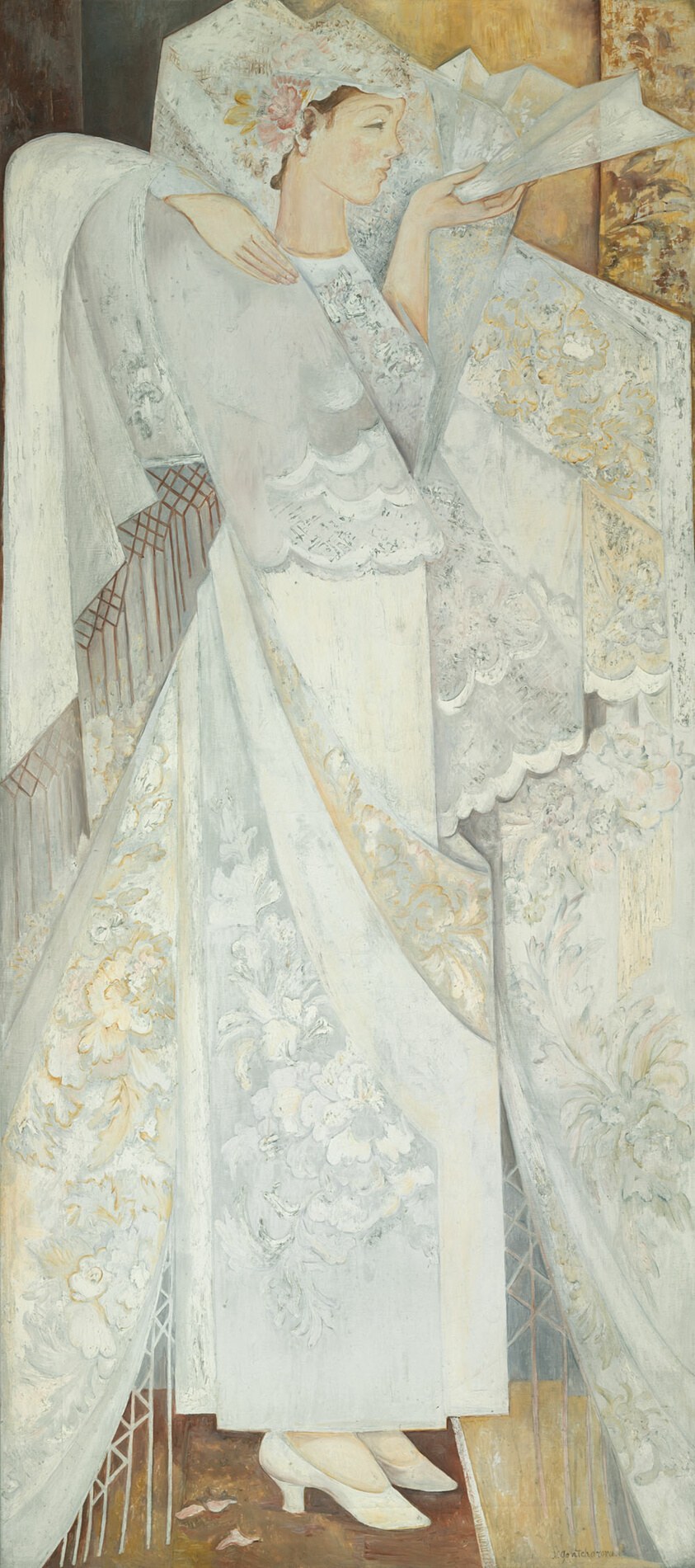
A solitary female figure dominates the composition, dressed in an elegant white or cream-colored gown with elaborate lace detailing and a flowing cape or shawl draped across her shoulders. She stands in profile, her head turned slightly to gaze at an ornate fan she holds before her face. The background is a patchwork of rich, patterned surfaces—gilt decorative panels, floral damask wallpaper, and aged golden surfaces suggesting a luxurious interior. The figure's posture is upright and graceful, with her weight settled, suggesting a moment of repose rather than active movement. The color palette is dominated by whites, creams, and golds, with warm ochre and rust tones in the patterned backgrounds. The painting has a soft, faded quality, as though glimpsing an intimate moment in a grand salon.
The dancing
The single figure is captured in a standing position, weight evenly distributed, with a composed and refined bearing. Her arms are positioned gracefully—one hand holding the fan at face level, the other resting gently at her side. The body is elongated and elegant, with the shoulders relaxed and the neck extended. There is no sense of active choreography or movement; instead, the pose conveys statuary poise and aristocratic restraint. The figure appears to be a portrait study of elegant deportment rather than a captured moment of dancing action.
The dance depicted
This is not a depiction of dance in motion, but rather a study of refined feminine posture and courtly bearing. The image presents the aestheticized, stationary elegance that would have been central to aristocratic dance training and social presentation in the early 20th century. While the figure's deportment reflects the upright carriage and graceful arm placement cultivated in classical dance training, there is no indication of footwork, partnering, or the kinetic energy of performance. The work documents an ideal of beauty and refinement rather than a choreographic moment.
How it was made
Oil on canvas, as stated in the catalogue. The painting employs a technique of soft blending and delicate color layering, with visible brushwork that creates atmospheric depth. The artist has used translucent washes to achieve the luminous quality of the fabrics and the aged appearance of the patterned backgrounds. The technique suggests an interest in capturing texture and light rather than narrative action—the surfaces shimmer with age and richness. This is a work of fine art painting intended for gallery exhibition, not a document or sketch.
About this work
This painting by Natalia Goncharova presents a female figure in early twentieth-century dress, posed with the refined bearing cultivated by classical dance training. The title *Spanish Dancer* suggests a cultural or ethnic association, yet the image shows no actual dancing—instead, a woman in elegant repose, her attention absorbed by her fan. The work belongs in a gallery about dance in art as a document of how dance culture shaped feminine deportment and beauty ideals in the early modern period, even in stillness. Goncharova, a Russian avant-garde artist with deep investment in folk and theatrical aesthetics, has rendered an icon of cultivated elegance rather than captured movement.
How to look at it
Attend to the stillness of the pose and the way it embodies rather than enacts dance. The refined arm position and upright carriage reflect balletic training, yet the figure is absorbed in private contemplation rather than performance or movement. Notice how the artist has chosen a moment of repose, not action—the fan is held near the face as though in conversation or reverie. The sumptuous patterned backgrounds create a jewel-box intimacy, suggesting the figure is displayed as an object of aesthetic pleasure rather than a subject engaged in kinetic practice. The title *Spanish Dancer* invites the viewer to project movement and exoticism onto what is actually an image of aristocratic stillness.
The artist
Natalia Goncharova (1881–1962) was a Russian avant-garde painter, designer, and printmaker who worked across Cubism, Futurism, and Constructivism. She was deeply engaged with Russian folk art, Orthodox iconography, and theatrical design, creating sets and costumes for Sergei Diaghilev's Ballets Russes. Her practice spanned easel painting, graphic work, and applied design. Based in Paris from 1917 onward, she maintained a lyrical approach to modernism, often incorporating cultural references—particularly to Russian and Spanish traditions—into her work. Her interest in dance extended to design and aesthetics as much as to formal movement.
The period
This work was created in 1920, during the height of Diaghilev's Ballets Russes, which elevated dance to a central position in avant-garde artistic discourse. The early twentieth century saw intense interest in folk and national dance traditions, particularly Spanish flamenco and Russian folk forms, as sources of authenticity and emotional expression. Goncharova's work coincides with a broader modernist fascination with non-Western and folk aesthetics as alternatives to academic realism. At the same time, classical ballet training and its associated bodily ideals—the upright carriage, the refined arm placement—remained the foundation of elite feminine deportment across Europe. The painting sits at the intersection of these currents: modernist formal innovation in painting combined with a deeply traditional understanding of feminine beauty and dance-derived elegance.
Where it lives
The work is held in the Modern Art collection of the Art Institute of Chicago (aic). It is an oil painting on canvas dated to 1920.
Questions about this work
Is this woman actually dancing?
No. She is shown standing in an elegant pose with refined bearing, but there is no indication of movement, footwork, or choreography. The painting captures a moment of stillness and contemplation, not active dance. The title *Spanish Dancer* may refer to her cultural association or training, but the image documents posture and deportment rather than action.
Why is a non-dancing image in a gallery about dance?
The image is important precisely because it shows how deeply dance culture shaped feminine beauty and bodily conduct in the early twentieth century. The figure's upright carriage, graceful arm placement, and refined bearing are products of classical dance training. The work documents the ideal body cultivated by dance practice, even when that body is at rest.
What does the fan signify?
The fan is both a practical accessory and a marker of aristocratic elegance. It gives the figure something to do with her hands while maintaining the refined, composed pose. Its presence reinforces the sense of a woman of leisure and cultivation in an intimate interior setting.
Who was Natalia Goncharova?
A Russian avant-garde painter and designer (1881–1962) who worked across modernist styles and was deeply engaged with theatrical design for the Ballets Russes. She was based in Paris from 1917 onward and is known for combining formal modernist innovation with references to Russian folk art and non-Western traditions.
More dance artwork





