49 works in this view — arrow keys or swipe to move between them.
Dance in Art
Homage to the Romantic Ballet
Joseph Cornell American, 1903–1972
- Medium:
- Box construction with blue glass
- Collection:
- Modern Art
- Source:
- Art Institute of Chicago
- Rights:
- Rights reserved by the holding institution — do not reuse without permission. Source record ↗
- Recorded as:
- AIC — rights reserved
This work matters because it shows how modernist artists engaged with ballet not as a subject for illustration but as a philosophical or spiritual principle. Cornell's choice to honor the Romantic Ballet through abstraction rather than figuration—through precious, identical, anonymous units rather than through recognizable dancers or costumes—raises questions about what ballet means beyond movement: about ethereality, repetition, collection, and loss. For historians of dance in art, it demonstrates that by the 1940s, the relationship between visual art and ballet had moved far beyond narrative representation into the realm of formal experiment and conceptual tribute.
What you are looking at
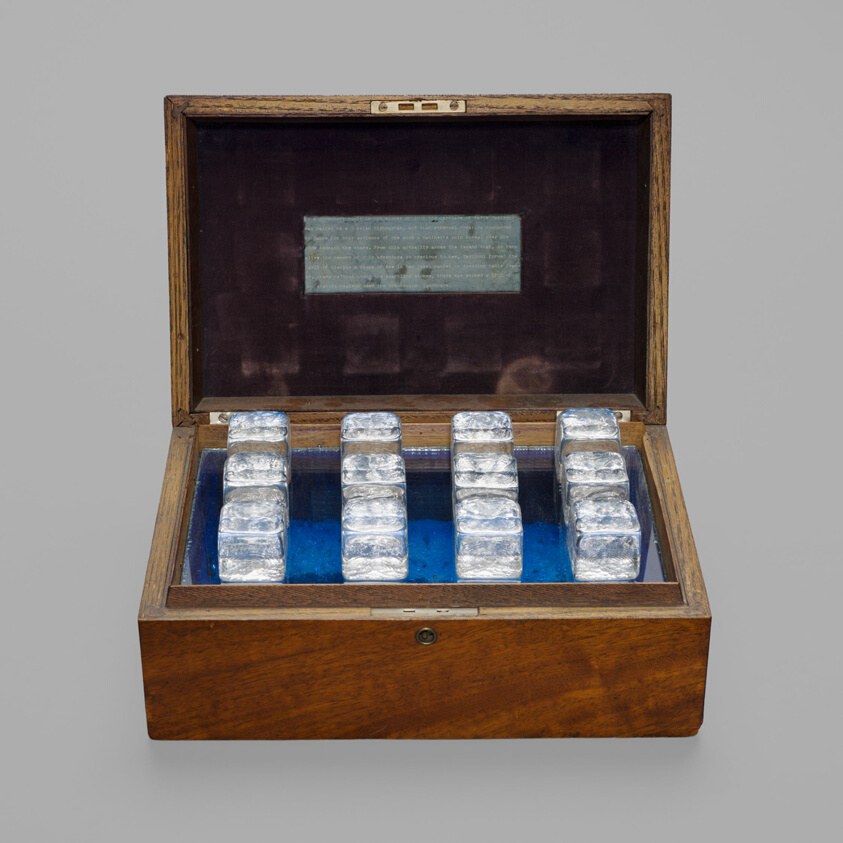
A wooden box lies open, its interior lined with deep blue glass or velvet. Arranged in four vertical stacks across the interior are sixteen crystalline or glass blocks, each capped with a silvered or frosted top. The blocks appear to be transparent or translucent, catching light with a cool, luminous quality. At the top of the open lid, a handwritten label on pale blue paper is visible but illegible in the photograph. The wooden exterior shows the patina of age, with brass hardware at the hinges. The symmetry and precision of the arrangement suggests a curated, almost reliquary quality—the blocks are uniform in size and evenly spaced within their blue field, creating a formal, reverent display.
The dancing
There are no human figures or bodies in this work. No dancers, no gesture, no movement of any kind. This is an object, not a representation of dance.
The dance depicted
The work does not depict dance. The title *Homage to the Romantic Ballet* establishes a conceptual relationship to Romantic ballet (the aesthetic period of the 1830s–1840s when works like *Giselle* and *La Sylphide* were created), but the visual content offers no figurative representation of dancers, choreography, or movement. The 'homage' appears to operate through material elegance, precious enclosure, and the metaphor of crystallized beauty—perhaps invoking the ethereal, otherworldly quality associated with the Romantic ballet's supernatural heroines and pointe-work aesthetic. Without figuration, interpretation depends on the artist's stated intention rather than visual evidence.
How it was made
This is a box construction, a form Cornell pioneered in the 1930s and continued throughout his career. The construction combines found and fabricated elements: a wooden box (likely antique or salvaged), blue glass or velvet lining, sixteen identical glass or crystal blocks with frosted or silvered caps, and a handwritten label. Box construction was Cornell's signature medium, a hybrid of assemblage, collage, and three-dimensional still life that sat outside traditional fine-art categories. The form allowed him to create portable galleries of memory and metaphor, densely symbolic yet intimate in scale. These works were intended to be opened and handled, inviting the viewer into a private, enclosed world. The precision of arrangement here—the identical units, the symmetry, the precious materials—suggests an organized collection, perhaps of talismans or specimens.
About this work
This is Joseph Cornell's *Homage to the Romantic Ballet*, a box construction from 1942. It contains no dancers and no narrative scene; instead, it honors an aesthetic through abstraction and material beauty. The work consists of sixteen identical glass blocks arranged in perfect rows within a blue-lined wooden box, creating a grid that evokes both scientific specimens and precious relics. The title anchors the work to the 1830s–1840s era of ethereal, supernatural ballets and their otherworldly female dancers, but Cornell's approach is contemplative rather than representational—he captures the feeling or essence of Romanticism through geometry, crystalline substance, and careful presentation rather than through figuration. This places the work at an intersection of Surrealism, minimalism, and what might be called poetic abstraction; it asks what remains when you remove the human body from an art form devoted entirely to the human body.
How to look at it
Approach this as a reliquary or cabinet rather than a narrative image. Notice the handcrafted precision: each block identical, each placed with care, the blue field creating a contemplative ground. The crystalline quality of the blocks—transparent yet opaque, catching light—suggests both clarity and mystery. Consider what Cornell might mean by abstracting away the dancer's body: is he suggesting that Romantic Ballet was always about something beyond the physical, some quality of grace or otherworldliness that cannot be captured in representation? Notice, too, the scale (a box you could hold in your hands) and the invitation to open it—this is an artwork meant to be intimate, private, to invite wonder rather than spectacle.
The artist
Joseph Cornell (1903–1972) was an American artist best known for his box constructions, assemblages that combined found objects, printed ephemera, maps, photographs, and fabricated elements into small, densely symbolic environments. Largely self-taught and working outside mainstream art institutions, he created work that bridged Surrealism, folk art, and modernist abstraction. Cornell was fascinated by European Romantic culture, cinema, natural history, and the aesthetics of collection and display. His boxes often contained hidden or layered meanings, references to historical figures (particularly dancers and actresses), and materials that suggested memory, time, and loss. He worked in near-isolation in his family home in Queens, New York, and his reputation grew steadily through exhibitions and the admiration of artists and curators who recognized in his work a unique synthesis of poetry, craft, and conceptual innovation.
The period
In 1942, Romantic Ballet was seventy years in the past—already a historical form. The Romantic era proper (1830s–1840s) had elevated female dancers to supernatural, weightless beings in works like *La Sylphide* and *Giselle*; by the 1930s and 1940s, these ballets were performed as historical revivals, treasured as part of a European cultural heritage. Meanwhile, modern dance in America (Graham, Dunham, Limon) was establishing itself as a radical alternative to ballet; American ballet was finding its own voice through figures like George Balanchine and American Ballet Theatre. In the visual arts, Cornell was working in the shadow of Surrealism, which had already absorbed ballet as a subject (Dalí's designs, Ernst's collages) but typically through provocative or dreamlike imagery. Cornell's approach was quieter, more elegiac—he treated Romantic Ballet as a lost or precious world, preserved in crystalline form.
Where it lives
The work is held in the collection of the Art Institute of Chicago (Modern Art), listed in the source as AIC. It dates to 1942, early in Cornell's mature period as a box maker. The record provides minimal description, characteristic of many Cornell boxes in institutional collections.
Questions about this work
Why is this called an 'Homage to the Romantic Ballet' if there are no dancers?
Cornell was not trying to illustrate or represent the Romantic Ballet. Instead, he was honoring the aesthetic principle he associated with it—ethereality, precision, beauty, otherworldliness—through abstraction. The crystalline blocks, arranged in perfect symmetry and lit with a cool glow, evoke the weightlessness and transcendence that Romantic dancers represented. By removing the human figure, Cornell invites us to think about what ballet means beyond spectacle: the feeling of it, the idea of it.
What are the glass blocks and why are there sixteen of them?
The blocks appear to be either crystal or glass with frosted or silvered tops, arranged in four columns of four—a perfect grid. Cornell often used repeated identical elements to create rhythm and meditation. The uniform repetition, combined with the precious, translucent material, suggests both scientific collection and spiritual reverence. The exact meaning of the number and the material remains open; Cornell's work often resists single interpretation.
Is this the same as a Surrealist artwork?
Cornell was influenced by Surrealism but created something distinct. Where Surrealists used dream logic and disruption, Cornell used precision, order, and poetic association. His boxes are more contemplative and elegiac than provocative. They feel like private collections or personal altars rather than unconscious eruptions. This work's formal perfection sets it apart from Surrealist practice.
How would you display or experience this work?
Cornell's boxes were meant to be opened and looked into, not hung on a wall. In a gallery, it would typically be displayed at eye level with the lid open, as in this photograph, so viewers can peer into the interior and see the arrangement of objects and the light within. The experience is intimate and contemplative, more like encountering a cabinet of curiosities than viewing a traditional painting.
More dance artwork





