49 works in this view — arrow keys or swipe to move between them.
Dance in Art
Ballet Rose
Brassaï (Gyula Halász) French, born Hungary (now Romania), 1899–1984
- Medium:
- Gelatin silver print
- Collection:
- Photography and Media
- Source:
- Art Institute of Chicago
- Rights:
- Rights reserved by the holding institution — do not reuse without permission. Source record ↗
- Recorded as:
- AIC — rights reserved
For historians of 1930s dance photography and the aesthetics of theatrical undress, this work is significant as a record of how the body, costume, and the studio photograph intersected in the interwar period. It is also a document of Brassaï's engagement with the theatrical and cabaret worlds of Paris, which he documented extensively and which were central to modernist culture. Finally, the work raises a question central to dance history: what counts as dance documentation, and what happens when a photograph titles itself 'ballet' while showing something other than dancing.
What you are looking at
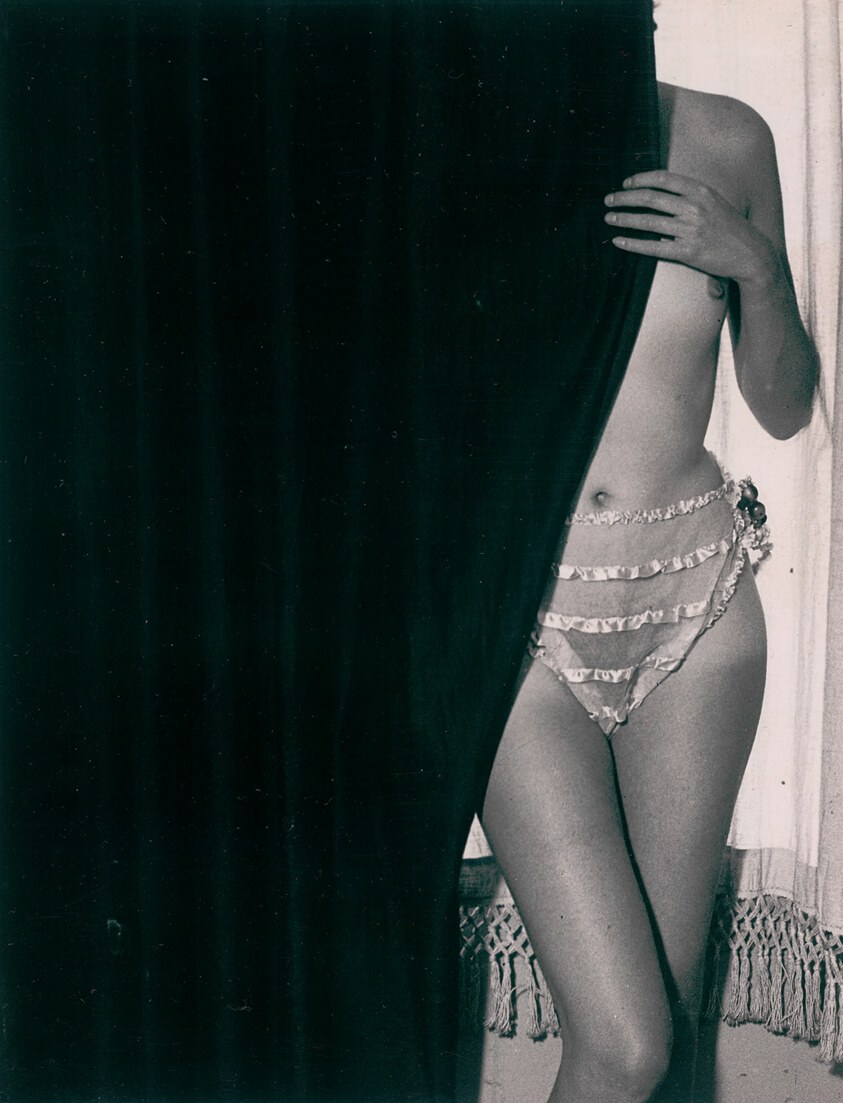
A black-and-white photograph captures a partially-draped female figure posed against a dark curtain, illuminated from the side in the manner of studio photography. The subject stands with one arm raised and bent, the hand touching or framing the side of her head in a gesture of modesty or contemplation. Her lower body is adorned with a decorative hip wrap or skirt of gathered fabric with ruffled or pleated detailing, worn low on the hips in the style of 1930s cabaret or revue costume. The figure is otherwise bare-skinned, and the composition frames her from approximately mid-thigh upward. The photograph employs strong chiaroscuro, with the pale flesh of the figure rendered in sharp relief against deep shadow, suggesting a carefully controlled studio setting. The pose is static and composed rather than captured mid-movement, presenting the body as a sculptural form for the camera.
The dancing
A single figure is shown in a standing position, weight evenly distributed. The raised arm and inclined head suggest a moment of self-awareness or presentation rather than active dancing. The body is relaxed rather than tensioned for movement; there is no evidence of turned-out legs, engaged core, or the postural alignment typical of trained dancers. The costume—a decorative hip wrap with ruffled tiers—is the only element that suggests dance or performance wear, though the pose itself is that of a studio model rather than a dancer in motion.
The dance depicted
The title 'Ballet Rose' proposes a connection to dance, likely referencing the Ballets Russes context or the pink-and-rose aesthetic associated with early 20th-century ballet. However, the image itself shows no evidence of choreography, technique, or movement. The figure is posed, not dancing; the composition is that of fashion or figure photography, not dance documentation. The decorative costume may reference cabaret, revue, or theatrical undress rather than any specific ballet tradition. Without additional documentation, it is unclear whether this is a costume study for a ballet, a reference photograph for a designer, or a work of art photography that merely borrows the language of theatrical dance.
How it was made
This is a gelatin silver print, a photographic medium that dominated art and commercial photography from the 1890s onward. The technique allowed fine control of tonal gradation and the creation of high-contrast, sculptural effects through directed studio lighting—the very effects visible here. As a print, this work would have circulated in limited editions or as a unique vintage print, reaching audiences through galleries, collections, and the publishing networks that supported art and fashion photography. Brassaï's mastery of gelatin silver printing was fundamental to his aesthetic: the medium enabled the dramatic interplay of light and shadow that characterizes his work.
About this work
This photograph by Brassaï presents a staged, formally composed studio image of a female figure in theatrical undress, titled 'Ballet Rose.' The work occupies the contested ground between fashion photography, figure study, and dance documentation—a zone that preoccupied artists and photographers of the 1930s as they negotiated between fine art, commerce, and the new visual languages of modernism. The image does not depict dance in action but rather uses the costume and poses associated with theatrical performance to construct an image of the body as a formal and aesthetic object. It belongs in a dance archive not because it shows dancing, but because it reveals how dance costume and the theatricalized body operated in visual culture, and because the title invokes a dance idiom even as the photograph withdraws from depicting movement.
How to look at it
Attend to the relationship between pose and the promise of the title. The photograph is composed as a moment of stillness and presentation, not capture. Notice how the side-lighting models the body as form, and how the costume (though fragmentary) asserts a theatrical identity. Ask whether the raised arm and lowered gaze suggest a shy modesty or a knowing performance for the camera—the ambiguity is deliberate. The photograph does not 'show' ballet; it stages an encounter between the language of dance costume and the formal strategies of studio photography.
The artist
Gyula Halász, known as Brassaï (1899–1984), was a Hungarian-born photographer and artist who settled in Paris in 1924 and became a key figure in French photographic modernism. He is best known for his nighttime photographs of Paris—cabarets, street scenes, and the city's underworld—made with available light and infrared film in the late 1920s and 1930s. Brassaï's work was championed by Henry Miller and Man Ray, and he contributed to Surrealist and modernist publications including *Minotaure*. His practice combined reportage, formal composition, and a deep interest in the human body and theatrical performance. He was also a draftsman, sculptor, and printmaker, and throughout his career returned to classical figural subjects and the nude.
The period
In 1932, when this photograph was made, Paris was the center of European modernism, and photography was establishing itself as a fine art medium. The Ballets Russes, though in decline after Diaghilev's death in 1929, had reshaped expectations of theatrical design and the relationship between avant-garde art and dance. The title 'Ballet Rose' likely plays on the Ballets Russes context, though it may also reference the aesthetic of pink and rose tones associated with Romantic ballet revivals and decadent theatrical imagery. In the same period, commercial and artistic photography of the female body and theatrical costume was flourishing, driven by cabaret culture, fashion, and the modernist exploration of form. The 1930s also saw intense interest in the nude as a modernist sculptural subject, independent of narrative or movement.
Where it lives
The work is held in the Photography and Media collection of the Art Institute of Chicago. It is catalogued as a gelatin silver print from 1932, part of Brassaï's substantial archive and legacy within the museum's collections of modernist photography.
Questions about this work
Is this actually a ballet photograph?
The title invokes ballet, and the costume suggests theatrical dance, but the image shows a static studio pose rather than choreography or movement. It is better understood as a work of art photography that engages with the aesthetics and idioms of theatrical dance without documenting dance itself. The relationship between the title and the image is part of the work's meaning.
Who was the model?
The catalogue record does not identify the model. Brassaï worked with many subjects during his Paris years, including professional dancers, cabaret performers, and artists' models, but without further documentation it is not possible to name her.
What is 'Ballet Rose'?
The title most likely references the aesthetic and idiom of the Ballets Russes or of pink-toned Romantic ballet imagery, but it may also be a poetic title given to the photograph after it was made. Without the artist's own documentation, the title's specific reference remains uncertain.
Why would a dance archive collect this?
This photograph is valuable for understanding how dance, costume, and the theatrical body were represented in visual culture, and how photographers used dance idioms as a formal language. It also documents the intersection of modernist photography, cabaret culture, and theatrical performance in 1930s Paris.
More dance artwork





