49 works in this view — arrow keys or swipe to move between them.
Dance in Art
After the Ballet
Constantin Guys French, 1802-1892
- Medium:
- Pen and brown ink, with brush and gray wash, over graphite, on ivory wove paper
- Collection:
- Prints and Drawings
- Source:
- Art Institute of Chicago
- Rights:
- Public domain — free to use, share and adapt.
- Recorded as:
- CC0 (Public Domain)
The work documents how 19th-century artists represented the social and theatrical dimensions of ballroom culture—not the dance steps themselves but the exaggerated affect, hierarchy, and dramatic attention that framed women's presentation in such spaces. For historians of dance and social history, it reveals the performative excess and gestural language that attended fashionable entertainment beyond the formal structures of the dance.
What you are looking at
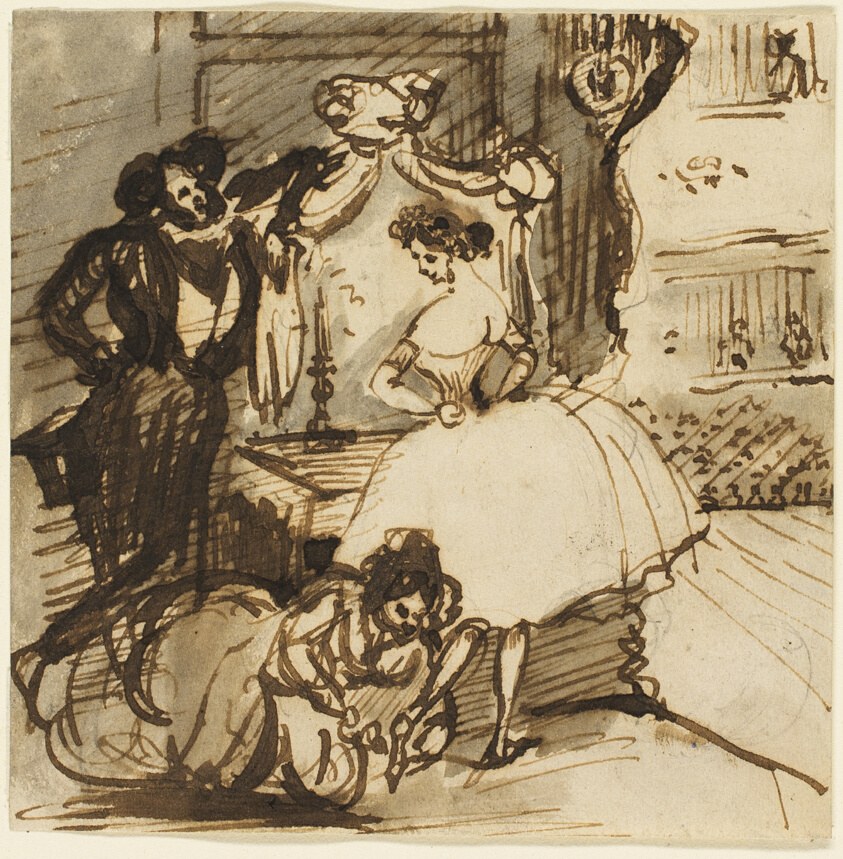
A woman in a full white ball gown stands at the center of an elegant interior, her posture upright and composed. She wears her hair swept up with flowers or ornaments. Around her stand several figures in dark clothing—attendants or gentlemen—who gesture toward her with animated hands. In the foreground, two or three additional figures in dark dress bend or crouch, their bodies twisted in exaggerated attitudes that suggest either deep obeisance or dramatic mimicry. The setting appears to be a grand room with draped walls and architectural detail visible at the edges; the perspective and spatial clarity are sketchy, with the artist's pen and wash suggesting movement and shadow rather than precise definition. The overall mood is theatrical and social—a moment of intense attention directed at the central female figure, who remains relatively still while others respond with pronounced physical drama.
The dancing
The central woman holds a composed, frontal stance with arms slightly away from her body, the posture of formal presentation or display. The surrounding figures employ exaggerated gestural language: raised arms, bent torsos, and contorted limbs that read as either homage, mockery, or dramatic reaction. The two foreground figures are particularly extreme, with bodies folded nearly double, suggesting either deep bows or tumbling movement. No closed holds or partnered dance positions are evident; the arrangement is hierarchical, with focus radiating toward the woman in the center rather than reciprocal engagement between dancers.
The dance depicted
This appears to be a scene of social theater or court entertainment rather than ballroom dance proper, though the formal dress and interior setting place it within the world of 19th-century European fashionable society. The woman's stillness and central positioning, combined with the exaggerated reactions of her attendants, suggests a moment of social performance—possibly a ball, a reception, or a theatrical representation of one. The title 'After the Ballet' implies this is a backstage or social aftermath scene rather than a depiction of choreographed dance itself. The extreme postures of the secondary figures may reference pantomime or commedia dell'arte conventions rather than ballroom technique, though the overall context is ballroom society.
How it was made
This is a drawing in pen and brown ink with brush and gray wash over graphite, a technique that allowed rapid, gestural notation of figure and composition. The wash builds shadow and depth while the pen line articulates gesture and detail with economy; the technique is characteristic of 19th-century observational or editorial drawing rather than preparatory studio work. Such works were frequently made for reproduction as prints or illustrations, suggesting this may have been intended for publication or as a study for a larger work. The sketchy, unfinished quality in places (especially the architectural background) is typical of working drawings by artists of the period who aimed to capture social observation rather than formal finish.
About this work
This drawing captures a moment of social theater within fashionable 19th-century European society, titled as an 'after the ballet' scene and depicting a woman in formal white dress as the center of animated attention from attendants and observers. The artist uses exaggerated gesture and contorted posture among the secondary figures to convey drama, mockery, or theatrical excess—the emotional temperature of a social performance rather than a dance lesson. The work sits at the intersection of fashion illustration, social satire, and dance-world documentation, recording not ballroom choreography itself but the performative gestures and attitudes that accompanied it.
How to look at it
Attend first to the woman's stillness and frontal presentation—she is the anchor of the composition, the object of the attention around her. Then observe the extreme physicality of the figures surrounding her: the bent backs, raised arms, and contorted positions that suggest not ballroom propriety but theatrical excess, exaggeration, or satire. The title 'After the Ballet' suggests this is a moment of social release or theatrical commentary rather than the dance itself; the artist may be capturing the performative excess and affected gestures that attended high society rather than celebrating ballroom grace.
The artist
Constantin Guys (1802–1892) was a French illustrator and painter known for his social observation and rapid pen technique, often documenting fashionable life, military campaigns, and theatrical subjects. He was admired by the critic Charles Baudelaire, who praised his ability to capture the movement and transient moments of modern social life. His drawing style—loose, gestural, and economical with line and wash—was suited to both journalistic illustration and fine-art practice, making him a bridge between documentary observation and artistic interpretation of contemporary society.
The period
This work dates to the early 19th century, when Romantic ballet was beginning to reshape European theatrical dance and fashionable ballroom culture remained central to elite social life. The 1820s saw the rise of the Romantic aesthetic in dance, with an emphasis on ethereal grace and theatrical spectacle; ballroom fashion and social etiquette were highly codified, with women's dress (the white ball gown, the elaborate coiffure) as central to social performance as the dance steps themselves. Guys' interest in capturing the social theater of fashionable life situates this drawing within a broader artistic engagement with modern leisure and urban social performance.
Where it lives
The work is held in the Prints and Drawings collection of the Art Institute of Chicago, where it is recorded as a pen and brown ink drawing with brush wash and graphite on ivory wove paper. Works of this type in such collections were typically acquired as examples of 19th-century graphic art and social documentation.
Dance in this work
Questions about this work
Is this a ballroom dance or a ballet?
The title says 'After the Ballet,' suggesting this is a social scene inspired by or following theatrical ballet rather than a depiction of choreographed dance itself. The woman's formal white gown and the interior setting place it in ballroom society, but the exaggerated gestures of the surrounding figures suggest theatrical or satirical excess rather than actual dance steps.
What are the figures in the foreground doing?
The two or three figures bent nearly double in the foreground appear to be bowing deeply, or possibly mimicking exaggerated obeisance or comic postures. Their extreme contortion reads more as theatrical gesture or satire than as ballroom comportment, suggesting the artist may be commenting on the excess or artificiality of such social performance.
Why does the central woman look so still?
Her stillness and upright posture contrast with the animated gestures around her, making her the focal point and object of attention. This compositional choice suggests a moment of social display or presentation—the woman as spectacle—rather than active participation in dance.
Who was Constantin Guys?
Guys was a 19th-century French illustrator and painter celebrated for his rapid, gestural drawings of fashionable and military life. Charles Baudelaire admired his ability to capture transient moments of modern social and theatrical activity, making him an important documenter of 19th-century leisure and performance culture.
More dance artwork





