49 works in this view — arrow keys or swipe to move between them.
Dance in Art
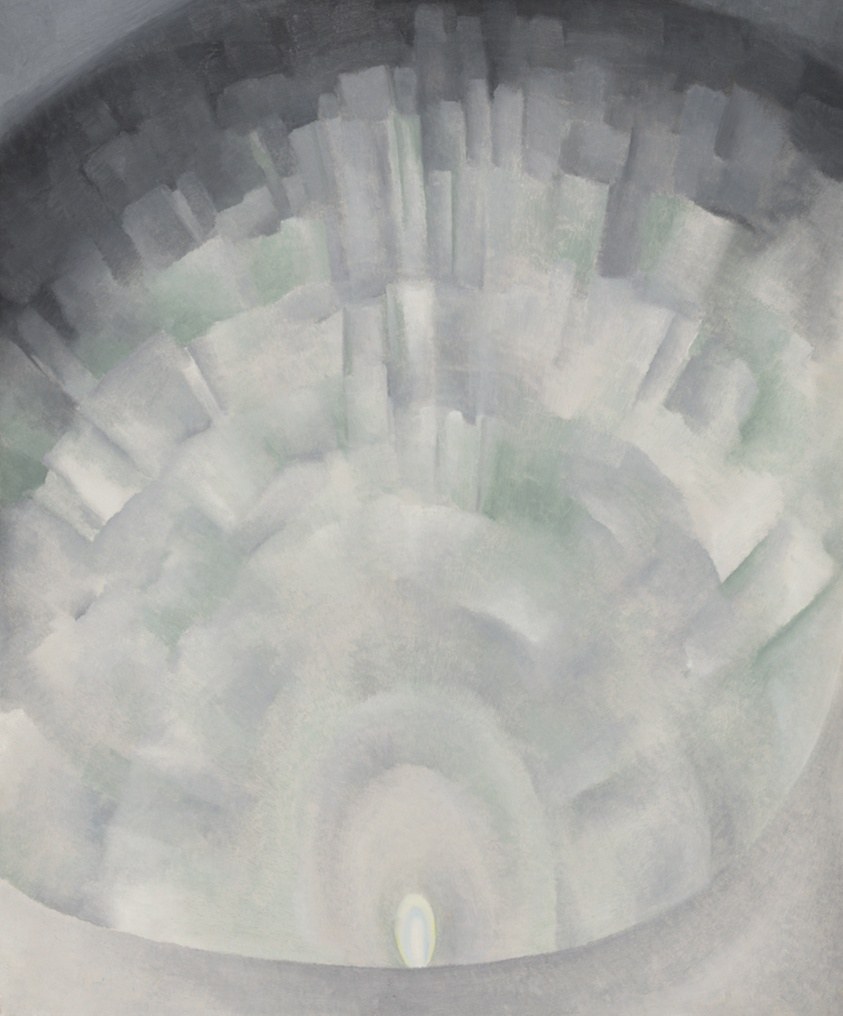
Ballet Skirt or Electric Light (from the White Rose Motif)
Georgia O'Keeffe (American, 1887–1986)
- Medium:
- Oil on canvas
- Collection:
- Arts of the Americas
- Source:
- Art Institute of Chicago
- Rights:
- Rights reserved by the holding institution — do not reuse without permission. Source record ↗
- Recorded as:
- AIC — rights reserved
O'Keeffe's painting demonstrates how early modernism found abstraction not by rejecting representation but by radically reframing it: the ballet skirt becomes an occasion to explore light, volume, and geometric structure. For dance historians, the work is a rare moment when modernist abstraction and stage costume intersect, and it captures the visual experience of watching ballet—the overwhelming impression of volume and movement—rather than documenting a particular choreography or dancer.
What you are looking at
A monumental composition of white tulle and silk fabric fills the picture plane, photographed or painted from directly above. The skirt—voluminous, layered, and deeply pleated—rises in concentric rings toward the center, where vertical pleats create sharp linear striations that catch light and cast shadow. The fabric appears almost architectural in its geometry: pale cream and white with hints of pale green or blue in the shadows between folds. The perspective is vertiginous, as if the viewer is positioned inside or directly above a dancer's skirt at the moment of a full turn or lift, watching the fabric expand outward in response to motion. The work collapses the distinction between the dancer's body (absent or invisible) and the costume itself, which becomes the subject entirely.
The dancing
No human figure is visible. The work isolates the costume—specifically the tulle skirt—as the primary compositional element. The radial pleating suggests rotational movement or the centrifugal force of a spin, but the viewer sees only the result: the way the fabric has been engineered and positioned to respond to or echo the dancer's body. The pleats are precise and formal rather than naturalistic, suggesting the skirt has been structured, possibly placed on a frame or photographed mid-movement.
The dance depicted
This work likely depicts a ballet costume, specifically the skirt worn in classical or romantic ballet, at the moment when rotation or vertical lift creates maximum volume and definition. The type of tulle and the degree of pleating are consistent with late 19th or early 20th century ballet costuming. The title's reference to 'electric light' suggests O'Keeffe was interested in how artificial light interacted with the translucent fabric—the way modern technology could illuminate and transform a traditional theatrical costume. The work does not show a dancer performing or a recognizable ballet vocabulary; instead, it abstracts the visual experience of watching a ballet skirt in motion, reducing the dance to its most essential visual component: volume, light, and the geometry of fabric.
How it was made
Oil on canvas, according to the record. O'Keeffe's technique here is photorealistic or near-photographic in its precision and close framing, but executed in paint rather than photography. The work sits at the intersection of abstraction and representation: while the subject is recognizable, the composition—a radical close-up with no visible context or figures—transforms it into something approaching pure form. The painting technique allows O'Keeffe to control contrast and light in ways a photograph might not, emphasizing the almost sculptural quality of the pleated fabric.
About this work
O'Keeffe's *Ballet Skirt (or Electric Light)* isolates a single element of theatrical costume and magnifies it into a monumental abstract composition. The painting treats the tulle skirt as a study in light, texture, and geometric form rather than as an accessory to a dancer's body. In doing so, O'Keeffe participates in an early 20th-century modernist fascination with close-up vision and the objects of modern and theatrical life—a tendency evident in photography, film, and the visual arts of the 1920s. The work elevates a functional stage costume into fine art, dissolving the boundary between decorative and abstract form.
How to look at it
The viewer should attend to the radial structure of the pleats and how they create a sense of centrifugal force or movement frozen in time. The interplay of light and shadow in the folds of tulle is crucial: O'Keeffe uses subtle gradations to suggest three-dimensionality and volume. Notice how the title references both ballet and modern technology ('electric light'), inviting the viewer to consider how artificial light has transformed the appearance and experience of theatrical costume. The work asks: what does a ballet skirt actually look like when you get close enough? What are its essential formal qualities?
The artist
Georgia O'Keeffe (1887–1986) is best known for her large-scale paintings of flowers, New York skyscrapers, and New Mexico landscapes. In the 1920s, O'Keeffe was in New York, where she was married to photographer Alfred Stieglitz and deeply engaged with the city's avant-garde art scene. Her paintings from this period often employ radical close-ups and magnification, transforming ordinary objects into almost unrecognizable abstractions. O'Keeffe's practice was rooted in the idea that by enlarging and isolating a subject, the artist could reveal its essential form and force viewers to see familiar things anew. The *Ballet Skirt* painting sits within this larger project of intimate magnification and abstraction.
The period
In the 1920s, ballet was a central concern of the European and American avant-garde. Sergei Diaghilev's Ballets Russes had revolutionized stage design and costume; artists like Pablo Picasso, Henri Matisse, and Salvador Dalí created sets and costumes for ballet productions. In New York, where O'Keeffe worked, there was widespread fascination with modern dance (Martha Graham, etc.) and with the visual spectacle of the theater stage. Simultaneously, modernist artists were turning to photography and cinema as models for composition and perspective, embracing close-ups, unusual angles, and the cropping of the frame. O'Keeffe's approach to the ballet skirt reflects this moment: she treats the costume as a subject worthy of fine art attention, and she uses photographic principles of framing and magnification to create a new kind of abstraction.
Where it lives
The work is held in the Arts of the Americas collection at the Art Institute of Chicago (per the record source). It is an oil on canvas, dated 1927, part of O'Keeffe's sustained engagement with the visual forms of modern American life during the 1920s.
Questions about this work
Is there a dancer in this painting?
No visible dancer appears in the work. O'Keeffe has isolated and magnified the ballet skirt itself, treating it as the primary subject. The painting captures the visual impression of the costume—its volume, pleating, and response to light—without showing the body it would clothe.
What does 'electric light' in the title refer to?
The title suggests O'Keeffe was interested in how artificial stage lighting interacts with and illuminates the translucent tulle fabric. Early 20th-century electric theater lighting transformed how audiences experienced ballet costumes, and O'Keeffe may be exploring that transformation through paint.
Why did O'Keeffe paint a ballet skirt?
In the 1920s, O'Keeffe was fascinated by magnification and close-up vision as tools for abstraction. By isolating a familiar object (the ballet skirt) and enlarging it, she could reveal new formal and aesthetic possibilities—the geometry of the pleats, the play of light through tulle, the sense of movement frozen in time.
Is this a real ballet skirt or imagined?
The title and composition suggest O'Keeffe was working from observation or photography of an actual ballet costume, likely from the Ballets Russes or New York theater scene of the 1920s. However, the painting abstracts and stylizes the subject rather than documenting it literally.
More dance artwork





