49 works in this view — arrow keys or swipe to move between them.
Dance in Art
Ballet of the Left-Handed Piano
Michael Hurson American, 1941–2007
- Medium:
- Oil and charcoal on canvas
- Collection:
- Contemporary Art
- Source:
- Art Institute of Chicago
- Rights:
- Rights reserved by the holding institution — do not reuse without permission. Source record ↗
- Recorded as:
- AIC — rights reserved
The work demonstrates a mid-twentieth-century avant-garde position that treats dance not as a subject to be represented realistically, but as a conceptual framework within which to explore the nature of representation itself. For historians of dance imagery, it marks a moment when artists began to use dance terminology and the dancer's body as abstract material rather than as vehicles for celebrating human movement or technical virtuosity.
What you are looking at
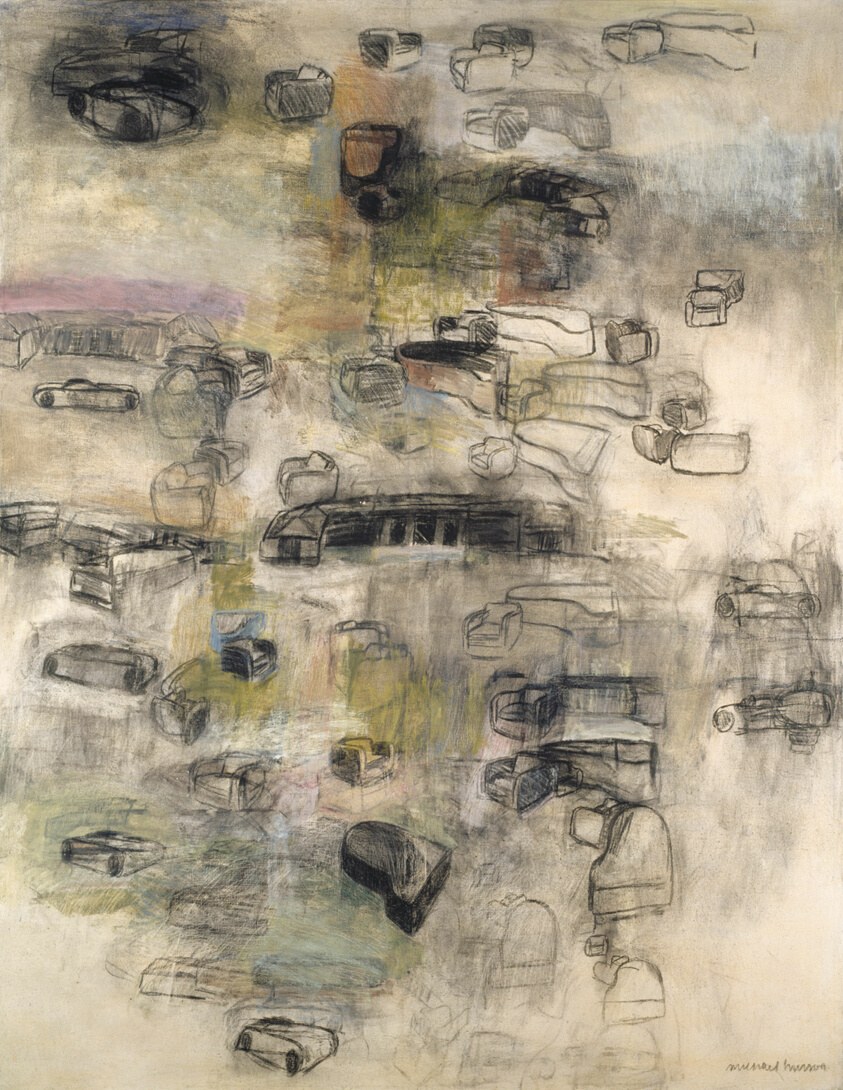
A densely layered composition of overlapping sketched and partially rendered figures scattered across a cream-colored canvas, dominated by what appears to be architectural or furniture forms rendered in charcoal and muted ochre and grey tones. The dominant central form suggests a horizontal structure, possibly a piano or architectural element, rendered in darker tones. Surrounding this are numerous smaller figures, most appearing to be seated or in profile, executed as quick linear sketches in black charcoal with minimal detail. The figures vary greatly in finish: some are barely indicated as outline, others have greater tonal modeling. A single figure in darker clothing stands out against the lighter ground in the center-right area. The overall composition creates a sense of crowded, simultaneous activity—multiple moments or multiple dancers occupying the same space—with the forms appearing to overlap and interpenetrate. The paint application is gestural and intentionally unfinished in many areas, with the raw canvas and underpainting visible throughout, creating a palimpsest effect of revision and accumulation.
The dancing
The figures are rendered almost exclusively in linear, economical line work—minimal indication of bodies rather than fully modeled forms. Where visible, most appear to be seated or in repose positions rather than in active dance movement. The bodies show little articulation of joints or weight distribution; they read more as schematic presences than as kinetically engaged dancers. A single more fully rendered figure in dark clothing in the center shows some three-dimensionality but remains gestural. The multiplicity of figures—perhaps thirty or more—suggests a group setting, but there is no clear spatial relationship between them, no suggestion of group choreography or ensemble formation. The repetitive, sketch-like quality implies these may be studies or variations rather than a single unified scene of movement.
The dance depicted
The title *Ballet of the Left-Handed Piano* suggests this is meant to depict ballet, but the image presents substantial visual tension with that claim. The sketched, underdeveloped figures show little evidence of ballet technique—no indication of turnout, no pointe work, no lifted posture, no classical alignment. The numerous seated or resting positions are fundamentally at odds with ballet's kinetic vocabulary. The work reads more as a conceptual or surrealist meditation on dance—perhaps exploring the idea of performance, or the disjunction between the title's specificity and the image's ambiguity—than as a straightforward representation of a ballet scene. The piano reference in the title combined with the architectural form at the composition's center might suggest this is about the relationship between music and dance, or between visual and aural experience, but the image offers no clear narrative or representational clarity to confirm such reading.
How it was made
Oil and charcoal on canvas, a combination that prioritizes drawing and line over painterly modeling. The charcoal allows rapid, gestural mark-making and the sketched quality that dominates the composition; the oil paint provides areas of tonal development and the ochre and grey washes that unify the composition. The technique creates deliberate incompleteness—some figures are finished, others are barely indicated, and large areas of canvas remain exposed. This mixed-media approach, combining drawing media with painting media, was characteristic of mid-twentieth-century modernist practice and allowed the artist to preserve the directness and spontaneity of drawing while building compositional depth. The resulting surface reads as a working process left visible rather than a finished object, which was a valued modernist strategy in the 1950s-60s.
About this work
Michael Hurson's *Ballet of the Left-Handed Piano* (1962) is a conceptual meditation on dance and performance that uses the grammar of ballet as a departure point rather than as a strict subject. The work assembles dozens of sketched figures, most seated or in repose, around an architecturally suggested central form, creating a crowded, simultaneous space that resists linear narrative. The title—whimsical and specific—pulls away from what the image shows, suggesting Hurson was interested in the disjunction between language, music, and visual representation rather than in depicting an actual ballet. The work exemplifies mid-century modernist practice in its unfinished appearance, its combination of charcoal drawing with oil paint, and its embrace of the working process as a finished aesthetic statement.
For viewers interested in dance imagery, the work challenges rather than confirms conventional expectations. It does not celebrate the dancer's body or the virtuosity of classical technique; instead, it treats the figure—any figure, all figures together—as one element among many in a composition preoccupied with structure, accumulation, and the gap between title and image. The result is a work that belongs in a dance gallery not because it depicts dance with clarity, but because it uses the concept and vocabulary of dance to ask what it means to represent movement, music, and performance in a visual medium.
How to look at it
Begin with the title and notice the distance between it and the image: the specificity of "left-handed piano" and "ballet" contrasts sharply with the ambiguity and schematic quality of what is actually shown. Trace the sketched figures across the canvas and observe how few are in active movement; most are seated, resting, or barely indicated. Look at the central architectural form and consider what it might represent—a piano, a stage, a structure—and how the figures relate to it (they do not seem to be performing on or with it). Notice the varied degrees of finish across the composition, from fully rendered passages to bare charcoal outline, and consider what this incomplete, working quality suggests about Hurson's approach to the image as a process rather than as a fixed representation.
The artist
Michael Hurson (1941–2007) was an American painter and sculptor whose practice was rooted in drawing and conceptual investigation. His work frequently engaged with language, representation, and the gap between what is named and what is shown. During the early 1960s, when this work was made, Hurson was developing his characteristic approach to the canvas as a site of accumulation and revision, with figures and forms treated as notation or schematic presence rather than as subjects demanding illusionistic rendering. His use of charcoal combined with oil paint reflects a commitment to drawing as a primary conceptual tool within painting practice.
The period
In 1962, ballet imagery held a complex position in American art. The New York School had largely moved away from narrative figuration and illustration, and dance—particularly ballet—was increasingly a subject for pop artists and those interested in mass culture and entertainment rather than for modernist painters engaged with abstraction and conceptual work. Simultaneously, the Judson Dance Theater in New York was beginning to challenge classical ballet orthodoxy, embracing pedestrian movement, ordinary bodies, and anti-theatrical aesthetics. Hurson's work, with its refusal to represent ballet virtuosity or elegance, may be understood as aligned with this emerging critique, using the language of ballet while emptying it of its traditional heroic content.
Where it lives
The work is held in the Contemporary Art collection of the Art Institute of Chicago, indicating its recognition as a significant object within modernist painting practice rather than as a specialized or marginal work. The AIC collection emphasizes twentieth-century artistic innovation across media.
Questions about this work
Is this actually a ballet scene?
The title suggests ballet, but the image resists that reading. Most figures are seated or in repose, with no visible classical ballet technique, turnout, or lifted posture. The work seems more interested in the concept or language of ballet—in its title, its association with formality and culture—than in depicting actual ballet movement. This gap between title and image is likely intentional, part of Hurson's investigation of how language and visual representation relate.
Why are there so many unfinished sketches?
The incomplete, sketched quality is characteristic of modernist practice in the early 1960s. By leaving charcoal outlines and gestural marks visible, Hurson preserves the directness of drawing and emphasizes the working process. This also creates a sense of accumulation and multiplicity—many moments or possibilities existing simultaneously on the canvas—rather than a single fixed image of performance.
What does the central form represent?
The title mentions a piano, and the horizontal structure at the center of the composition could suggest one, but it is rendered so abstractly and architecturally that it resists clear identification. Its primary function seems to be compositional—a focal point around which the figures are arranged—rather than narrative or representational.
Who were the dancers for this ballet?
There is no evidence that this work depicts an actual ballet performance or that specific dancers were involved. The title appears to be conceptual rather than documentary; the work is a studio invention, not a record of a performance or commission.
More dance artwork





