49 works in this view — arrow keys or swipe to move between them.
Dance in Art
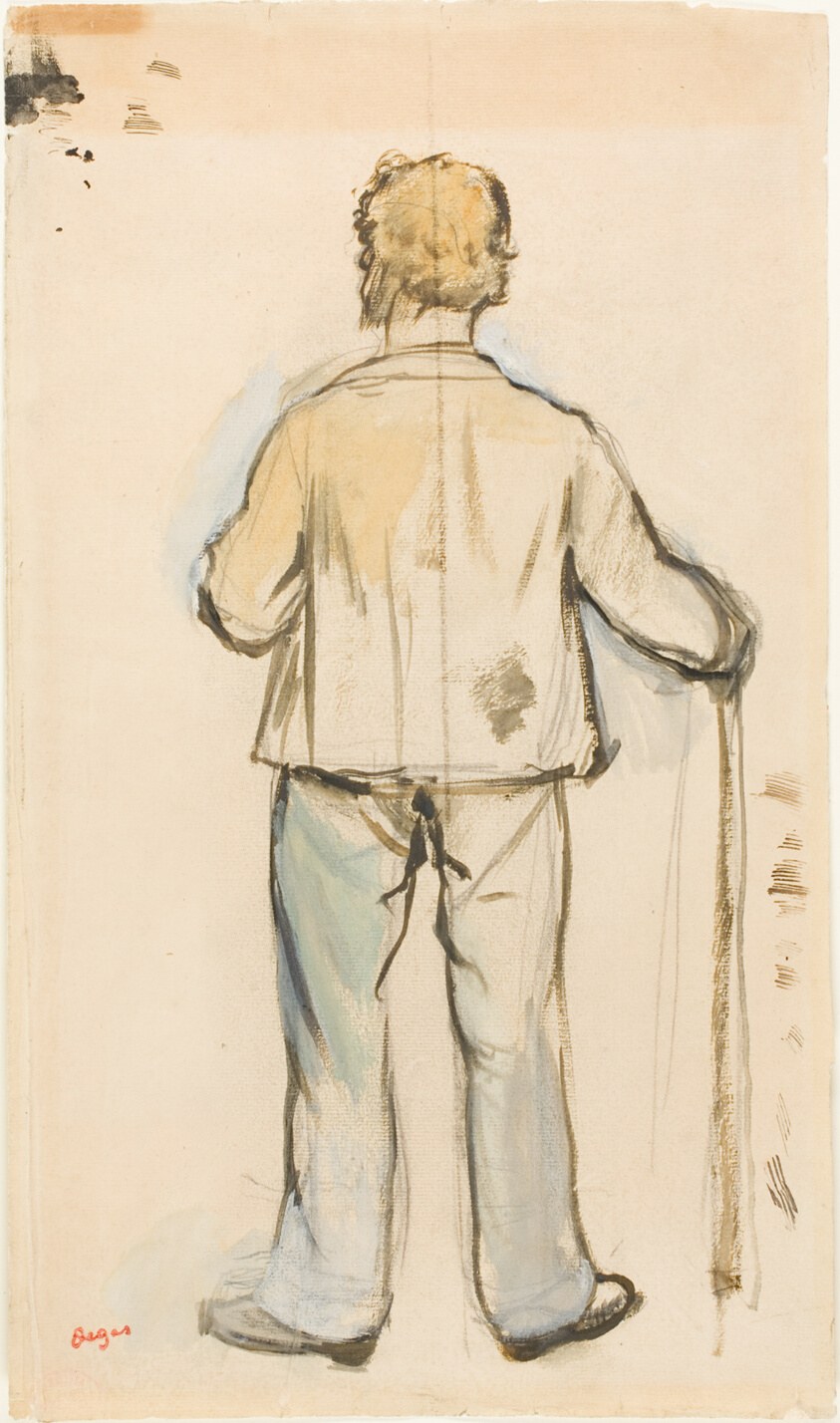
The Ballet Master
Edgar Degas French, 1834-1917
- Medium:
- Watercolor and oil paint, with graphite and touches of pen and brown and black ink, on buff laid paper, ruled at center in charcoal, laid down on Japanese paper
- Collection:
- Prints and Drawings
- Source:
- Art Institute of Chicago
- Rights:
- Rights reserved by the holding institution — do not reuse without permission. Source record ↗
- Recorded as:
- AIC — rights reserved
For anyone studying the history of ballet and its institutions, this drawing reveals how nineteenth-century artists understood the ballet master's role—not as a performer but as the disciplinary and creative center of the ballet world. It is evidence of how thoroughly Degas engaged with ballet as a system of labor and instruction, not merely as spectacle.
What you are looking at
A solitary male figure stands in three-quarter view, weight evenly distributed, facing away from the viewer toward the upper right of the composition. He wears a cream linen jacket with visible creasing and a patch or stain on the back, paired with pale blue-grey trousers and dark shoes. The figure is rendered in watercolor and ink with considerable anatomical care: the head is sketched in ochre and black, the shoulders broad and naturally relaxed. The background is plain buff paper with minimal spatial indication—a few dark marks in the upper left corner suggest distant figures or architectural elements, but they remain vague. The drawing is ruled at the center with charcoal, indicating this may have been a study for a larger work or a teaching document. The overall effect is of a casual, observational sketch—neither a posed formal portrait nor a dynamic action scene, but rather a figure captured in stillness and contemplation.
The dancing
A single standing male figure, weight centered and balanced. The shoulders are open and slightly dropped, the arms hanging naturally at the sides with subtle definition in the wrists and hands. The posture suggests ease rather than tension—this is not a figure in performance attitude. The head is turned slightly, the profile suggesting a moment of thought or attention directed elsewhere. The musculature is suggested economically but with understanding: the back shows the structure beneath the jacket, and the legs are planted with natural weight distribution.
The dance depicted
This is not a representation of dance in action. The figure—likely a ballet master or choreographer—is depicted in a moment of pause or observation, the kind of stillness that frames instruction and authority rather than movement. The title 'The Ballet Master' confirms this reading: the work documents a figure of institutional power within the theatre, not a dancer performing. The plain dress, the lack of ornament, and the inward-facing posture suggest someone in a working capacity, present to direct or critique rather than to be admired. If dance is the subject of the drawing, it is dance as a discipline governed by a teaching presence.
How it was made
Watercolor and oil paint applied over graphite and pen and ink on buff laid paper, mounted on Japanese paper. The layering of media is deliberate: the graphite underdrawing is visible and functional, the pen provides definition at key points (the jacket's seams, the outline of the head), and watercolor adds tonal depth and the suggestion of fabric weight. This combination was standard in European academic practice for rapid figure studies and costume documentation. The technique allows for quick revision and layering without the commitment of oil alone, and the small scale and plain support suggest this was a working study, possibly prepared for a larger historical or genre painting, or kept as reference material in a studio.
About this work
This is a figure study of a ballet master, drawn in the mixed media favored by French academic artists of the 1860s. It documents not a moment of dance but the figure who governs dance—the choreographer or instructor present at rehearsal or performance, shown in plain street dress and a posture of calm authority. The work belongs to Degas's sustained interest in the ballet world and the lives of its practitioners, an interest that deepened through the 1860s and 1870s. Unlike the more famous paintings of dancers in costume or motion, this drawing insists on the institutional and pedagogical frame: the master is the one who stands still and watches, whose authority lies in knowledge and judgment rather than in the body's display.
How to look at it
Attend to the posture—what does it communicate about authority and presence? The figure does not face the viewer; he is absorbed in watching or thinking. Notice the economy of the rendering: the artist has suggested the body beneath the clothing without overworking the surface. The jacket's creases and the patch on the back suggest wear and use—this is not a man in ceremonial dress but in working clothes. Look at the faint marks in the background: they suggest the presence of other figures or a space (the studio, the theatre), but they are deliberately left vague, keeping the focus on the still, commanding figure in the foreground. The plainness of the setting emphasizes the figure's authority: he needs no stage, no ornament.
The artist
Edgar Degas (1834–1917) was a founder of Impressionism and a devoted student of movement, particularly of the Paris Opéra ballet. He made hundreds of works depicting dancers—in performance, in rehearsal, in costume, and in the studio. His sustained engagement with the ballet world lasted from the 1860s until his death, and he approached dancers not as idealized muses but as workers performing bodily labor under strict instruction. This drawing, dated 1862, falls within the period when Degas was consolidating his practice as a painter of modern life and beginning his long investigation of the ballet. He sketched endlessly from life and from memory, building a visual archive of poses, costumes, and moments that could be assembled into larger compositions. His technique—combining drawing, watercolor, pastel, and oil—was suited to rapid notation and revision.
The period
In the 1860s, ballet in Paris was undergoing institutional consolidation and artistic reorientation. The Romantic era had faded; dancers were no longer chiefly ethereal heroines in tulle. The Opéra was a major cultural institution, and dancers were recognized as trained professionals subject to rigorous pedagogy. The social position of dancers (often working-class women, many of them vulnerable to exploitation) was coming into sharper focus among artists and critics. Degas's engagement with ballet coincided with a broader nineteenth-century interest in modernity, labor, and the visibility of previously invisible professions. The figure of the ballet master—the teacher, the choreographer, the authority—became a subject in its own right, representing institutional knowledge and aesthetic judgment. In the 1860s, too, academic drawing practice in France was still rooted in figure study from life, though artists like Degas were already experimenting with new formats, scales, and materials that would reshape artistic practice by century's end.
Where it lives
The work is held in the Prints and Drawings collection of the Art Institute of Chicago. It is recorded as watercolor, oil paint, graphite, and pen and brown and black ink on buff laid paper, ruled at center in charcoal, and laid down on Japanese paper. This mounting and the mixed media suggest it was treated as a precious study, worthy of preservation and display.
Questions about this work
Is this a dancer?
No. The title identifies him as a ballet master, likely a choreographer or instructor. The figure is not in a pose of performance; he stands in plain dress, facing away, in a posture of observation and authority. This is a study of a teaching figure, not an artist.
Why did Degas paint the ballet master if he was so interested in dancers?
Because the ballet master was the orchestrator of the ballet world—the figure who made decisions, set standards, and shaped what dancers did. Degas understood ballet as an institution, not just as spectacle. The master represents knowledge, judgment, and the discipline that made the art possible.
What are those marks in the background?
They are minimal and deliberately vague—suggestions of figures or architectural elements in the distance. The artist has kept them sketchy to maintain focus on the central figure and to suggest a space (perhaps a studio or theatre) without defining it fully.
Why is the jacket patched or stained?
The marking on the jacket suggests wear and use—this is a working garment, not formal dress. It signals that this man is present in the ballet world as a functional presence, not as an ornamental or ceremonial figure. The imperfection also grounds the work in observed life rather than idealization.
More dance artwork





