49 works in this view — arrow keys or swipe to move between them.
Dance in Art
Siamese Ballet
Designed by Edward Daly Brown (American, active c. 1950–1955) Produced by Schiffer Prints Division, Mil-Art Company, Inc. United States, New York, New York
- Medium:
- Cotton, plain weave; screen printed
- Collection:
- Textiles
- Source:
- Art Institute of Chicago
- Rights:
- Rights reserved by the holding institution — do not reuse without permission. Source record ↗
- Recorded as:
- AIC — rights reserved
The textile documents how Western modernist design absorbed non-Western dance imagery and transformed it into abstract pattern, revealing the complex circulation of dance cultures through commercial media and domestic consumption. It shows that dance—even when severely abstracted—carried exotic cultural cachet in postwar American design and remains legible as a subject even when stripped of authentic detail.
What you are looking at
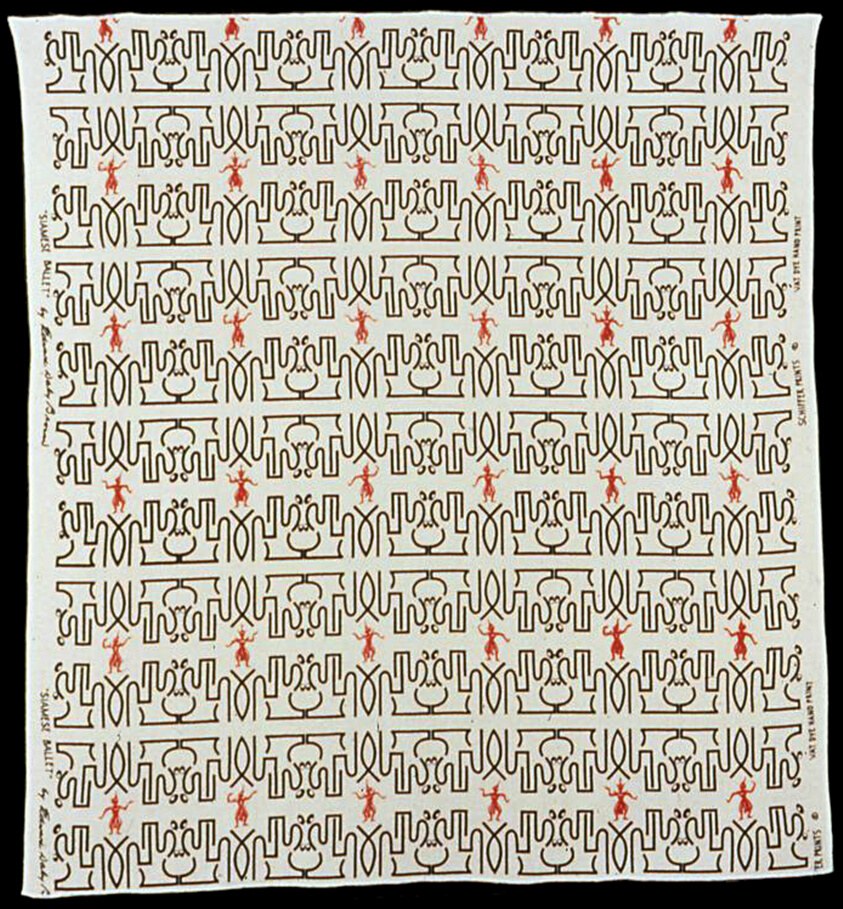
A repeating pattern of stylized dancers fills the entire cotton textile, arranged in a regular grid across the cream ground. Each figure is rendered in brown outlines with red accents, depicting dancers in profile or three-quarter view with elongated limbs and distinctive postures. The dancers appear to be in motion, with arms raised or extended and legs positioned in active stances. Small red flame-like or crown-like ornaments appear above some figures at regular intervals, creating a secondary rhythm across the pattern. The composition is densely repetitive and symmetrical, with no narrative or spatial depth—the textile functions as a continuous, all-over design where the dance figures serve as the primary decorative motif rather than depicting a scene or story.
The dancing
Each dancer figure stands alone, simplified to essential line work with a characteristic forward-leaning torso and splayed limbs suggesting movement and grace. The arms are often elevated or swept outward, and the legs display a wide stance or walking/striding position. The figures are androgynous and highly stylized, rendered as flat, linear forms without anatomical detail. The repetition suggests multiple dancers performing the same movement or pose, creating a uniform visual rhythm rather than individual characterization. No social or spatial relationships between dancers are depicted—each floats independently on the ground.
The dance depicted
The work is titled *Siamese Ballet*, indicating a reference to Thai dance tradition, yet the stylized linear figures bear no clear resemblance to classical Thai dance costumes, postures, or the characteristic hand mudras (gestures) of Khon or other Thai court traditions. The elongated, abstract quality and the modernist reduction of the human form suggest the designer drew inspiration from Thai dance imagery rather than documenting it directly. The upright postures, raised arms, and forward momentum do not correspond to identifiable Thai dance vocabulary or the codified positions of Southeast Asian temple or court dance. This appears to be a Western artist's decorative interpretation of an exotic theme, using simplified human figures as pattern elements rather than representing any specific dance technique or tradition.
How it was made
The work is a screen-printed cotton textile, a commercial process that allowed mass production of repeating patterns for domestic and fashion use. The printing technique is evident in the solid, uniform line weights and the crisp registration of the brown outlines and red accents. Screen printing was well-suited to geometric, high-contrast designs and made such textiles economically accessible as furnishing or dress fabric. The all-over repeat pattern and commercial production indicate this was designed for wide circulation as a home textile, likely affordable to a middle-class American market in the early 1950s.
About this work
This is a mid-century commercial cotton textile featuring a repeating pattern of stylized dancers, titled *Siamese Ballet* and designed by Edward Daly Brown for the Schiffer Prints Division around 1950. The textile interprets Thai dance through modernist abstraction, reducing dancers to simplified linear forms arranged in a continuous grid. Rather than ethnographic documentation, it represents the postwar Western fashion for Orientalist decoration and the use of non-Western dance imagery as decorative motif in American domestic textiles.
The work belongs in a dance imagery collection as evidence of how dance themes circulated through commercial design and mass-produced goods, and how Western artists adapted and abstracted foreign dance traditions to suit midcentury modernist aesthetics. It reflects the designer's access to Thai imagery and the popular appetite for exotic decoration at a moment when international tourism and cultural awareness were expanding in the United States.
How to look at it
Attend to the rhythm of repetition: how the eye moves across identical figures in an endless grid, creating a hypnotic, textile-like effect. Notice the minimal vocabulary of the dancer's body—raised arms, forward lean, and splayed legs are the only gestures the designer employed, repeated without variation. The red accents above certain figures break the monotony of the brown line work and add a secondary focal point. The textile's function as pattern rather than narrative means the dance serves the surface design rather than telling a story; this is decoration that happens to depict movement, not a document of an actual dance.
The artist
Edward Daly Brown was an American designer active in the early 1950s, working for the Schiffer Prints Division of the Mil-Art Company in New York. The company was a commercial textile printer producing furnishing and apparel fabrics for the American market. Brown's practice was typical of mid-century industrial designers who drew on contemporary art movements, world cultures, and consumer trends to create commercially viable patterns. The modernist abstraction visible in this design—the reduction of the human figure to essential line and the geometric all-over repeat—reflects broader postwar design values of simplification, pattern, and decorative abstraction.
The period
The early 1950s saw an American design movement that embraced geometric modernism, atomic-age optimism, and what was often called "contemporary design." Simultaneously, postwar global awareness and increased tourism exposure to Asia drove a broader American interest in Asian aesthetics, though often filtered through Orientalist interpretation rather than rigorous study. Thai and other Southeast Asian cultures were fashionable sources for decorative exoticism. In dance, this period saw Western ballet and modern dance companies beginning to tour internationally and to engage with Asian dance forms, though often as curiosities rather than serious artistic study. The textile reflects this moment when Asian dance imagery was available to designers as a motif of sophistication and cosmopolitanism.
Where it lives
The work is held in the textile collection of the Art Institute of Chicago. It is catalogued as a design object and commercial textile product, reflecting its original function as a mass-produced furnishing or apparel fabric manufactured in New York for the American consumer market.
Questions about this work
Is this actually Thai dance?
The title claims a connection to Siamese (Thai) ballet, but the simplified linear figures do not depict recognizable Thai dance costumes, hand gestures, or body positions. This appears to be a Western designer's decorative interpretation of an exotic theme rather than documentation of actual Thai dance tradition. The modernist abstraction simplifies all human movement to a generic vocabulary of raised arms and forward stride.
Why was Thai imagery popular in 1950s American design?
Postwar America was increasingly globally aware and attracted to non-Western cultures as sources of exotic sophistication. Asian design and art were fashionable in modernist circles, and Southeast Asia in particular offered imagery that felt both distant and glamorous. Commercial designers capitalized on this appetite by using Asian themes—often simplified or generalized—to market textiles as cosmopolitan and contemporary.
What is screen printing and why does it matter here?
Screen printing is a commercial process that allows repeating patterns to be printed directly onto fabric in multiple passes. It was economical and fast, making decorated textiles affordable for mass-market consumption. The crisp, flat quality of the design—with its bold outlines and solid colors—is shaped by the technical capabilities and constraints of screen printing.
How does this compare to other dance textiles of the period?
Mid-century American textiles often featured human figures and cultural imagery as all-over patterns. Dance subjects were popular—modernist, jazz, and 'exotic' dance themes appeared frequently on furnishing and apparel fabrics. This textile is typical in its abstraction and its use of dance as a source of visual interest and cultural exoticism rather than as documentation of actual technique.
More dance artwork





