49 works in this view — arrow keys or swipe to move between them.
Dance in Art
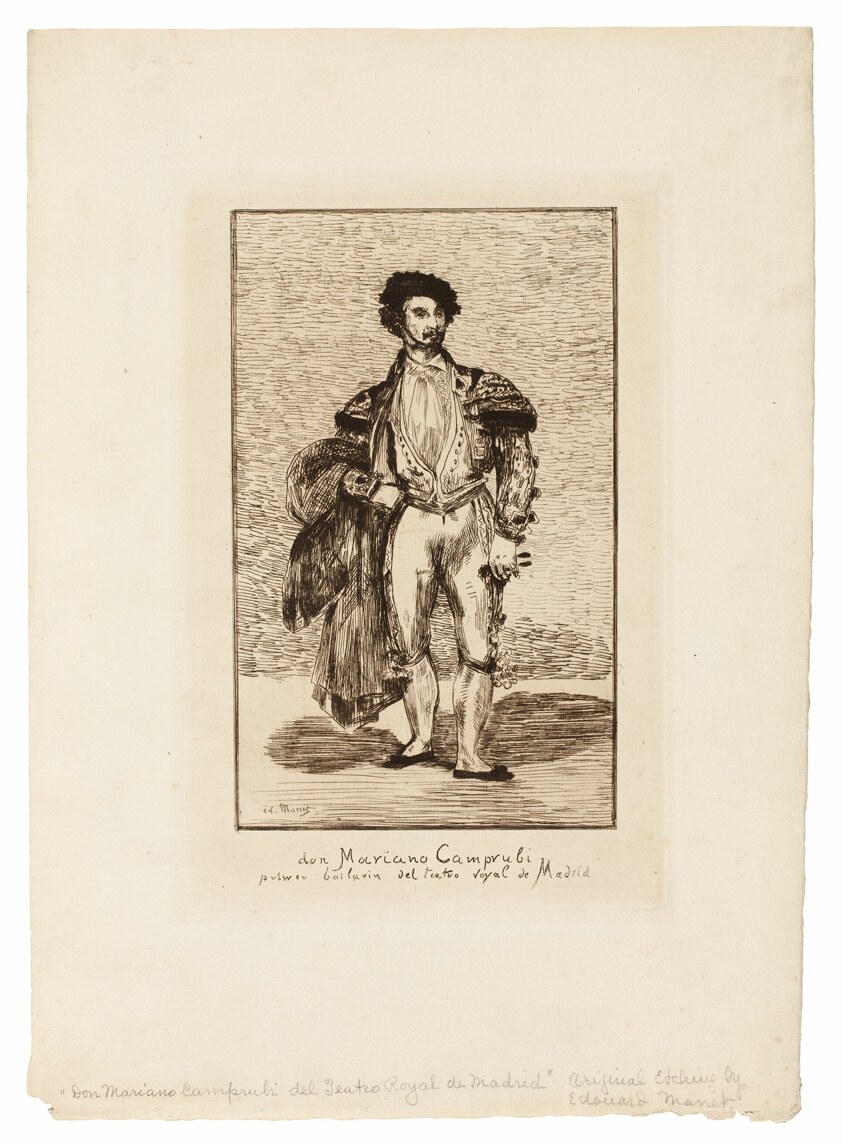
The Ballet Dancer (Don Mariano Camprubi)
Édouard Manet French, 1832-1883
- Medium:
- Etching in brown on cream laid paper
- Collection:
- Prints and Drawings
- Source:
- Art Institute of Chicago
- Rights:
- Public domain — free to use, share and adapt.
- Recorded as:
- CC0 (Public Domain)
This etching is one of relatively few major European artworks to commemorate a named Spanish or Latin American ballet dancer of the 19th century, making it an important document of regional dance history that is often overlooked in narratives centered on Paris, London, and Russia. As a Manet print, it also demonstrates the artist's engagement with dance subjects across multiple media and contexts—not only the famous scenes of modern urban leisure, but also the serious portraiture of professional dancers.
What you are looking at
A single male figure in early 19th-century dress stands in a relaxed contrapposto pose against a plain background. He wears a white linen shirt with a high collar, open at the chest, and tight-fitting breeches. A heavily patterned coat or cape with elaborate epaulets drapes across his shoulders and back, its fabric rendered in dense cross-hatching that suggests rich ornamentation or fur trim. His dark, curled hair and sharp features are rendered with fine linear detail. His weight rests primarily on one leg while the other is slightly bent, creating a classical pose of elegant ease. The figure occupies the full height of a narrow vertical frame, standing alone against an evenly hatched background that provides no narrative or scenic context.
The dancing
The single figure is rendered in a statuesque, almost sculptural pose that emphasizes verticality and balance. Weight is shifted to the back leg in a stance that suggests ease rather than action—this is a figure at rest or in transition, not executing steps. The arm position is naturalistic rather than formally held; one arm hangs at the side while the other rests across the torso. The posture recalls classical contrapposto: the S-curve of the body, the slight twist at the waist, the relaxed but dignified carriage all suggest a man of status presenting himself for view.
The dance depicted
This is not a depiction of active dancing but rather a portrait of a ballet dancer in street or formal dress. The inscription identifies him as Don Mariano Camprubi, a member of the royal ballet at Madrid (listed as primo bailarin del Panto Real de Madrid). The image captures the dancer as a social figure rather than in performance—a common genre of 19th-century dance portraiture, particularly in Spanish and Latin American contexts. The elegant formality of dress and pose conveys the social standing of a male principal dancer during the Romantic era, when the ballet profession was beginning to acquire respectability among the elite. No active dancing movement is depicted.
How it was made
This is an etching executed in brown ink on cream laid paper, a technique that allowed Manet to achieve fine linear detail and tonal variation through careful cross-hatching. Etching was a medium favored for portraiture and limited-edition prints aimed at a relatively small, educated audience—suitable for a portrait of a named individual of some prominence. The careful hatching and delicate line work suggest a hand trained in classical printmaking, creating an image that would have circulated among collectors and members of the Madrid cultural establishment.
About this work
This is a formal portrait etching of Mariano Camprubi, a principal dancer of the Real Teatro at Madrid, made by Édouard Manet in 1862. It belongs to a well-established European tradition of dancer portraiture in which the artist represents the dancer not in the act of performance but as a social and professional figure worthy of commemoration. Manet treats Camprubi with the same formal dignity he applied to portraits of other sitters: the clothing, pose, and careful rendering of individual features emphasize status and identity rather than virtuosity or spectacle. The work documents both a significant figure in mid-19th-century Spanish dance and the cultural value placed on dancers in an era when they were beginning to occupy a more respected position in European society.
How to look at it
The etching invites close looking at the rendering of fabric and surface: notice how Manet uses cross-hatching to suggest the weight and texture of the coat, the precision of the shirt's folds, and the careful delineation of the face. The pose itself is worth studying—the classical stance and relaxed bearing convey authority and ease, and the artist has chosen to show the dancer not mid-movement but in composed repose. This is a deliberate choice that treats the subject as a man of consequence, not as a performer captured in action.
The artist
Édouard Manet (1832–1883) was a French painter and printmaker whose work bridged Realism and Impressionism. He executed portraits, figure studies, and scenes of modern Parisian life, and made significant use of etching as a medium for both formal portraiture and experimental image-making. Dance subjects appear throughout his work, from casual scenes of entertainment to formal portraits such as this. His prints circulated among collectors and artists and helped establish his reputation before his paintings gained wider acceptance.
The period
In the 1860s, ballet in Madrid was undergoing a period of institutional development under royal patronage. The real teatro at Madrid was an important venue, and principal dancers like Camprubi occupied roles of genuine professional distinction. Across Europe, the Romantic era had elevated the status of the male ballet dancer, though this varied significantly by region—French and Italian traditions differed substantially from Spanish and Eastern European practices. Simultaneously, printmaking in the hands of artists like Manet was becoming a vehicle for serious artistic statement rather than mere reproductive or commercial work.
Where it lives
The work is held in the Prints and Drawings collection of the Art Institute of Chicago. It is an etching from the mid-19th century, likely one of a limited edition, and represents a category of small-scale, collectible portraiture that would have had a specialized audience.
Questions about this work
Was Mariano Camprubi a famous dancer?
He held the distinguished position of primo bailarín (principal dancer) at the Real Teatro at Madrid, suggesting he was a significant figure in Spanish dance during the mid-19th century. However, Spanish and Latin American dancers of the period are underrepresented in dance history as conventionally written, and little detailed biographical information about Camprubi survives.
Why did Manet make a portrait of this Spanish dancer?
The specific commission or context for this etching is not documented, but Manet had documented interest in dance subjects and in printmaking as a vehicle for portraiture. The quality of the work suggests it was a deliberate artistic project, likely undertaken for a patron or collector with connections to the Madrid ballet world.
Is this a picture of Camprubi dancing?
No—this is a formal portrait showing the dancer in street or formal dress, standing at ease. The pose is derived from classical portraiture rather than from dance movement, and captures Camprubi as a social figure rather than depicting him performing.
What is an etching and why did Manet use this technique?
An etching is made by incising an image into a metal plate with acid, then printing from the plate. The technique allowed Manet to achieve fine linear detail and subtle tonal effects through cross-hatching, and produced limited-edition prints suitable for collectors and galleries rather than mass reproduction.
More dance artwork





