49 works in this view — arrow keys or swipe to move between them.
Dance in Art
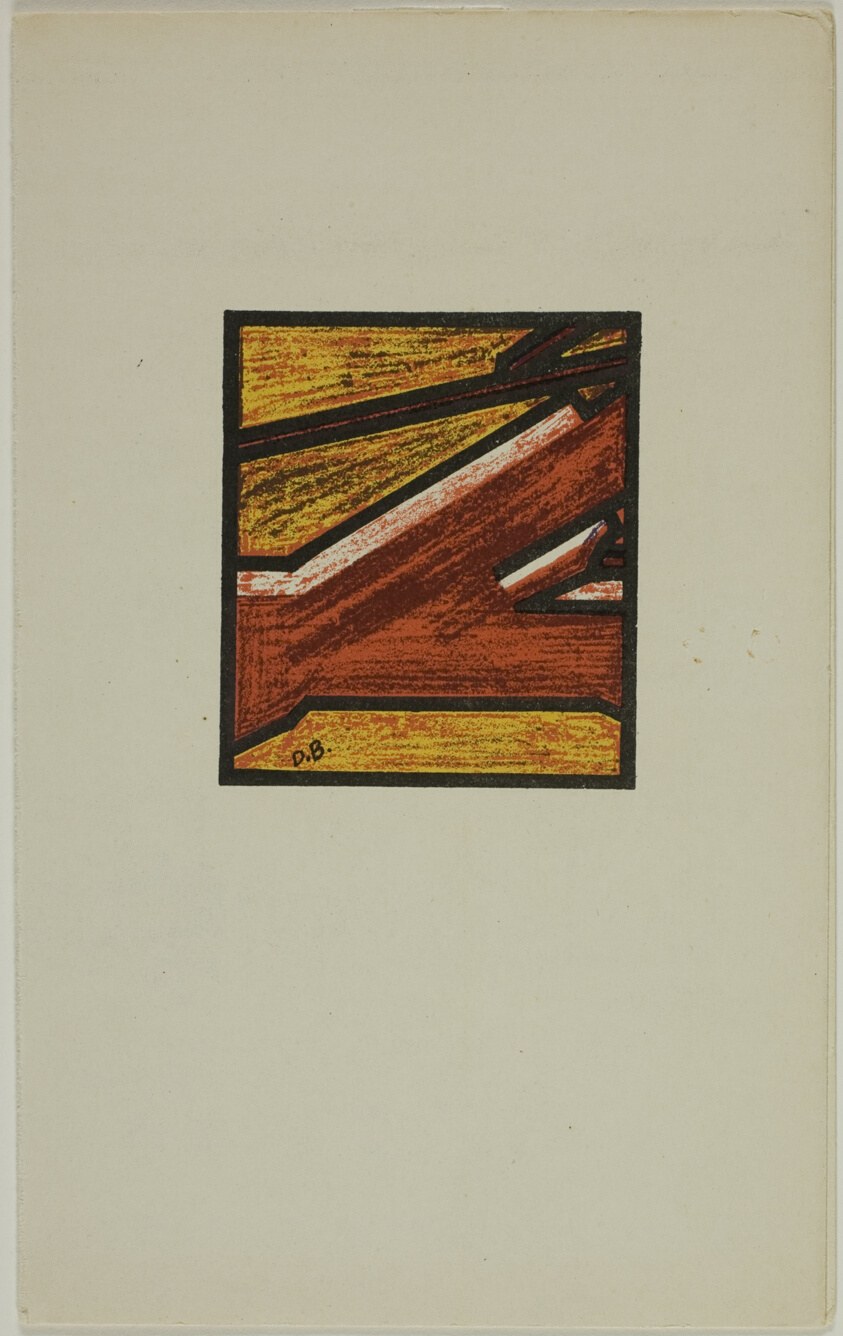
Sheet I from Russian Ballet
David Bomberg English, 1890-1957
- Medium:
- Lithograph on cream wove paper
- Collection:
- Prints and Drawings
- Source:
- Art Institute of Chicago
- Rights:
- Rights reserved by the holding institution — do not reuse without permission. Source record ↗
- Recorded as:
- AIC — rights reserved
This work documents the ripple effect of the Ballets Russes on visual modernism: how association with radical dance and theatre could push visual artists toward pure abstraction. It raises questions about what 'Russian Ballet' meant to artists of the 1910s beyond the stage itself—as a catalyst for formal experimentation and a zone of creative permission.
What you are looking at
A densely composed lithograph shows fragmented, overlapping wooden forms—beams, planks, and structural elements—rendered in warm ochres, browns, and burnt sienna against a black ground. The geometric arrangement suggests an architectural or industrial interior viewed from an unusual angle, with sharp diagonals and intersecting planes creating visual tension. Light strikes the surfaces unevenly, emphasizing texture and depth. The composition is claustrophobic and modernist, more concerned with formal abstraction than narrative. There is no legible human figure or recognizable dance scene.
The dancing
No human figures are present in this work. The formal language is entirely architectural or structural. There is no depiction of bodies, gesture, hold, frame, or movement.
The dance depicted
This work does not depict dance. The title 'Sheet I from Russian Ballet' suggests an association with the Ballets Russes or a related avant-garde movement, but the image itself contains no dancers, choreographic language, or theatrical setting. It appears to be an abstract or Constructivist composition, possibly a stage design or set study, rather than a representation of dance itself.
How it was made
The work is a lithograph on cream wove paper, a technique that allowed for bold linear work and tonal gradation across a stone matrix. Lithography was well-suited to modernist experimentation and allowed artists like Bomberg to achieve strong graphic effects and bold color separation. The black keyline pressing creates sharp definition against the warm interior tones, emphasizing the geometric severity of the composition.
About this work
This is an abstract lithograph titled as part of a 'Russian Ballet' series, but it does not depict dance or dancers. Rather, it appears to be a formal study in Constructivist geometry—possibly a stage set design or architectural abstraction inspired by the modernist energies of early 20th-century avant-garde theatre. The work belongs to a moment when artists associated with or influenced by the Ballets Russes were exploring pure abstraction and geometric form. For a gallery focused on dance imagery, this work is significant as evidence of how dance patronage and theatrical innovation could inspire non-representational art, but it does not itself show choreography or performance.
How to look at it
Attend to the interlocking planes and the play of light across what appears to be an architectural interior. The lithographic technique creates a strong tonal contrast: the black keyline defines edges with precision, while the warm ochres and browns are built up in layers to suggest depth and surface texture. The composition is deliberately unstable—diagonals push against horizontals, creating visual momentum even though nothing moves. Ask whether this might be a stage design: the geometric severity and abstract space could suggest a modernist theatre set, a space where dancers would move, rather than a representation of dancers themselves.
The artist
David Bomberg (1890–1957) was an English painter and printmaker who trained at the Slade School of Fine Art and engaged deeply with Cubism, Futurism, and Constructivism. He was active in London's avant-garde circles in the 1910s and was associated with the Vorticist movement and the Omega Workshops. His work often combined geometric abstraction with bold graphic technique. He was also known for figurative work, particularly landscapes and portraiture later in life. His practice encompassed painting, printmaking, and drawing, and he taught at several art schools.
The period
The 1914 date places this work in the earliest phase of Bomberg's maturity, a moment of intense formal experimentation in London modernism. The Ballets Russes, founded in 1909, had fundamentally altered how artists thought about colour, movement, and theatrical possibility. Diaghilev's company inspired not only choreographers and dancers but also visual artists—painters and set designers collaborated directly (Picasso, Matisse, Braque), and the broader ethos of radical innovation in dance performance radiated outward. Bomberg's geometric abstraction may be a response to the kinetic energy and non-naturalistic aesthetics associated with Russian modernism and theatrical innovation, even as it moves away from representation toward pure form.
Where it lives
The work is held in the Prints and Drawings collection of the Art Institute of Chicago. It is catalogued as part of a series titled 'Russian Ballet,' identified as Sheet I. The record indicates it is a lithograph on cream wove paper from 1914.
Questions about this work
Why is this in a dance gallery if there are no dancers?
The work is titled 'Sheet I from Russian Ballet' and was created in 1914, a moment when the Ballets Russes was transforming avant-garde visual culture. It belongs here as evidence of how dance innovation inspired formal experiment in visual art—even art that moved toward pure abstraction. It raises questions about the boundaries between dance patronage, theatre design, and modernist art.
What is the subject of this lithograph?
The primary subject appears to be an abstract arrangement of wooden structural forms—beams, planks, and architectural elements in layered perspective. It may represent a stage interior or a Constructivist study of geometric form. The warm tones and tectonic arrangement suggest space and depth rather than a single readable scene.
Is this a stage design?
The composition and title suggest it may be related to theatre design or the aesthetic world of the Ballets Russes, but the image does not clearly represent a theatrical setting with performers. It functions more as an abstract formal study that may have been inspired by modernist theatre aesthetics.
More dance artwork





