49 works in this view — arrow keys or swipe to move between them.
Dance in Art
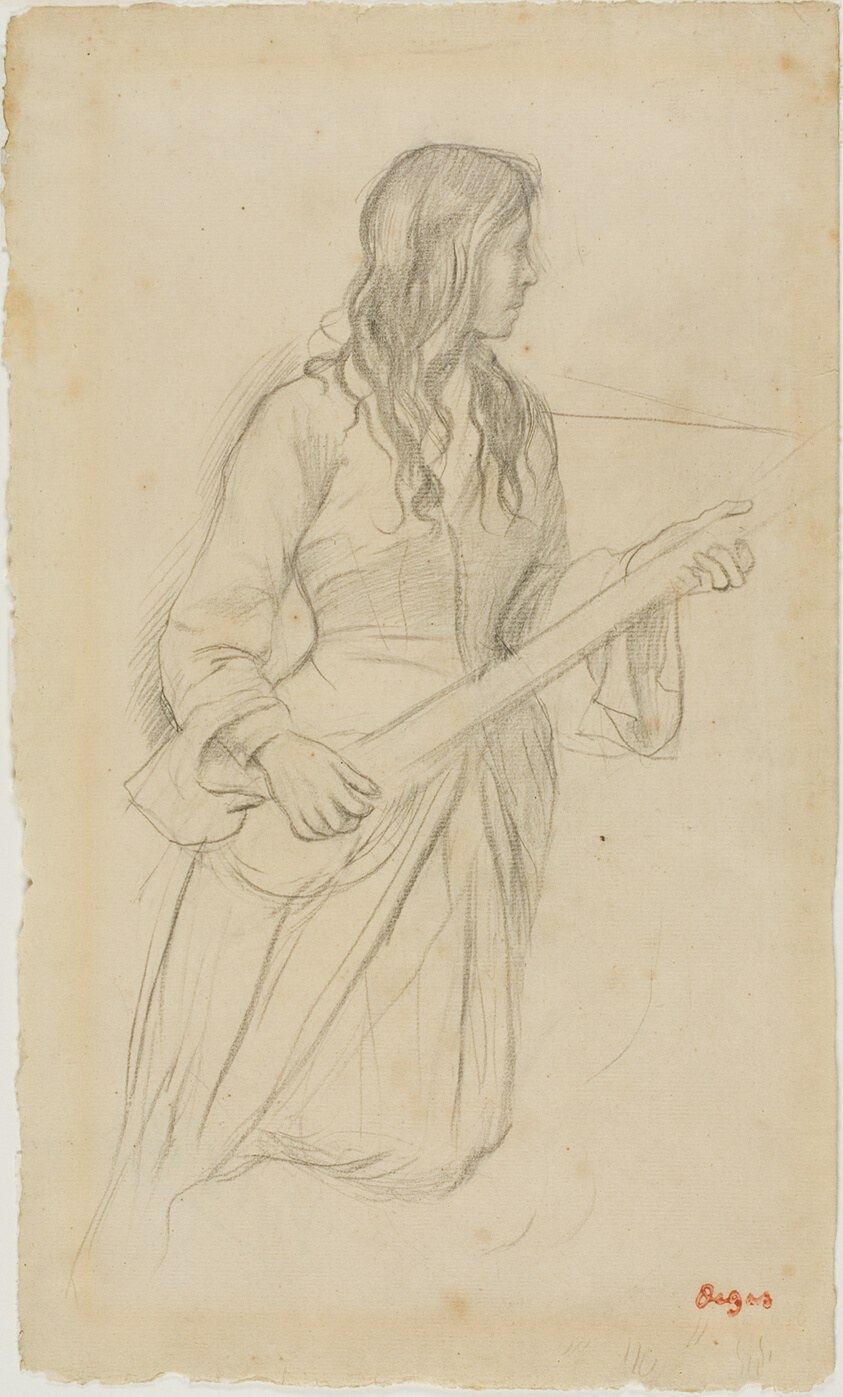
Young Woman Playing a Mandolin, Study for Portrait of Mlle. Fiocre in the Ballet "La Source"
Edgar Degas French, 1834-1917
- Medium:
- Graphite on ivory laid paper
- Collection:
- Prints and Drawings
- Source:
- Art Institute of Chicago
- Rights:
- Public domain — free to use, share and adapt.
- Recorded as:
- CC0 (Public Domain)
Mlle. Fiocre was a major dancer in the second act of *La Source* (1861), one of the most successful ballets of the decade, and this study reveals how dancers of the Romantic era were documented and memorialized in portraiture. The work shows Degas's practice of drawing from the live model with precision and sensitivity long before he became famous for his images of dancers in rehearsal and performance; it captures a moment in his career when portraiture and dance were not yet entirely separated in his practice.
What you are looking at
A young woman stands in three-quarter view, her body turned slightly to the left, holding a mandolin at hip level with both hands. She wears a long draped dress with vertical pleating and a fitted bodice laced or buttoned down the front, typical of mid-19th-century fashion. Her long wavy hair falls past her shoulders. The drawing is executed in graphite with careful attention to the fall of fabric and the subtle modeling of form through cross-hatching and directional line. The composition is a studio study—a figure posed against a neutral ground, conceived as a portrait study rather than a narrative scene. The mandolin, held at an angle across her body, is rendered with particular care, its form clearly articulated. There is no setting beyond the figure itself; the focus is entirely on the young woman's pose, dress, and the instrument she holds.
The dancing
The figure stands with weight evenly distributed, the body upright but relaxed. Her arms are bent at a natural angle to hold and position the mandolin. The left arm supports the body of the instrument while the right hand is positioned as if to play. Her head is held high, turned in profile or near-profile, gazing slightly downward with a contemplative expression. The pose is stable and formal—a portrait stance rather than a moment of active playing. There is no indication of movement or dance; the body is still and composed.
The dance depicted
This is not a dance scene. The title indicates this is a study for a portrait of Mlle. Fiocre in the ballet *La Source*, but the drawing itself shows only the sitter in a portrait pose holding a musical instrument. While *La Source* was a celebrated ballet of the 1860s and Fiocre was one of its principal dancers, this particular study captures her as a portrait subject rather than in a dance role or moment. The mandolin may have been a prop or costume element in the ballet, but the drawing presents a stationary figure, not dance movement.
How it was made
This is a graphite drawing on ivory laid paper, a standard medium for portrait studies and preparatory work in 19th-century French art. Degas's technique here is precise and disciplined—the line work defines the form clearly while parallel hatching creates volume and shadow, particularly in the folds of the dress and the modeling of the face and hands. This is a studio study, one of many preparatory drawings Degas would have made before painting a formal portrait. The medium allowed for quick revision and careful observation of pose and proportion, and the laid paper itself, with its subtle texture, accepts the graphite in a way that produces warm, nuanced tones.
About this work
This is a portrait study by Edgar Degas, dated to 1866, showing a young woman identified as Mlle. Fiocre, a celebrated dancer of the Paris Opéra, posing with a mandolin. The work is not a depiction of dance itself but rather a studio preparation for what would become a formal portrait—the kind of careful observational drawing that Degas produced in quantity throughout his career. The sitter was famous as a ballet dancer, and the mandolin may have been chosen as a costume element or personal attribute for the finished portrait, but in this study, the emphasis is on the figure's form, dress, and contemplative presence rather than on movement or performance. It belongs in a dance collection because it documents a historical ballet figure and provides insight into how 19th-century artists approached the portrayal of dancers outside of choreographed performance.
How to look at it
Attend to the precision of the pose: this is not a caught moment but a carefully arranged studio stance. The figure is posed formally, as if for a seated or standing full-length portrait, but the artist has chosen to show her standing, holding the mandolin as an attribute—much as a painter might pose a woman holding a book or a fan. Notice how the dress is rendered—the vertical pleating, the fit of the bodice, the weight of the skirt—with a level of detail that makes clear Degas was interested in costume and silhouette. The study was made to establish the pose and composition for a larger work; it is a working drawing, not a finished exhibition piece, and its power lies in the directness of the observation and the economy of the line.
The artist
Edgar Degas (1834–1917) was a French painter and draughtsman trained in academic tradition who became one of the most innovative artists of the 19th century. In the 1860s, he was still engaged with portraiture and historical painting, but he was increasingly drawn to the subject of dance—the backstage world of the Paris Opéra, rehearsals, and performers. His later works on dance made him famous, but his early career included many portrait studies of sitters from the cultural world of Paris, including performers. This drawing of Mlle. Fiocre shows him at the moment when academic portraiture and his emerging fascination with dancers were still closely linked.
The period
In 1866, when this study was made, the Paris Opéra was at the height of the Romantic ballet era. *La Source*, first performed in 1861 with music by Léo Delibes and Minkus, had established itself as a modern classic, and its dancers—including Fiocre—were among the most celebrated performers in Europe. Portrait painting in France was still a primary mode of commemorating notable figures, and it was standard for artists to produce detailed graphite studies before undertaking oil paintings. The 1860s were a moment of transition: traditional academic portraiture was still dominant, but the avant-garde was already beginning to look toward new subjects and modes of representation—including the unflattering, candid views of performers that Degas would pioneer in the 1870s and 1880s.
Where it lives
This work is held in the Prints and Drawings collection of the Art Institute of Chicago. It is catalogued as a study, reflecting its function as a preparatory drawing made in the artist's studio as part of the process of creating a portrait commission. The presence of what appears to be a collector's or artist's mark (in red ink, lower right) suggests it was valued and preserved as part of an artist's estate or collection.
Questions about this work
Is this a drawing of a dance or a ballet scene?
No. This is a portrait study of a dancer shown in a stationary pose, not a representation of choreography or performance. The sitter, Mlle. Fiocre, was a celebrated ballet dancer, but this study captures her as a portrait subject, holding a mandolin as a personal or costume attribute. It belongs to the history of dance imagery because of who the sitter was, not because it depicts movement or dance itself.
What is *La Source*?
*La Source* (1861) was a two-act ballet with music by Léo Delibes and Minkus, choreographed by Arthur Saint-Léon for the Paris Opéra. It was one of the most successful and frequently performed ballets of the Romantic era and featured spectacular scenery and costume. Mlle. Fiocre danced the role of Naïla in the second act, making her one of the stars of the production.
Why is a dancer holding a mandolin?
The mandolin may have been a prop or costume element in *La Source*, or it may have been included in the portrait as a personal attribute—a detail chosen to suggest the sitter's cultural refinement or artistic interests. Without seeing the finished portrait, it is not possible to be certain of its significance. It was common in 19th-century portraiture to pose sitters with objects that reflected their profession, interests, or social identity.
What is Degas doing in this study?
Degas is working out the composition for a formal portrait. He is observing the live model carefully, establishing the pose, the proportions of the figure, the way the dress hangs, and the angle of the head. This kind of detailed graphite study on paper was a standard step in the academic process before beginning work in oil on canvas. It allowed the artist to refine the composition and to study the sitter's likeness and character in preparation for the finished work.
More dance artwork





