49 works in this view — arrow keys or swipe to move between them.
Dance in Art
Pelike (Storage Jar)
Greek; Athens
- Medium:
- terracotta, black-figure with applied paint
- Collection:
- Arts of Greece, Rome, and Byzantium
- Source:
- Art Institute of Chicago
- Rights:
- Public domain — free to use, share and adapt.
- Recorded as:
- CC0 (Public Domain)
For dance historians, this object illuminates the broader context of physical performance in ancient Athens—the gymnasium training, wrestling, boxing, and hunting activities that existed alongside dance and were often depicted in the same visual and social settings. Understanding the full range of athletic and physical culture helps contextualize how dance fit into Greek masculine ideals and social practice. The pot itself demonstrates how narrative scenes were used to communicate cultural values across the ancient Mediterranean world.
What you are looking at
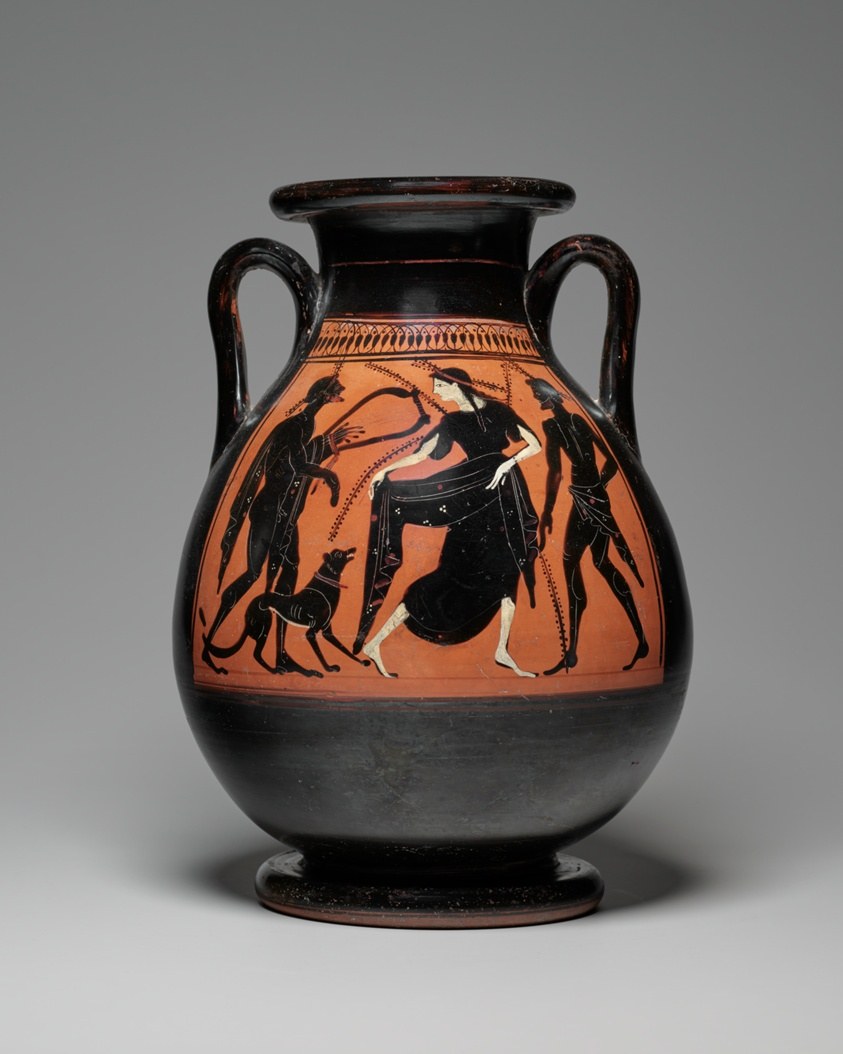
A terracotta storage jar (pelike) painted in the black-figure technique shows a scene of athletic competition or physical contest. Against the characteristic orange-red clay ground, black silhouetted figures are arranged across the shoulder of the vessel. At least three human figures are depicted in dynamic poses—some bent forward, one with arm raised—alongside a dog rendered in profile with its body stretched horizontally. The figures wear minimal dress or appear nude, typical of athletic scenes in Athenian pottery. A decorative band of incised linear patterns runs along the upper rim, framing the narrative scene. The vessel itself is bulbous, with two handles rising from the shoulder and a distinctive flared rim.
The dancing
The bodies are rendered in the black-figure silhouette style characteristic of Athenian pottery from this period. Multiple figures are shown in active, forward-leaning postures suggesting exertion or competition. At least one figure has an arm raised in what may be a striking or grappling gesture. The dog, positioned lower and stretched horizontally, suggests it may be part of a hunting scene or serves as a sign of elite activity. The poses show understanding of the human body in action, with bent knees and forward inclination indicating movement and effort rather than static stance.
The dance depicted
This is not a depiction of dance in the theatrical or social sense, but rather athletic competition or hunting activity. The figures appear to be engaged in wrestling, boxing, or similar contest—possibly part of the gymnasium or athletic games tradition in ancient Athens. The presence of the dog and the dynamic, aggressive postures of the human figures suggest either athletic competition or a hunting expedition, both of which were central to elite male activity in classical Athens but fall outside dance genres. The scene documents physical culture and masculine achievement rather than choreographed movement.
How it was made
This is a terracotta storage jar (pelike) painted in the black-figure technique, a method in which figures are rendered as solid black silhouettes against the natural orange-red clay ground, with interior details incised through the black slip. The technique was perfected in Athens in the sixth century BCE and allowed for rapid production and wide distribution. The black-figure style required the artist to compose the entire scene in negative space, planning the arrangement carefully before firing. This method produced durable, functional vessels that could serve both practical storage purposes and display of artistic status, making it a primary medium for narrative art in its era.
About this work
This pelike is a functional storage vessel that documents the athletic and hunting practices of ancient Athenian elite society. Dating to approximately 510 BCE, it exemplifies the black-figure pottery tradition at its height, combining practical function with sophisticated narrative imagery. The scene captures a moment of physical exertion and competition—whether wrestling, boxing, or hunting—that was central to the masculine ideals and gymnasium culture of classical Athens. As an object, it records not choreographed dance but the vigorous physical practices that shaped athletic culture and were often depicted alongside dance in symposium and festival contexts.
The vessel belongs to a category of Athenian export ware that circulated throughout the Mediterranean, carrying Athenian visual culture and values into elite households across the region. Its narrative scene would have been visible to users and viewers during daily life, making the imagery of athletic achievement and masculine prowess a constant presence in the domestic sphere.
How to look at it
The viewer should trace the individual figures and their postures around the bulging shoulder of the vessel, reading the scene as a sequence of moments or a multifigure composition. The black silhouettes against the red clay create strong visual contrast and make the gestures and body positions immediately legible despite their miniature scale. Notice how the artist has arranged the figures to suggest movement and effort—forward lean, raised arms, bent knees—capturing a moment of intense physical activity. The incised lines within the black silhouettes would have been visible in raking light, adding refinement to what appears at first glance as a simple silhouette.
The artist
Unknown. The artist is identified in the record only as "Greek; Athens," indicating production in Athens during the early Classical period. Black-figure pottery of this period was produced by professional potters and painters working in the Kerameikos district of Athens, likely in workshops where potter and painter were often separate craftspeople. The quality of execution and the sophisticated composition suggest a skilled hand working within an established tradition.
The period
In approximately 510 BCE, Athens was in the early decades of democracy and at the height of the black-figure pottery tradition, which would soon be superseded by the red-figure technique. This was a period of intense interest in depicting the body—both in athletic competition and in the gymnasium, which served as a center for male social bonding, education, and display. Athletic contests (agon) were central to Greek culture, staged at festivals and competitions, and were closely related to the performance culture that included dance, music, and drama. The imagery of physical exertion and masculine competition on functional vessels like this pelike reflects the values of the society that used them.
Where it lives
This object is held by the Art Institute of Chicago, part of its collection of Arts of Greece, Rome, and Byzantium. It is a representative example of Athenian black-figure pottery from the late Archaic period and exemplifies the fine ceramics that were produced for export and display in elite contexts throughout the Mediterranean.
Questions about this work
Is this a dance scene?
No. This vessel depicts athletic competition or hunting—likely wrestling or boxing—rather than choreographed dance. However, such scenes are valuable for understanding the broader physical culture of ancient Athens and the contexts in which dance occurred. Athletic contests, symposia, and festivals often featured both athletic competition and dance performance.
What was a pelike used for?
A pelike was a large storage jar used to hold wine, oil, or grain in the household or for trade. Its broad shoulder and sturdy form made it practical for storage, while its surface provided space for decoration. Decorated pelikai like this one would have been displayed and seen daily, making the narrative imagery a constant presence in elite homes.
Why are the figures black?
This is the black-figure technique, a method invented in Corinth and perfected in Athens. The artist painted the entire figure as a solid silhouette in black slip, then incised details (such as muscles, folds of cloth, or facial features) through the black to reveal the red clay underneath. After firing, the black figures stood out boldly against the natural red clay ground.
Who made this pot?
The maker is unknown. It was produced in Athens around 510 BCE by a professional potter and painter working in the Kerameikos district. Many black-figure vessels of this quality were not signed, and the workshops produced vessels for both local use and export throughout the Mediterranean.
More dance artwork





