49 works in this view — arrow keys or swipe to move between them.
Dance in Art
The Ballroom
June Leaf American, 1929-2024
- Medium:
- Transfer lithograph on cream wove paper
- Collection:
- Prints and Drawings
- Source:
- Art Institute of Chicago
- Rights:
- Rights reserved by the holding institution — do not reuse without permission. Source record ↗
- Recorded as:
- AIC — rights reserved
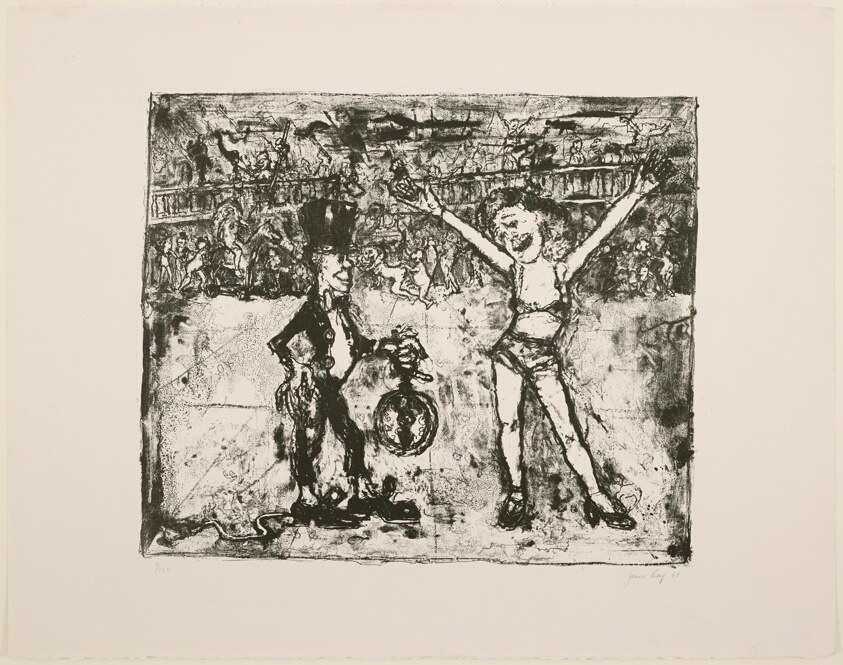
Leaf was a sculptor and printmaker who worked at the intersection of figuration, abstraction, and social observation; this print shows her treating dance as a psychological and social subject rather than as formal spectacle. The ballroom, a space central to 20th-century dance history and social life, is here rendered as a site of anxiety and performance rather than pleasure, offering a counter-narrative to the escapism and romance conventionally associated with ballroom culture.
What you are looking at
A crowded ballroom unfolds in this transfer lithograph, dense with figures arranged across the composition in a flattened, graphic space. The scene reads as a cross-section of social life: in the foreground, a man in dark formal dress stands at left, his posture alert and contained; to his right, a woman in an elaborate gown with a full skirt caught mid-movement. Behind and around them, the ballroom teems with activity—couples dancing, musicians, spectators leaning over balconies, architectural details suggesting grand interior space. The background dissolves into a hatch of marks suggesting depth and crowding. Light is handled as a graphic element, created through the bare paper showing through the printed marks, giving the composition an energetic, somewhat anxious quality. The mood is one of social performance and surveillance: bodies navigate the formal codes of ballroom decorum while remaining acutely aware of observation.
The dancing
The two foreground figures suggest a dance hold, though not a rigid formal one. The man's posture is upright but his arm placement suggests he may be leading or about to lead; the woman's body angle and the dramatic sweep of her skirt indicate active weight shift or turning. Their relationship is spatial and kinetic rather than intimate—there is tension in the separation. The surrounding figures are rendered more summarily, but several pairs appear to be in closed or semi-closed holds typical of ballroom dancing. Feet are not clearly articulated, but the overall weight distribution suggests movement through space rather than stillness.
The dance depicted
The image depicts ballroom dancing as a social institution rather than a single identifiable style. The formal dress, the interior architectural setting, and the narrative framing—spectators, musicians, social hierarchy visible in figure placement—all point to historic ballroom culture, likely early-to-mid-20th century. The specific dance (waltz, foxtrot, tango) cannot be determined from hold or footwork alone, but the composition treats ballroom as a social theater where dancing serves as a vehicle for class negotiation, courtship, and public display. This is ballroom as observed phenomenon rather than as technique.
How it was made
A transfer lithograph on cream wove paper, a technique that allowed the artist to draw or paint on a specially prepared surface, then transfer the image to stone for printing. This method permits a rich range of mark-making—hatching, gestural line, tonal fields—visible throughout this print. The technique was favored for its expressive potential and for producing multiple impressions suitable for wider distribution than unique drawings. The dense, layered quality here, with areas of heavy marking and areas of reserve, is characteristic of transfer lithography and conveys psychological intensity and social density simultaneously.
About this work
Leaf's *The Ballroom* presents the ballroom not as a site of aesthetic harmony but as a psychologically complex social space. The formal codes of ballroom dancing—the closed hold, the prescribed frame, the public visibility—become the subject matter itself. The lithographic technique, with its capacity for both precision and expressionistic mark-making, renders the ballroom as both orderly (the formal dress, the architectural setting) and chaotic (the crowded composition, the gestural energy). For a viewer trained in dance history, the work asks what the ballroom dance *means* beyond its technical execution: it is a site of class aspiration, sexual negotiation, and social control, all registered in the tense formal relationship between the two foreground figures and the observing crowd behind them.
How to look at it
Focus first on the foreground pair: the man's upright but slightly uncomfortable posture, the woman's active weight shift suggested by the sweep of her skirt. Notice the tension in their spatial relationship—they are partnered but not merged. Then track the eye backward into the composition: the figures become more densely packed and gesturally abbreviated, suggesting both the immersive quality of being in a ballroom and the artist's interest in social observation and crowding. The marks themselves—their density, direction, and accumulation—create the sense of a charged social space. The composition is fundamentally about the experience of dancing *in public*, under observation, negotiating form and desire simultaneously.
The artist
June Leaf (1929–2024) was an American sculptor, painter, and printmaker known for figurative and abstract work that often engaged with social themes and the human body. Working from the 1950s onward, she developed a distinctive graphic language combining gestural expressionism with structured composition. Her prints, in particular, often depicted crowded social scenes and interior spaces with a psychological intensity that suggested social critique. Leaf's practice was informed by European modernism and American social realism, and she maintained a studio practice spanning multiple media throughout her career.
The period
The work dates to 1968, a moment of social upheaval in the United States and Europe. The ballroom dance, once a central institution of social life and courtship, was increasingly viewed by younger generations as outmoded, formalized, and emblematic of repressive social codes. Simultaneously, avant-garde artists were reassessing figuration and social observation after the dominance of abstraction in the 1950s and early 1960s. Leaf's treatment of the ballroom—crowded, psychologically charged, rendered in gestural marks—participates in this reassessment: the ballroom is neither celebrated nor dismissed, but rather examined as a complex social fact. In printmaking, 1968 saw continued investment in lithography and other traditional techniques as means of reaching broader audiences and engaging with social and political content.
Where it lives
The work is held in the Prints and Drawings collection of the Art Institute of Chicago. It represents the collection's holdings in mid-20th-century American printmaking and figuration.
Dance in this work
Questions about this work
What specific ballroom dance is being shown here?
The image does not provide enough detail of hold, footwork, or frame to identify a specific style with confidence. The formal dress and interior setting suggest a social ballroom of the 1940s–1950s era, but the artist's interest is in ballroom as social phenomenon rather than in technical accuracy. The ambiguity is intentional: this is ballroom as spectacle and social theater, not as technique.
Why does this ballroom look so crowded and anxious?
Leaf's compositional strategy emphasizes the social density and psychological complexity of the ballroom. The crowding conveys both the immersive, almost claustrophobic quality of being in a formal social space and the ballroom as a site of observation and judgment. The gestural, accumulative mark-making adds psychological intensity; this is not a celebration of ballroom dancing but an examination of its social functions and costs.
Is this a realistic depiction of a specific ballroom?
No. The composition is abstracted and stylized, using the ballroom as a conceptual subject rather than as a documentary scene. The architectural details suggest a grand interior, but the flattened perspective, the gestural rendering of figures, and the overall density are modernist formal choices. The work is about the *idea* of the ballroom and what it represents socially and psychologically.
More dance artwork





