49 works in this view — arrow keys or swipe to move between them.
Dance in Art
The Connecticut Ballroom
H.C. Westermann American, 1922-1981
- Medium:
- Woodcut on Japanese paper
- Collection:
- Prints and Drawings
- Source:
- Art Institute of Chicago
- Rights:
- Rights reserved by the holding institution — do not reuse without permission. Source record ↗
- Recorded as:
- AIC — rights reserved
This work expands the definition of dance imagery beyond figures in motion to include the architecture and designed spaces that make dance possible and meaningful. For historians and dancers, it documents how mid-twentieth-century artists engaged with ballroom culture not as a subject for figuration but as a formal problem in composition and representation.
What you are looking at
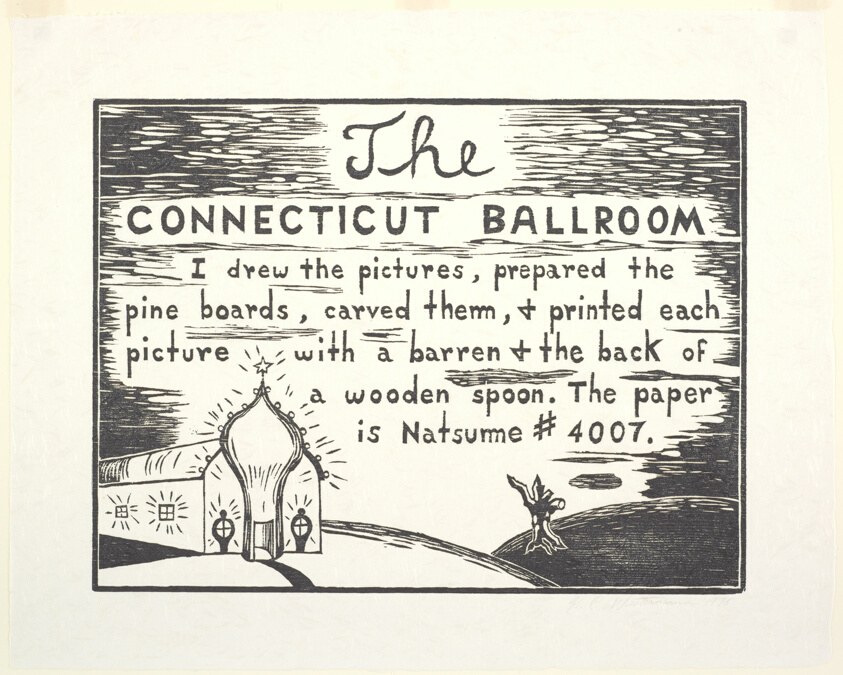
This woodcut depicts an interior ballroom rendered in bold black lines and high-contrast cross-hatching typical of the medium. The space is architecturally fantastical: a central structure with a bulbous, onion-dome roof crowned with radiating spikes dominates the composition, flanked by geometric forms suggesting wall sconces or architectural details. The floor recedes into shadow at the lower right. The artist has used the whitespace of the paper to suggest an open, elegant venue, while the ornamental building at the composition's center—with its decorative silhouette—evokes both modernist abstraction and the decorative vocabulary of historic ballroom design. The scene is uninhabited; no dancers appear. The title inscribed in the lower portion of the print identifies this as a representation of a specific ballroom, rendered as an imagined or stylized architectural monument rather than a literal documentation.
The dancing
No human figures or dancers are present in this work. The composition centers entirely on architectural form rather than bodies in motion.
The dance depicted
Though titled *The Connecticut Ballroom*, this work does not depict an actual dance or dancers. Instead, it presents the ballroom as an architectural subject—a building or interior space abstracted into formal geometric shapes. The work thus engages with ballroom culture not through the representation of movement or social interaction, but through the monumental rendering of the space itself. This approach treats the ballroom as a place of cultural significance worthy of artistic attention in its own right.
How it was made
This is a woodcut on Japanese paper—a technique in which an image is carved into a wooden block, with the raised surfaces inked and printed. The artist has exploited the medium's characteristic bold lines and areas of solid black to create stark, high-contrast compositions. The cross-hatching visible in the shadowed areas was achieved through careful carving. Woodcut was a relatively direct and affordable printing method, allowing for multiple impressions from a single block, and Japanese papers were prized for their delicacy and ability to receive fine detail. The choice of this traditional medium for a modernist subject suggests a dialogue between historical printmaking technique and contemporary formal abstraction.
About this work
H.C. Westermann's *The Connecticut Ballroom* is an architectural fantasy rendered as a woodcut print, depicting not a dance or dancers but the imagined interior monument of a ballroom itself. Created in 1976, the work converts the social and cultural space of the ballroom into a formal composition of geometric shapes—a bulbous central structure, radiating lines, and abstracted spatial planes. Rather than document a specific historical ballroom or the social practices within it, Westermann elevates the ballroom to the status of a sculptural or architectural form worthy of contemplation. The work sits at the intersection of Americana and modernist abstraction, treating vernacular leisure culture as a subject for serious artistic investigation.
For a gallery focused on dance in art, this work presents a necessary provocation: it asks what it means to represent ballroom culture without depicting dancers, bodies, or movement. By rendering only the space—the container for dance—Westermann suggests that the ballroom itself, as an architectural and social institution, is inseparable from the dances that occur within it, and that the two can be studied as a single integrated subject.
How to look at it
Attend to the formal vocabulary Westermann has chosen: the bold, almost heraldic silhouette of the central structure; the use of solid black and intricate cross-hatching to create spatial recession; the way the onion dome at the center suggests both ornament and abstraction. Notice that despite the title's specificity, no identifying detail or historical reference situates this ballroom in Connecticut or any real location—it is a ballroom as pure form. The artist has chosen to render the space as an imagined interior monument, a structure of cultural significance abstracted from any human presence. This invites the viewer to consider what the ballroom means as an idea, a social institution, and a shaped environment.
The artist
H.C. Westermann (1922–1981) was an American artist and sculptor known for his surrealist and often darkly humorous works that blended folk materials, architectural forms, and symbolic imagery. He worked across multiple media—wood, metal, drawing, and printmaking—and frequently drew on American vernacular subjects, childhood memory, and architectural fantasy. His work often presents everyday American institutions and spaces (houses, fairgrounds, ballrooms) as sites of psychic intensity and formal experimentation. Westermann had a sustained interest in printmaking and in the intersection of craft traditions with contemporary art practice.
The period
In the 1970s, American artists were increasingly turning to vernacular and popular culture as subjects for serious artistic treatment, rejecting earlier distinctions between "high" and "low" subject matter. Social dance and ballroom culture, long associated with working-class and regional American life, became subjects of artistic interest. At the same time, there was renewed enthusiasm for traditional printmaking techniques, particularly among artists interested in craft and in art that could be reproduced and circulated beyond the gallery system. Woodcut and other relief-printing methods experienced a revival as artists valued their directness, their connection to historical practice, and their democratic potential.
Where it lives
This work is held in the Prints and Drawings collection at the Art Institute of Chicago (AIC). It is catalogued on Japanese paper (Natsume #4007) and represents the artist's sustained engagement with printmaking as a primary medium of artistic expression.
Questions about this work
Why is there no one dancing in this picture if it's called a ballroom?
Westermann has chosen to depict the ballroom as an architectural form rather than as a social scene with dancers. By rendering only the space itself—the interior structure and formal design—he suggests that the ballroom, as a cultural and physical space, is itself a subject worthy of artistic attention. The absence of figures invites viewers to imagine the dances and social interactions that occur there, and to think about how architecture shapes and facilitates human movement and social gathering.
What is the building with the onion dome in the center?
It appears to be Westermann's imagined or abstracted interpretation of a ballroom's interior architecture—not a literal representation of an actual Connecticut ballroom, but a formal composition using geometric and ornamental shapes. The onion dome is a recurring motif in Westermann's work and may reference European or folk architectural traditions. The structure functions as both a decorative and spatial anchor for the composition.
How did Westermann make this print?
This is a woodcut, made by carving an image into a wooden block. The raised surfaces are inked and printed onto paper. Westermann used cross-hatching (fine parallel lines carved into the block) to create areas of shadow and spatial depth. The bold black lines and high contrast are characteristic of the woodcut medium and were intentional choices that give the work its dramatic, graphic quality.
More dance artwork





