49 works in this view — arrow keys or swipe to move between them.
Dance in Art
Merrymakers in an Inn
Adriaen van Ostade (Dutch, 1610–1685)
- Medium:
- Oil on panel
- Collection:
- Painting and Sculpture of Europe
- Source:
- Art Institute of Chicago
- Rights:
- Public domain — free to use, share and adapt.
- Recorded as:
- CC0 (Public Domain)
This is one of the richest visual documents of 17th-century European folk social dance, capturing not formal steps but the actual embodied practice of village celebration. For historians of vernacular dance, Van Ostade's works are invaluable because they show dance as it was lived by the majority of people, unfiltered through the conventions of courtly notation or theatrical record.
What you are looking at
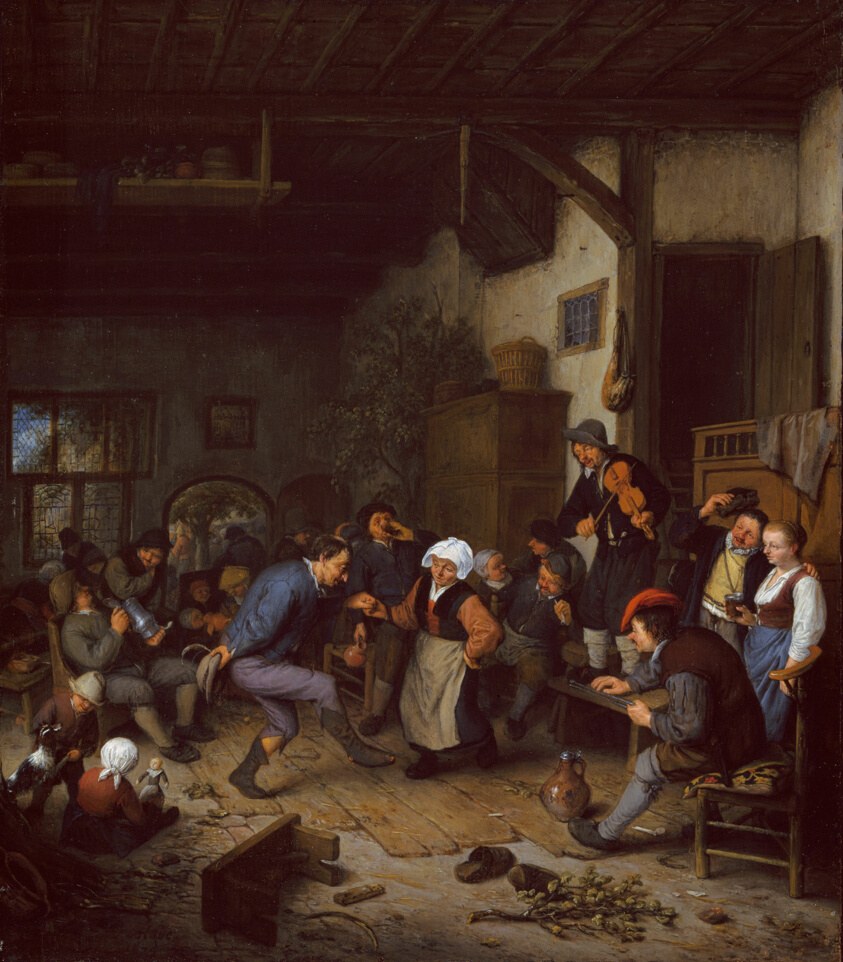
A crowded tavern or alehouse interior, packed with rural villagers in the robust style of mid-17th-century Flemish life painting. The wooden-beamed ceiling and rough plaster walls define a humble space lit by natural light from a small window. In the center, a man in blue plays a stringed instrument—a fiddle or hurdy-gurdy—while around him figures in earth tones, whites, and warm ochres gesture, dance, and socialize in clusters. Some stand in animated conversation; others appear to be actively dancing. A woman in a white cap and tan apron occupies the foreground left, with figures seated and standing throughout the composition. The floor is scattered with debris and discarded objects. The scene captures a moment of popular festivity and rural merrymaking, with the artist paying close attention to individual character and posture rather than formal arrangement.
The dancing
The figures move with the loose, informal postures of vernacular social dance rather than trained technique. Several appear to be in the act of dancing, with bent knees and inclined torsos suggesting energetic movement. A man in a dark hat and red hose gestures with raised arms, possibly mid-step. The musician at center provides the music source, establishing the scene's animated energy. Bodies are arranged in the irregular, overlapping clusters characteristic of spontaneous social activity rather than choreographed formation. The weight distribution and arm positions suggest folk dances of the period—informal, participatory, with varied levels of engagement from spectators and dancers alike.
The dance depicted
This is a scene of village or tavern dance—a social gathering centered on folk celebration rather than any specific named dance form. The context and dress point to 17th-century Low Countries vernacular practice, likely depicting a kermis (village fair) or alehouse entertainment. The presence of a live musician (fiddle or similar), the mixed-gender participation, and the informal, animated gestures all align with European folk social dancing of the period. The artist does not isolate or idealize the dancers; instead, they are embedded in a larger scene of rustic conviviality. This is not theatrical dance, courtly minuet, or formal choreography, but rather the spontaneous, participatory dancing of common people at leisure.
How it was made
Oil on panel, a technique that allowed for rich atmospheric detail and subtle tonal gradations crucial to the scene's believability. The panel support suggests a work created for a patron with means, not a casual sketch. The technique enabled the artist to render individual faces, fabric textures, and the play of light across the crowded interior with the precision expected of high Flemish painting. This is not a broadside or popular print, but a fine-art object—evidence that scenes of peasant life held appeal for educated collectors by the 1670s.
About this work
This is a genre scene—a celebration of peasant or working-class life rendered in the Flemish tradition of social observation. Adriaen van Ostade (1610–1685) was the master of such scenes, and this painting exemplifies his practice of using popular gatherings—fairs, taverns, village celebrations—as subjects for detailed character study and narrative richness. The work sits at an important moment in European art history when scenes of everyday life, including dance, began to be worthy of the canvas previously reserved for history, mythology, and courtly subjects.
The painting preserves a visual record of folk social practice in the Northern European countryside. It shows us not the choreography or technique of formal dance, but the lived reality of how ordinary people moved together in celebration. The work belongs in a dance gallery because it documents a genuine historical moment of dance practice and offers evidence of the vernacular traditions that survived alongside the more documented courtly and theatrical forms.
How to look at it
Focus on the center figure playing the fiddle and trace outward to see how his music animates the crowd. Notice the artist's choice to freeze a moment not of coordinated group dance, but of overlapping social interaction—some figures are clearly dancing, others watching or talking. Look at individual postures: the bent knees, the inclined torsos, the raised arms. These tell us something about the character of the movement—vigorous, informal, unregulated. Observe how the artist uses light and shadow to guide your eye through the crowded space, and how costume (the white caps, the red hose, the aprons) helps identify individuals and their social roles. The composition is deliberately messy and chaotic, the opposite of courtly arrangement; this is the artist's way of saying: this is how real people dance.
The artist
Adriaen van Ostade (1610–1685) was a Dutch Golden Age painter who specialized in scenes of peasant and working-class life. He was a student of Frans Hals and created hundreds of paintings, drawings, and etchings documenting tavern scenes, village fairs, workshops, and domestic interiors. His work was highly sought after by contemporary collectors and remained influential through the 18th century. Van Ostade's approach was sympathetic rather than satirical; he rendered his subjects with humor and humanity, paying close attention to costume, gesture, and individual character. His scenes of music and dance were particularly popular and remain among the most valuable records we have of how ordinary Europeans danced in the 17th century.
The period
By the 1670s, when this work was painted, Dutch and Flemish society was experiencing a golden age of commerce and urban wealth, even as rural life remained the subject of artistic fascination for city collectors. Genre painting—the depiction of everyday life—had become a major category of fine art in the Low Countries. Social dances at village fairs and taverns were familiar contexts for celebration and courtship, but they were also increasingly subjects of moral and religious concern for Reformed Protestant communities. This painting captures the tension between the vitality of popular culture and the more formal, regulated world of courtly and theatrical dance that was developing in the same period. The work shows us a world that was already becoming nostalgic by the time it was painted—a rural, festive culture under gradual transformation.
Where it lives
The work is held in the Painting and Sculpture of Europe collection at the Art Institute of Chicago, identified as an oil on panel from 1674. It is catalogued as 'Merrymakers in an Inn,' a title that captures the mixed-purpose gathering—not a dance performance or formal event, but a tavern or village social space where music and dancing were incidental to broader conviviality.
Dance in this work
Questions about this work
Is this actually a dance scene, or just people in a tavern?
It is both. Several figures are clearly dancing—you can see the bent knees and raised arms characteristic of active movement. But the artist has chosen to embed the dancers in a larger scene of social activity. This is historically accurate: vernacular dancing in the 17th century happened in taverns and village spaces as part of broader celebration, not in dedicated performance contexts. The painting is valuable precisely because it shows dance as it was actually lived and practiced.
What dance is being performed?
No specific named dance can be identified from the postures and positioning. This is likely a generic folk social dance of the Low Countries in the 1670s—possibly a round dance or an informal grouping. The presence of a musician suggests the dance was improvised or followed simple repeated patterns rather than complex choreography. The energy and posture suggest a vigorous, participatory form rather than a courtly or theatrical one.
Why would a wealthy collector own a painting of peasants dancing in a tavern?
By the Dutch Golden Age, scenes of peasant and working-class life had become fashionable subjects for collectors, partly out of genuine interest in social observation and character, and partly out of a more complex fascination with the lives of people unlike themselves. Van Ostade's works were highly valued for their detail, humor, and humanity. Owning such a painting showed cultural sophistication and access to the best contemporary art.
How does this compare to formal dance of the same period?
This represents a completely different world from the courtly minuet or ballet de cour that was developing at the same time. Here, there is no regulated technique, no formal costume, no trained bodies. The dancers are responding to music and to each other in a spontaneous, participatory way. The contrast between this scene and a formal dance of the 1670s shows us how profoundly divided dance practice was by class and education.
More dance artwork





