49 works in this view — arrow keys or swipe to move between them.
Dance in Art
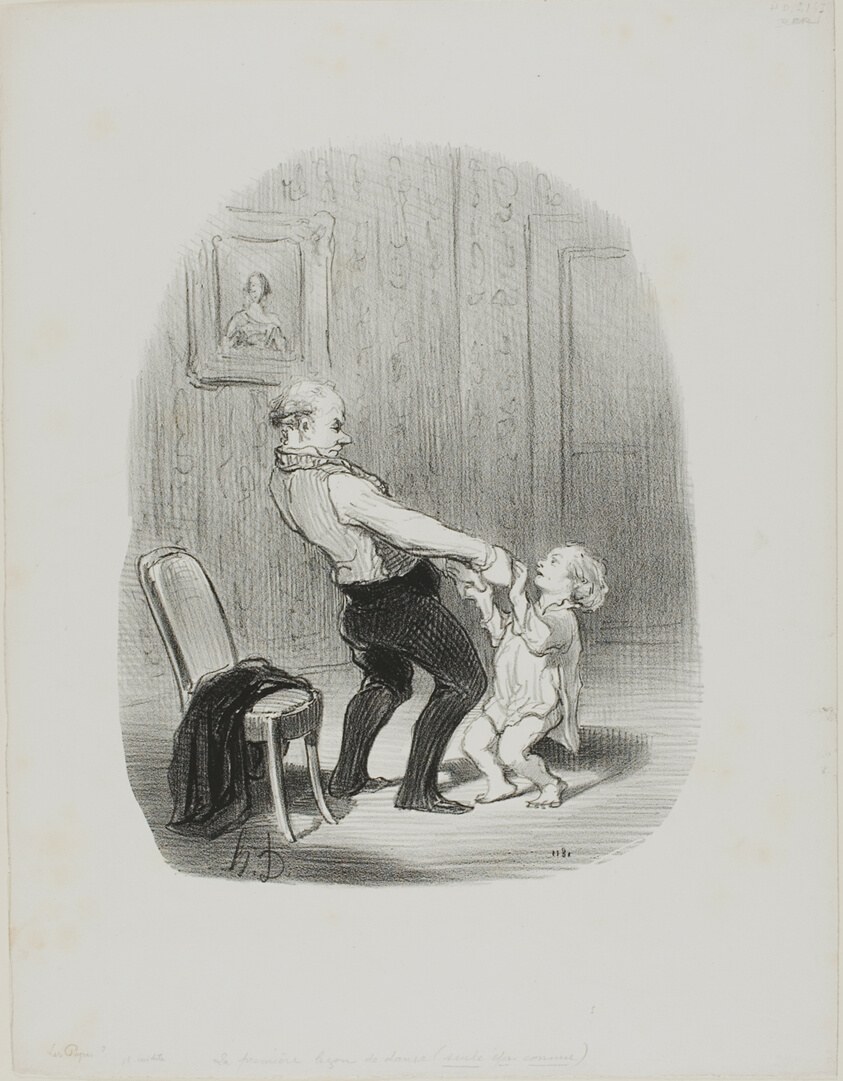
The First Dance Lession, from Les Papas
Honoré Victorin Daumier French, 1808-1879
- Medium:
- Lithograph in black on white wove paper
- Collection:
- Prints and Drawings
- Source:
- Art Institute of Chicago
- Rights:
- Public domain — free to use, share and adapt.
- Recorded as:
- CC0 (Public Domain)
For dance historians, this image documents the foundational pedagogy of nineteenth-century ballroom culture—the discipline, posture, and authority structures embedded in even the earliest instruction. For scholars of childhood and bourgeois ideology, it reveals how dance training functioned as a mechanism for the social reproduction of class and bodily discipline. Daumier's satirical lens complicates any romantic notion of dance instruction, exposing the coercive dimension of formal training.
What you are looking at
A domestic interior scene in which an adult man teaches a small child to dance. The man, dressed in formal attire with a white shirt and dark trousers, stands in profile facing right, his posture upright and commanding. He grasps the child's hand firmly while the child, a toddler in a white garment, reaches upward toward him with evident effort, body angled away as if pulled into motion. Behind them, a wooden-paneled interior with vertical wallpaper or textile pattern is visible, and a framed portrait hangs on the wall above—a domestic space rather than a ballroom. A chair with a dark coat draped over it sits to the left. The lithograph captures an intimate pedagogical moment: the formal instruction of bodily discipline in childhood, the child's small frame contrasting sharply with the adult's authority.
The dancing
The man's body is held in a rigid, erect posture typical of nineteenth-century deportment pedagogy—shoulders back, chest forward, arm extended. The child's weight is distributed unequally, one leg bearing weight while the other reaches; the reaching arm is extended upward in what appears to be an elementary position, the body responding to the adult's pull rather than initiating movement. There is no closed ballroom hold here, but rather the asymmetrical grip of instruction: the child is being positioned, not partnered.
The dance depicted
This depicts the ritualized instruction of bodily deportment and basic dancing posture in nineteenth-century bourgeois childhood, not the performance of a recognizable dance form. The 'first lesson' is the inculcation of formal carriage and the subordination of the child's body to adult direction—a foundational discipline rather than the learning of technique. The context is pedagogical: this is how bourgeois children (especially girls, though the gender of this child is unclear) were trained to move in polite society. No specific dance style is being taught; rather, the basic grammar of formal bodily comportment is being established.
How it was made
This is a lithograph, a planographic print technique that allowed Daumier to create multiple impressions from a single drawn image on stone. Lithography was the dominant medium for French satirical and observational art of the mid-nineteenth century, enabling rapid production and wide circulation in periodicals and collected series. The technique's tonal range—the subtle gradations visible in the shading and hatching—lent itself to psychological and social commentary. The work is printed in black on wove paper, a standard format for such prints.
About this work
This lithograph from Daumier's series *Les Papas* (*The Fathers*) captures a moment of domestic pedagogy: the formal instruction of bodily discipline in childhood. It belongs in a dance gallery not because it depicts the performance of a dance, but because it documents the ritualized training of the body that preceded and enabled participation in nineteenth-century ballroom culture. It reveals the ideological work underlying dance instruction—the subordination of children's bodies to adult authority, the enforcement of formal posture, the transformation of natural movement into regulated deportment.
Daumier's series *Les Papas* is an extended meditation on fatherhood and male authority in bourgeois life. This print sits alongside images of fathers supervising their children's education, discipline, and socialization. By depicting the 'first dance lesson' as a moment of physical correction rather than pleasure, Daumier offers a sardonic critique of bourgeois pedagogy: the child's body is a site for the inscription of social order.
How to look at it
Attend to the physical relationship between adult and child: the asymmetry of power, the direction of the force, the child's compliance despite evident strain. The rigidity of the man's posture—the absolute control of his own body—contrasts with the child's incomplete, struggling form. Daumier has frozen the moment not of accomplishment but of instruction, the moment in which the child is being corrected into position. The spare, domestic setting (not a dance hall) emphasizes that this discipline is woven into everyday domestic life. The small scale of the child emphasizes vulnerability and dependence.
The artist
Honoré Daumier (1808–1879) was a prolific French lithographer, caricaturist, and social commentator whose work targeted the politics and manners of the July Monarchy and Second Empire. He was best known for his political satire and his merciless caricatures of public figures, but he also produced extensive series on social types and domestic life, including *Les Papas*, from which this print comes. Daumier's graphic style—economical line, expressive distortion, and keen observation of human behavior—made him one of the most influential printmakers of the nineteenth century. His work circulated primarily through periodicals like *La Caricature* and *Le Charivari*, reaching a broad urban readership. Though he worked across multiple media, lithography remained his primary vehicle for social critique.
The period
In the 1840s, when this print was made, ballroom dancing was the primary arena for the display and negotiation of bourgeois sociability, particularly for young women entering marriage markets. The formalization of ballroom technique—the emergence of standardized positions, holds, and figures—had accelerated during the preceding decades, making dance instruction increasingly central to bourgeois child-rearing. The 'accomplishments' (dancing, drawing, music, languages) were essential markers of gentility and were enforced through rigorous domestic pedagogy. Daumier's satire of this regime reflects broader mid-century anxiety about the costs of bourgeois discipline, the loss of childhood spontaneity, and the mechanisms by which social order was reproduced through the training of children's bodies.
Where it lives
This print is held in the Art Institute of Chicago's Prints and Drawings collection. It is part of a series, *Les Papas*, and was published as a lithograph in 1848. The AIC record identifies it by title and artist but provides no further descriptive detail.
Dance in this work
Questions about this work
Is this actually depicting a dance, or just a father playing with his child?
The title *The First Dance Lesson* and the formal posture of the adult indicate this is pedagogical instruction, not play. However, Daumier's satirical intent suggests the scene is partly ridiculous: the father's rigid authority and the child's strain make the 'lesson' look more like physical correction than joyful learning. The lithograph documents both the historical reality of bourgeois dance pedagogy and Daumier's skepticism about it.
Why would a dance gallery include a print that doesn't show skilled dancing?
Dance history is not only about performance; it is also about how bodies are trained, disciplined, and made to move in particular ways. This print documents the foundational pedagogy that made ballroom dancing possible—the enforcement of posture, the subordination of children's bodies to adult authority, and the embedding of social order in bodily technique.
What is *Les Papas*, and why did Daumier make this series?
*Les Papas* is a series of satirical lithographs depicting various aspects of fatherhood and masculine authority in bourgeois life. Daumier used the series to critique the often-heavy-handed discipline and self-seriousness of nineteenth-century fathers. The series belonged to a broader tradition of *physiologies*—print series that anatomized social types and behaviors.
What was ballroom dancing like in 1848?
By the mid-nineteenth century, ballroom dancing had become highly formalized, with standardized positions (like the closed hold), regulated steps, and explicit rules of etiquette. Instruction began in childhood, emphasizing posture, carriage, and the suppression of spontaneous movement. The waltz, quadrille, and cotillion were the dominant forms, and dancing was essential to courtship and social advancement in bourgeois society.
More dance artwork





