49 works in this view — arrow keys or swipe to move between them.
Dance in Art
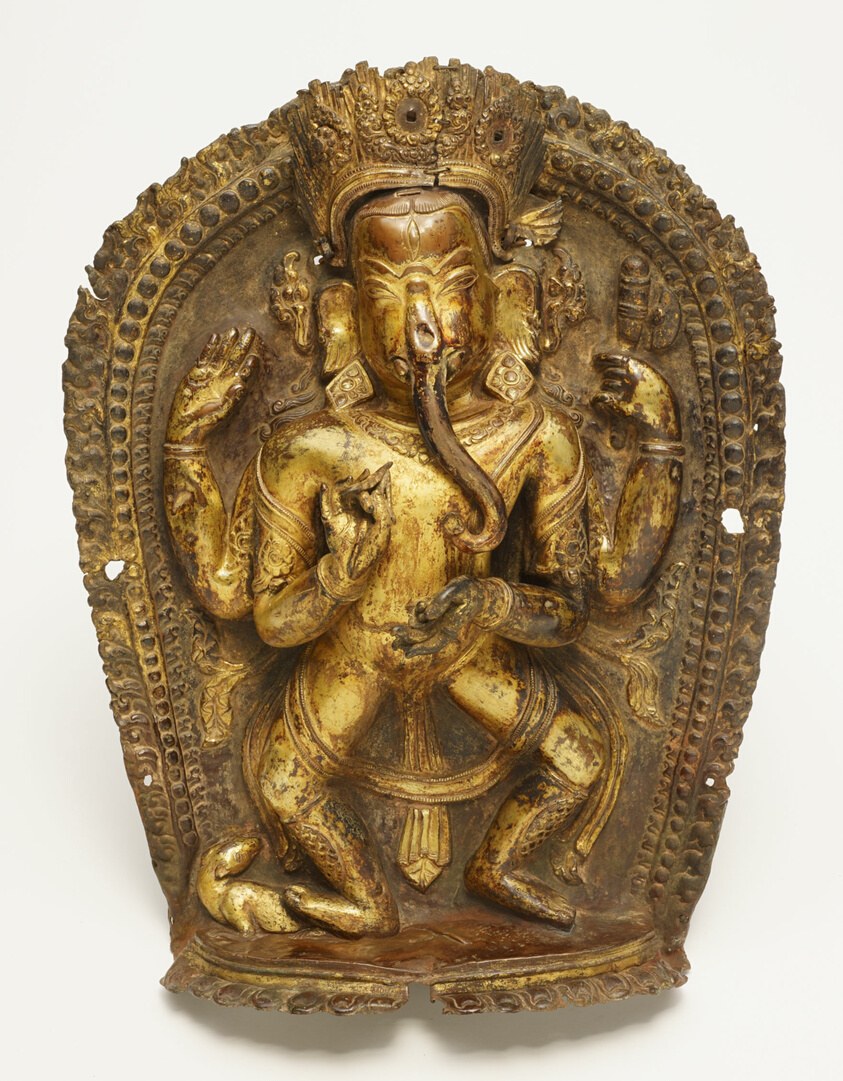
Four-Armed Dancing God Ganesha with His Rat Mount
Nepal Kathmandu Valley
- Medium:
- Gilt bronze repoussé
- Collection:
- Arts of Asia
- Source:
- Art Institute of Chicago
- Rights:
- Public domain — free to use, share and adapt.
- Recorded as:
- CC0 (Public Domain)
For dance historians, this image illustrates the deep integration of visual art and embodied ritual in Hindu and Buddhist practice. Though Ganesha himself is not shown dancing, the sculpture is evidence of how deity images functioned as centers for processional and circumambulatory movement—forms of sacred choreography that remain central to South Asian religious life.
What you are looking at
A gilt bronze relief portrait of Ganesha, the four-armed Hindu deity, shown in a frontal standing pose against an ornately carved background. The figure wears a jeweled crown and elaborate ornaments across the chest and limbs. Below Ganesha stands a small rat, his traditional mount (vahana), rendered in sharp profile. The composition is enclosed within a shaped frame of densely patterned concentric circles and decorative borders, characteristic of Nepalese metalwork. The surface shows the warm patina of aged bronze with gilt highlighting the raised surfaces, particularly visible on the deity's face, torso, and the rat.
The dancing
Ganesha stands in a balanced, frontal stance with weight distributed evenly on both feet. His four arms extend outward in a calm, beneficent pose rather than an active one—two lower arms hold attributes (possibly a rosary and modaka sweet), while the upper arms are raised in a gesture of blessing or protection. The body is full and rounded, the posture serene rather than dynamic. The rat beneath him is small and supporting, reinforcing the deity's dominance and centrality. There is no suggestion of active movement or step; this is a portrait of divine presence rather than ritual action.
The dance depicted
This is not a depiction of dance in the Western sense. However, in Hindu and Buddhist temple practice, deity images serve as focal points for ritual movement and circumambulation (pradakshina), and sculptures like this one were often processed during religious ceremonies. Ganesha is worshipped at the beginning of rituals and festivals throughout South Asia, and sculptural representations of the deity—whether static or integrated into ceremonial contexts—hold central significance in devotional practice. The posture and formal presentation suggest this relief was designed for altar veneration rather than to capture a moment of movement, though the image would have been experienced as part of dynamic ritual and processional ceremonies.
How it was made
This is a repoussé work in gilt bronze—the metal was hammered from behind to raise the design in relief, then finished and gilded. Repoussé allowed for fine surface detail and made the work luminous when lit by oil lamps or candlelight in temple settings. The technique was labour-intensive and expensive, indicating this was a prestigious commission. The shaped frame and dense patterning suggest it was designed as a temple plaque or altar attachment, meant to be viewed from directly in front and to catch and reflect light during ritual use. The gilding would have been renewed periodically as it wore.
About this work
This Nepali gilt-bronze relief of Ganesha from the early 16th century represents a sophisticated tradition of metal casting in the Kathmandu Valley. Though static in form, it is inseparable from the ritual movement and ceremonial handling that occurred around it—Hindu and Buddhist worship involved processing such images, circumambulating them, and incorporating them into embodied devotional practice. The work documents how divine presence was materially anchored in sculpture during this period, and how such anchors became nodes for movement and prayer.
How to look at it
Approach this as a portrait meant to be regarded frontally and at close range. The artist has used symmetry and frontal presentation to communicate divine calm and omniscience rather than action. Notice how the four arms create a balanced composition around the central body, and how the small rat below anchors the deity's authority. Look at the surface play of light on the gilt and the detailed patterning of the frame—these would have been more dramatic in the dim light of a temple, where the image would seem to glow. The lack of action is intentional: this is a god to be worshipped and carried, not to be seen as performing.
The artist
The work is attributed to the Kathmandu Valley metalworking tradition, which by the early 16th century was already centuries old. Nepalese bronze casting combined indigenous techniques with influences from Tibet and India, and the valley's artisans were renowned throughout South Asia. Individual artisans rarely signed works of this period; instead, pieces were commissioned by temples or wealthy patrons and executed within family or guild workshops. The high quality of this Ganesha suggests a master craftsperson, but their name is not recorded.
The period
The early 16th century was a period of intense religious patronage in the Kathmandu Valley under local Malla dynasties. Both Hindu and Buddhist communities commissioned temple art and processional objects. Ganesha worship was central to both traditions in Nepal, and images of the deity proliferated in this period as votive offerings and altar pieces. Metalwork competed with stone sculpture as the preferred medium for portable religious images, especially those meant to be carried in processions or housed in shrines. The elaborate ornamentation visible in this relief—the crown, jewelry, and detailed borders—reflects the wealth and sophistication of Kathmandu Valley patronage during the Malla period.
Where it lives
The work is held by the Art Institute of Chicago in its Arts of Asia collection, catalogued as a Nepalese gilt-bronze repoussé relief from the Kathmandu Valley, dated to 1501. It is documented as a temple or altar piece, typical of devotional metalwork commissioned for Hindu or Buddhist shrines during the Malla period.
Questions about this work
Why is Ganesha shown with four arms?
In Hindu iconography, four arms allow the deity to hold multiple symbolic attributes and gesture simultaneously—representing divine omniscience and the ability to bless, protect, and grant boons. In this relief, the arms extend in poses of benediction and hold ritual objects associated with Ganesha's role as the remover of obstacles and lord of beginnings.
What is the rat (vahana) doing?
The rat is Ganesha's traditional vehicle or mount (vahana in Sanskrit), representing the deity's dominion over the smallest of creatures and the humility required in devotion. In ritual contexts, the rat symbolizes how Ganesha can penetrate all places, no matter how hidden, to remove obstacles.
How was this object used?
As a repoussé bronze, this relief was likely mounted on a temple altar, shrine wall, or portable processional object. During festivals and ceremonies, Ganesha images were carried in processions, circumambulated by worshippers, and given offerings of flowers, incense, and food. The gilding and formal presentation suggest it held an honored position in ritual life.
Does this count as dance art?
Not in a literal sense—the figure is static and not performing movement. However, it documents how Hindu and Buddhist worship integrated visual art with embodied ritual practices: circumambulation, procession, and offering all involve choreographed movement around such images, making the sculpture a node for sacred choreography rather than a record of dance itself.
More dance artwork





