49 works in this view — arrow keys or swipe to move between them.
Dance in Art
Study for Aspects of Negro Life: The Negro in an African Setting
Aaron Douglas American, 1899-1979
- Medium:
- Gouache, with touches of graphite, on illustration board
- Collection:
- Prints and Drawings
- Source:
- Art Institute of Chicago
- Rights:
- Rights reserved by the holding institution — do not reuse without permission. Source record ↗
- Recorded as:
- AIC — rights reserved
For dance historians, this work documents how African American artists of the Harlem Renaissance conceived of African dance and ritual in the 1930s—not as quaint anthropological object but as the living cultural heritage of a diaspora community. Douglas's modernist treatment of communal dance and music-making asserts the formal and aesthetic value of African cultural practices at a time when they were actively denigrated or exoticized in mainstream American culture. The image shows how visual artists engaged with questions of representation, authenticity, and cultural identity that were equally urgent in the dance world of the period.
What you are looking at
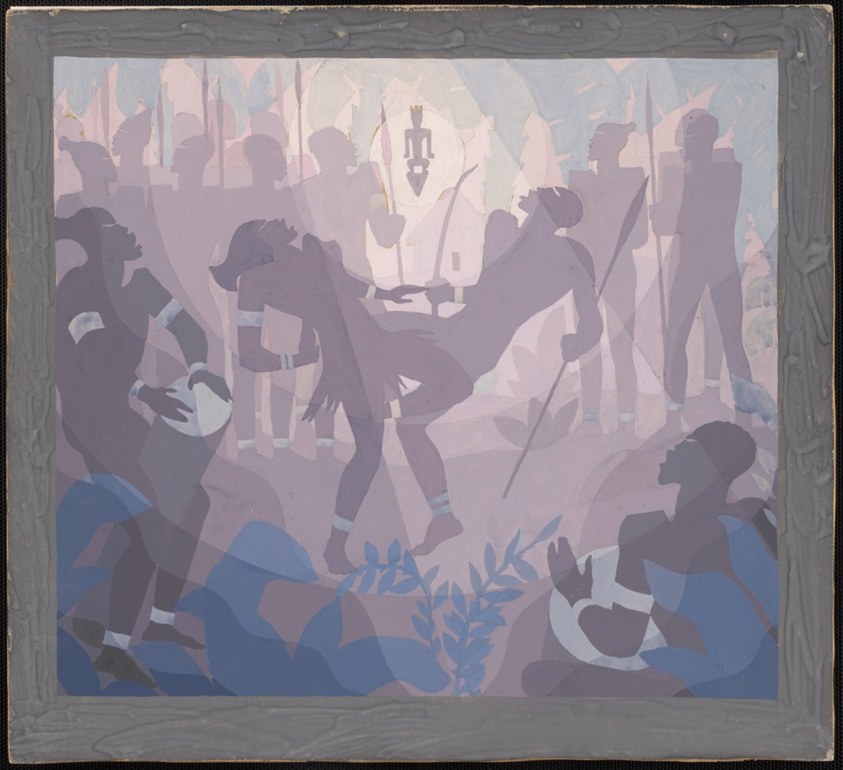
A silhouetted tableau of figures dancing and playing music in what appears to be a ceremonial or social gathering in an African setting. The composition is dominated by layered, translucent purple and lavender tones creating depth and atmosphere. In the foreground, figures seated at ground level wear blue garments and appear to be playing instruments or participating in the gathering. The middle ground shows standing figures in dynamic poses—some with arms raised, bodies twisting, suggesting active dance movement. A central figure hangs or swings from what may be a rope or vine, suspended above the others. The background is filled with tall, slender vertical forms suggesting either trees, posts, or architectural elements of a village or settlement. A white crescent or architectural element hovers in the upper center. The entire scene is rendered in a modernist silhouette style with minimal internal detail, emphasizing shape and movement over anatomical specificity. Light filters through the composition from above, creating an ethereal, dreamlike quality.
The dancing
The dancers display a range of vertical and diagonal orientations suggesting continuous movement rather than a posed moment. Several figures have arms extended upward or outward in gestures of exuberance or ritual expression. At least one figure appears to be in an inverted or acrobatic position—swinging or suspended—which is relatively uncommon in formal dance documentation. The ground-level figures seem to be in a different spatial and social relationship to the standing dancers, possibly musicians or participants in a different role. The bodies are rendered as flat silhouettes without articulation of individual limbs, making it difficult to determine precise footwork or hold patterns, but the overall silhouettes suggest upright, vertical carriage and dynamic weight shifts.
The dance depicted
This work depicts what appears to be a generalized African ceremonial or celebratory gathering rather than a specific identifiable dance form. The title indicates an 'African setting,' and the artist seems to have been evoking a sense of cultural celebration, community, and spiritual or social ritual rather than documenting a particular style. The presence of musicians at ground level, the variety of body positions, and the apparently sacred or ceremonial quality of the moment suggest this may represent collective participation in ritual music and dance rather than a choreographed entertainment form. The modernist rendering makes specific identification of regional or ethnic dance practices impossible from visual evidence alone.
How it was made
This is gouache with graphite on illustration board, a semi-transparent medium that allowed Douglas to build up layered washes of color to create atmospheric depth and the characteristic silhouette effect. The technique of layering translucent purple, lavender, and blue tones creates visual complexity while maintaining stark figure-ground separation. Gouache on board was common for commercial illustration and graphic design in the 1930s, and the work's scale and finish suggest it may have been created as a preparatory study or independent artwork in Douglas's commercial practice. The medium's opacity allows for the subtle gradations in tone that give the scene its dreamlike, nocturnal or interior quality.
About this work
This is a study for Douglas's larger mural or series work 'Aspects of Negro Life,' executed in 1934. It represents the artist's sustained engagement with African American cultural identity and heritage at a moment when such work was rare in American fine art. Douglas was a pioneer of the Harlem Renaissance visual style—a synthesis of modernist design principles with African American subject matter and aesthetic traditions. This particular study translates the social and ceremonial aspects of African life into a modernist visual language of silhouette, layered transparency, and geometric form, avoiding both ethnographic literalism and primitivist cliché. The work stands at the intersection of fine art, design, and social documentation, reflecting both artistic innovation and the political project of cultural affirmation.
How to look at it
Attend to the spatial relationships in the composition: the figures at ground level playing instruments occupy a different plane from the standing and dancing figures above them, suggesting a social and spiritual hierarchy or division of roles. Notice how Douglas uses transparency and layering rather than line to define the figures—the silhouettes are not simply black shapes but are built from overlapping washes of purple and blue, which creates a sense of motion and ambiguity. The suspended or swinging figure in the center is the focal point; look at how it breaks the vertical orientation of most of the other figures, introducing diagonal energy and suggesting a moment of ecstatic or uninhibited movement. The overall composition moves from the architectural/environmental frame (the vertical lines suggesting village or forest) inward toward the human figures, making the people rather than the landscape the subject.
The artist
Aaron Douglas (1899–1979) was a visual artist, graphic designer, and educator who became a central figure in the Harlem Renaissance. Though best known for his graphic design and illustration work in Crisis and Opportunity magazines, Douglas also created major mural and easel works addressing African American history and experience. He developed a distinctive visual language combining Art Deco geometric forms, silhouette, and subtle color modulation, often with African motifs and themes. Douglas taught at Fisk University and elsewhere, and his work bridged commercial design and fine art in ways that challenged hierarchies between them. His sustained engagement with African and African American visual culture was rare among American artists of his generation and reflected both aesthetic innovation and political commitment.
The period
The early 1930s were a peak period for the Harlem Renaissance, though the movement was beginning to fragment amid the economic devastation of the Great Depression. In visual art, Douglas and his peers were actively creating work that asserted African American cultural value and aesthetic sophistication. In dance, this was the era of the early modern dance revolution—Martha Graham, Lester Horton, and others were beginning to create concert dance outside the ballet tradition. Significantly, some modern dancers of the period were also exploring African and African diaspora movement vocabularies, though often through a lens of primitivism or exoticism. Douglas's approach was more historically and culturally grounded, representing a parallel effort in the visual arts to reclaim and dignify African cultural forms.
Where it lives
This work is held in the Prints and Drawings collection of the Art Institute of Chicago. It is catalogued as a study, suggesting it may have been preparatory to a larger work, though the specific mural or final composition it preceded is not identified in the available record.
Dance in this work
Questions about this work
Is this depicting a real African dance or a fictional one?
The title 'The Negro in an African Setting' suggests Douglas was evoking a generalized African cultural scene rather than documenting a specific dance form. The modernist silhouette style makes precise identification of regional practices impossible. Douglas was working from imagination, cultural knowledge, and modernist aesthetic principles rather than ethnographic observation, which was typical of Harlem Renaissance artists' approach to African themes.
Why are some figures on the ground and others standing?
The composition appears to show musicians or participants at ground level and standing dancers above them, suggesting a ceremonial or social gathering where different participants had different roles. This spatial arrangement was common in depictions of African communal gatherings and may reflect actual social practice, though Douglas's modernist treatment makes it difficult to determine whether this is based on observation or aesthetic choice.
What does the suspended figure represent?
The inverted or swinging figure at the center may represent ecstatic movement, ritual acrobatics, or spiritual elevation—a moment of transcendence or uninhibited celebration. Its central position and dynamic pose make it the focal point of the composition, suggesting its importance to Douglas's conception of the scene.
Why did Douglas use silhouettes instead of detailed figures?
Silhouette was a key formal strategy of Art Deco design and modernism generally, which Douglas helped adapt for African American subjects. The technique simplified form and emphasized dynamic outline, allowed for subtle color modulation through transparency, and created a sense of timelessness and universality—making the figures archetypal rather than individualized.
More dance artwork





