49 works in this view — arrow keys or swipe to move between them.
Dance in Art
Daniel-Henry Kahnweiler
Pablo Picasso Spanish, active France, 1881–1973
- Medium:
- Oil on canvas
- Collection:
- Modern Art
- Source:
- Art Institute of Chicago
- Rights:
- Rights reserved by the holding institution — do not reuse without permission. Source record ↗
- Recorded as:
- AIC — rights reserved
This is not a work about dance, but about the modernist reimagining of the human body as a subject. It stands in the collection as an example of how visual modernism and choreographic modernism shared an impulse to break down inherited conventions of how bodies are seen and represented—a parallel rather than a direct influence.
What you are looking at
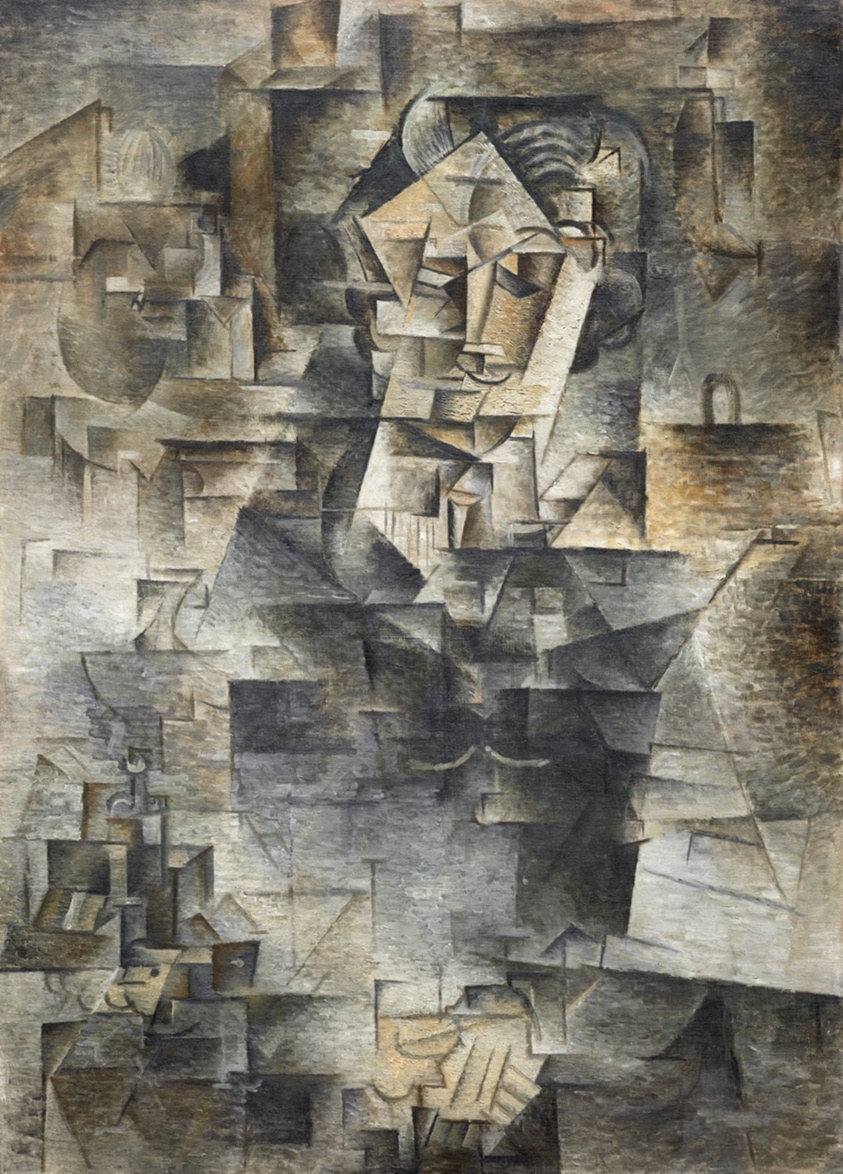
This is a cubist portrait of a figure rendered in ochres, grays, and blacks, composed of fragmented geometric planes that construct a head, shoulders, and torso from angular, intersecting facets. The figure sits or reclines, depicted from a viewpoint that simultaneously suggests frontality and profile; the face is assembled from sharp-edged triangular and rectangular forms that locate two eyes, a nose, and mouth without mimicking naturalistic anatomy. The entire composition is densely packed, with no empty ground—every inch of the canvas is occupied by overlapping planes that suggest drapery, clothing, or the sculptural surfaces of the body itself. The color palette is subdued and earthy, with warm ochres playing against cool grays and deep blacks, creating a sense of volumetric solidity despite the fractured, non-illusionistic construction. The work embodies the Analytic Cubism of the early 1910s, where form is deconstructed into its essential geometric components and reassembled according to the logic of multiple simultaneous viewpoints rather than optical appearance.
The dancing
A single seated or partially reclining figure dominates the composition. The body is constructed entirely through faceted planes—there is no continuous contour line, no unified flesh tone, no traditional modeling through light and shadow. What might be the sitter's hands, arms, or torso appear as interlocking geometric forms; the weight of the body seems distributed across the angular planes rather than suspended from a skeleton. The posture suggests repose or contemplation rather than action; there is no sense of movement, gesture, or muscular engagement. The absence of recognizable dance-related attributes—no pointed feet, no leap, no partnering—indicates this is a portrait rather than a choreographic study.
The dance depicted
This work does not depict dance. It is a portrait of a person (the art dealer and Picasso patron Daniel-Henry Kahnweiler, according to the catalogue), not a representation of dancers or dance movement. The figure is static and introspective, not in motion or in a recognized dance posture. The work's significance lies entirely within the history of modernist visual art—specifically, the development of Cubism—rather than in the iconography of dance.
How it was made
Oil on canvas. The painting employs the technique of Analytic Cubism, in which form is systematically fractured into small, tightly interlocking planes of muted color. Picasso builds the figure through layered applications of paint that reveal and conceal form simultaneously; the viewer must work to assemble the image into a coherent likeness, engaging actively rather than passively consuming representation. The technique was labor-intensive and required sustained looking from both artist and viewer, marking a fundamental shift in what painting could claim to show about reality and perception.
About this work
This is a portrait in oil by Pablo Picasso, dated 1910, of the art dealer Daniel-Henry Kahnweiler. It belongs to the Analytic Cubism movement and is one of the foundational works of modernist abstraction. The figure is rendered entirely through geometric fragmentation, with no reliance on anatomical proportion, continuous contour, or illusionistic space. It is a work of visual art history, not dance history, and appears in a gallery of dance in art only if the collection aims to document modernism's impact on how the body was represented—a sideways relationship rather than a direct one.
The work is significant for art history as a demonstration of how early-twentieth-century artists began to deconstruct the human form in response to new theories of perception and representation. For a dance-focused viewer, its interest would lie in understanding how the Cubist fragmentation of the body influenced later choreographic thinking about how movement could be constructed and perceived.
How to look at it
Look first at the eyes: locate them within the fragmented planes, noting that they do not sit symmetrically or occupy the space where optical naturalism would place them. Then trace the edges where one plane meets another—these fractures do not follow anatomical boundaries but cut across the figure arbitrarily, forcing the viewer to actively reconstruct the head and shoulders from parts. Notice the color shifts within adjacent planes; warm ochre can sit next to cool gray with no transitional modeling, yet the spatial illusion of depth persists through the geometry alone. This is not a portrait that reveals itself at a glance; it asks the viewer to labor, much as a Cubist sculpture asks the hand to move around its form.
The artist
Pablo Picasso (1881–1973) was a Spanish painter and sculptor active primarily in France, where he co-founded Cubism with Georges Braque around 1907–1908. By 1910, when this portrait was painted, Picasso was already the leading figure in the movement. Kahnweiler was his primary dealer and champion, and Picasso created several portraits of him during this period. Picasso's practice in these years was dedicated to dismantling the Western illusionistic tradition and rebuilding painting on new principles of multiple viewpoints, geometric abstraction, and the assertion of the canvas as a surface rather than a window. Dance would later engage with Cubism's innovations—notably in the Ballets Russes—but this portrait predates any direct choreographic response.
The period
In 1910, Cubism was only two or three years old and still radical. Picasso and Braque were working through the implications of breaking down illusionistic space and anatomical proportion. Simultaneously, the Ballets Russes (founded 1909) was beginning to introduce modernist aesthetic principles to dance through Fokine's reforms and Nijinsky's revolutionary choreography, though a direct dialogue between Cubist painting and avant-garde dance would not fully develop until the 1920s. In the broader context of early-modernism, both art forms were engaged in deconstructing nineteenth-century conventions of representation and movement.
Where it lives
The work is held in the collection of the Art Institute of Chicago, where it is catalogued as part of the Modern Art collection. This is a major institutional holding and one of several Cubist portraits Picasso painted of Kahnweiler; the most famous version is in a German collection. The AIC version is a crucial document of early Analytic Cubism in an American public museum.
Questions about this work
Why is this in a dance gallery if it's not a dance painting?
It appears here because dance history in the twentieth century cannot be understood without reference to modernist visual art. Choreographers and dancers engaged directly with Cubism, Futurism, and Constructivism to reimagine how bodies could be seen and moved. This portrait is included as a document of the modernist visual vocabulary that dance borrowed and adapted—a foundational text for understanding the aesthetic revolutions of the 1910s–1920s across multiple art forms.
Can you identify which features belong to the sitter's face?
Yes, with effort. The two eyes can be located in the upper portion of the canvas; a nose and mouth appear below them, though fragmented and distributed across multiple planes. The head tilts slightly; the jaw and chin are suggested by the lower contours of the composition. But Picasso's method is precisely to refuse the comfortable unity of the face-as-mask, forcing the viewer to assemble identity from fragments rather than receive it as a seamless whole.
Is this Analytic or Synthetic Cubism?
Analytic. The work is densely fragmented, monochromatic (within a narrow earth-tone palette), and concerned with the systematic deconstruction of form through small, tightly interlocking planes. It predates the collage and flatter compositions of Synthetic Cubism (which emerged around 1912).
More dance artwork





