49 works in this view — arrow keys or swipe to move between them.
Dance in Art
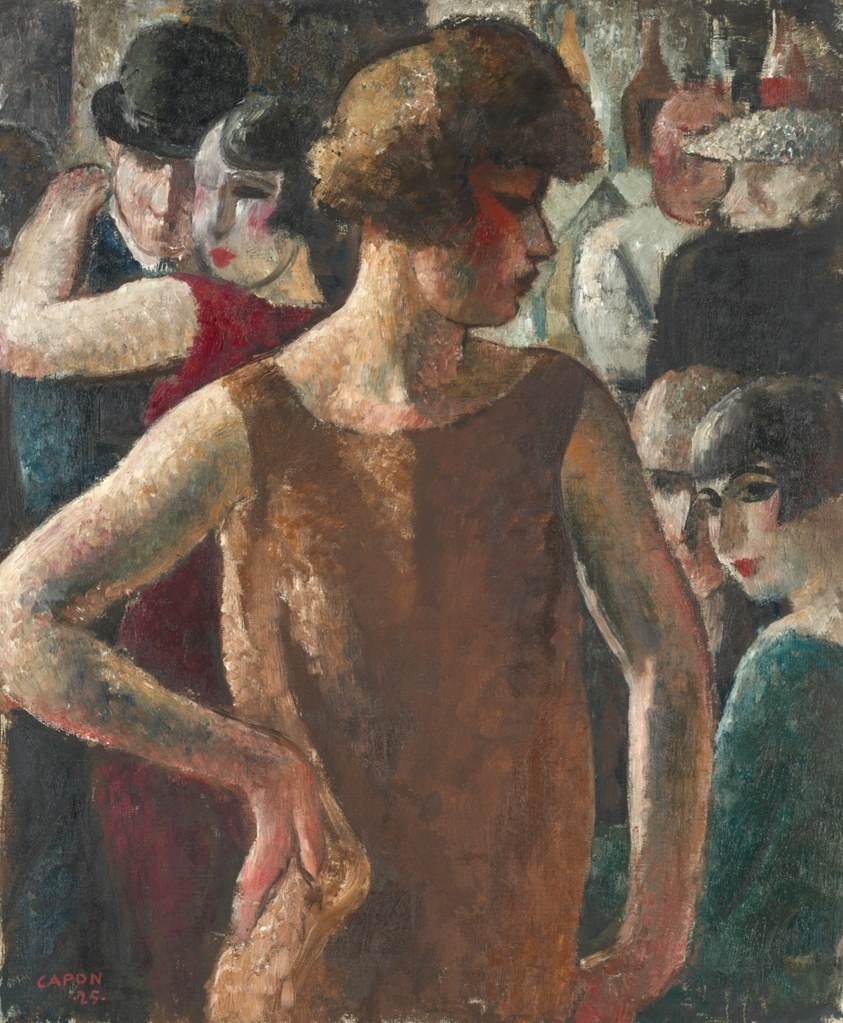
La Java
Georges Emile Capon French, 1890-1980
- Medium:
- Oil on canvas
- Collection:
- Modern Art
- Source:
- Art Institute of Chicago
- Rights:
- Rights reserved by the holding institution — do not reuse without permission. Source record ↗
- Recorded as:
- AIC — rights reserved
This is one of the few visual documents of the java from the period of its greatest currency, before it became a nostalgic or theatrical reference. For dance historians and social historians, it is primary evidence of how the dance looked when danced by ordinary people in its native context. For artists, it demonstrates how a modernist painter with no stake in ballet or theatrical spectacle could find his subject—and genuine visual interest—in the unvarnished observation of popular dance.
What you are looking at
A crowded interior scene depicting social dancers in what appears to be an early twentieth-century Parisian cabaret or dance hall. The composition is dense and layered, with figures arranged in loose groupings across the canvas. In the foreground, a woman in a brown sleeveless dress faces left in profile, her posture relaxed and observant. Behind and around her, other figures engage in conversation and dance—a man in dark clothing leans toward her, while further back, figures in various states of movement and interaction populate the space. The lighting is warm and muted, with ochre and brown tones dominating, creating an atmosphere of intimate conviviality. The brushwork is loose and gestural, with visible paint texture that suggests movement and spontaneity. The overall effect is one of observed social activity rather than formal performance: this is not a stage, but the floor of a working dance venue.
The dancing
The bodies are painted with an impressionistic economy that prioritizes mood over anatomical precision. The foreground woman stands with a natural, upright posture, her arms at rest; her head tilts slightly as though listening or observing. The male figure beside her leans in with a casual intimacy typical of social dance partner interaction. Other figures in the background are rendered more summarily, their limbs and torsos suggested rather than defined, creating a sense of movement and overlap. There is no formal closed hold or ballroom frame visible; the dancers relate to one another through proximity and casual engagement rather than structured partnership.
The dance depicted
This is a depiction of la java (the Java or Jova), a popular French social dance that emerged in Parisian working-class and bohemian venues in the early 1900s. The java was an informal, sensual waltz-derivative danced in cabarets, dance halls, and street festivals, performed by couples in close proximity with a characteristic sideways sway and shuffle. The painting captures the informal, improvisational character of the dance as it was actually performed in such venues—not as a theatrical spectacle but as participatory social entertainment. The loose, unstructured composition and the mixture of dancers and observers reflects the java's role as a social dance woven into the fabric of nightlife.
How it was made
Oil on canvas, executed with loose, gestural brushwork and warm, earthy palette. The painter worked wet-on-wet in places, allowing colors to merge and suggest form rather than define it sharply. This technique was well suited to capturing the fleeting atmosphere of a crowded, dimly lit interior and the informal movement of social dancers. The impressionistic handling suggests the painting was made either from direct observation or from sketches made in such venues, rather than from studio reconstruction.
About this work
Capon has painted a moment of observed social life in a Parisian dance venue, circa 1925. The work documents the java at a specific historical moment—after its initial emergence in working-class culture but before it had been codified or theatricalized. Unlike formal ballet or staged dance art, this is a record of vernacular social dance as practiced by the people who danced it, in the spaces where it lived. The painting belongs in a dance gallery precisely because it captures not the aestheticized or idealized version of the dance, but the actual social and physical reality of how bodies moved together in the early twentieth-century city.
How to look at it
Notice the informality of the pose and positioning. The foreground figure is not arranged for display but simply present, as if the painter observed her in a moment of pause or listening. Look at how the other figures are suggested rather than fully rendered—a hand here, a profile there—creating the sense of a crowded, dimly lit space where not every detail is equally visible. The warm, muted palette unifies the crowd and emphasizes atmosphere over individual clarity. This is a painting that asks you to reconstruct the social situation from partial views and atmospheric suggestion, much as you would perceive such a space if you were actually there.
The artist
Georges Emile Capon (1890–1980) was a French painter whose career spanned the twentieth century. He worked in a post-Impressionist idiom, with a particular interest in scenes of modern urban life, theater, and entertainment. Capon was part of the Paris art world during a period when artists were increasingly turning to subjects drawn from popular culture—music halls, cabarets, street life—rather than classical or literary themes. His approach was observational rather than romantic; he painted what he saw in the venues of contemporary Paris.
The period
The java emerged in Paris in the first decade of the 1900s, born in working-class and bohemian districts. By the 1920s, when Capon painted this work, the java was at the height of its popularity as a social dance, though it was beginning to acquire a nostalgic or quaint quality as other dances (Charleston, foxtrot, modern jazz-inflected styles) gained ground. In the visual arts, the 1920s were a moment of intense interest in capturing modern life—Cubism, Dada, and early Surrealism were all interrogating representation and subject matter. Capon's work represents a quieter, more descriptive strand of modernism: the careful observation of how people actually moved and socialized in contemporary urban spaces.
Where it lives
The work is held in the collection of the Art Institute of Chicago, catalogued as belonging to its Modern Art holdings. This identifies it as a twentieth-century European work acquired into a major North American institutional collection, likely during the mid-twentieth century when American museums were actively acquiring European modernist works.
Questions about this work
What is the java and why was it important?
The java (or jova) was a French social dance that emerged in Paris in the early 1900s, danced in cabarets and working-class venues. It was a close-couple dance with a characteristic sway and shuffle, performed to popular music. By the 1920s it was a staple of Parisian nightlife, representing a form of sensual, informal social dancing that contrasted with both the formal precision of ballroom dance and the theatrical spectacle of staged performance.
Is this a portrait of a specific moment or a general scene?
It is a composed scene rather than a documentary record of a specific evening, but it is built from the painter's direct observation of how such venues looked and how people moved in them. Capon was painting the type and the atmosphere rather than a particular identifiable occasion.
Why did early twentieth-century painters become interested in dance halls and cabarets?
Modernist artists saw in such venues the visual and social energy of modern urban life—crowds, artificial light, music, movement, and the mixing of different social classes. Dance halls were also sites where conventional social hierarchies were loosened and where people experimented with new forms of bodily expression. For painters, they offered rich, complex compositions and the challenge of capturing movement and atmosphere.
More dance artwork





