49 works in this view — arrow keys or swipe to move between them.
Dance in Art
The Dance
Pietro Longhi (Italian, 1702–1785)
- Medium:
- Oil on canvas
- Collection:
- Painting and Sculpture of Europe
- Source:
- Art Institute of Chicago
- Rights:
- Public domain — free to use, share and adapt.
- Recorded as:
- CC0 (Public Domain)
This painting documents the lived experience of street and domestic entertainment in 18th-century Venice, showing the music and performance that formed the backdrop to social dancing and cultural life. Understanding these moments of informal performance helps historians situate dance within the full range of bodily practices and entertainment that shaped dance culture. Longhi's work is valuable precisely because it treats such quotidian scenes with the visual care usually reserved for grander subjects, asserting that the observation of ordinary life and movement has artistic and historical significance.
What you are looking at
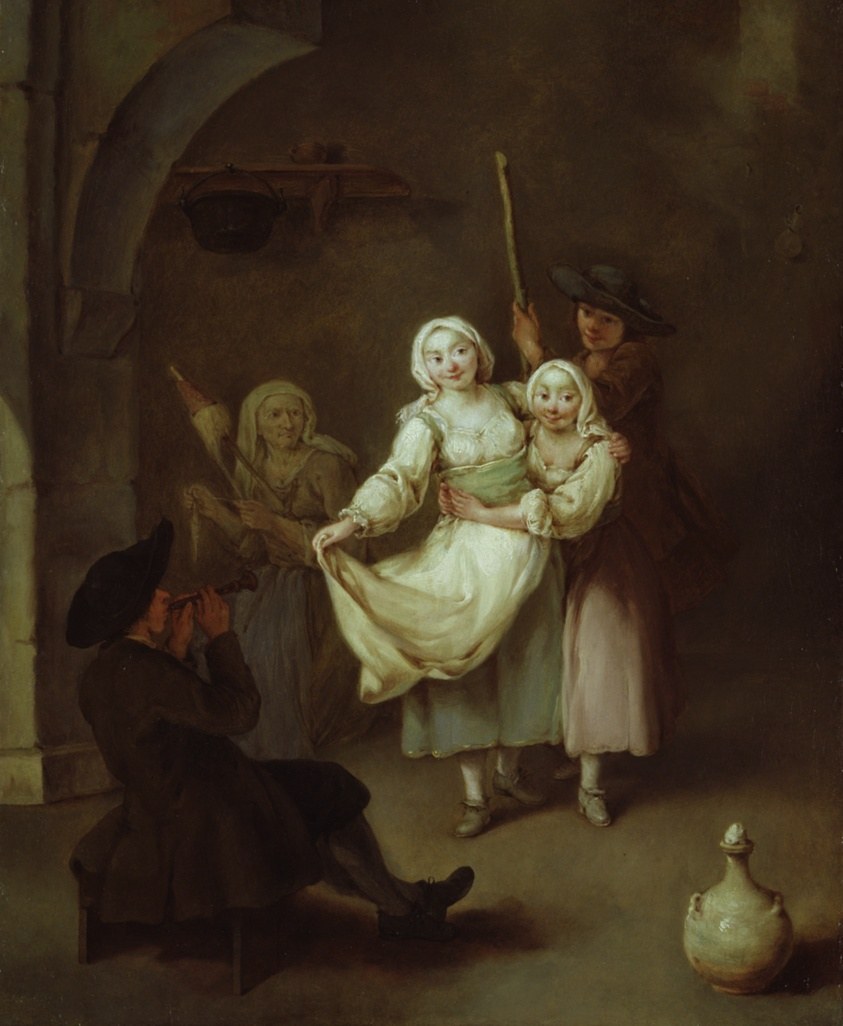
A domestic interior scene bathed in warm, diffused light from the left. A young woman in a white linen cap and pale green skirt stands at the center, attended by two children in matching white caps and simple dress. She gestures toward a crouching figure in dark clothing on the left—a man or older servant in a hat, whose posture and positioning suggest he is playing music or performing for the group. An older woman in a gray headscarf watches from the shadowed background. The setting appears to be a modest room with arched stonework visible at the top; a ceramic vessel sits on the floor in the foreground. The composition suggests a moment of entertainment or musical performance for the children, with the central woman as the focal point of attention.
The dancing
The central woman's weight appears to shift slightly to one side, her body angled toward the crouching performer. Her arms are loosely held, one hand extended as if gesturing or pointing. The two children flank her closely, their bodies turned toward the action. The crouching man on the left has his torso bent forward, knees bent, suggesting he is in the act of playing an instrument (likely bagpipes, given the shape and his posture) rather than dancing. His gaze is directed downward toward his instrument. The overall frame is vertical and frontal, emphasizing the watch-like stillness of the moment rather than the dynamic extension of movement.
The dance depicted
This image does not depict dance as active movement, but rather a musical or folk entertainment performance. The crouching figure appears to be a bagpiper or street musician playing for the assembled group—a common form of domestic or street entertainment in 18th-century Venice and Southern Europe. If any movement is implied, it would be the gentle swaying or informal gesturing that might accompany listening to folk music rather than formal dance. The woman and children are audience participants, not dancers. This is a scene of musical performance and social entertainment rather than a choreographed dance.
How it was made
Oil on canvas. The technique employs careful light modeling, with a concentrated warm light source from the left that creates soft shadows and volumetric definition. The palette is muted—creams, grays, browns, and earth tones—which was characteristic of Longhi's style. The visible brushwork is restrained; forms are suggested rather than minutely detailed, and the composition relies on tonal gradation to create spatial depth and atmospheric effect. This technique allowed for portable easel paintings suited to private collectors, marking a significant shift from large-scale religious or historical commissions.
About this work
This is an 18th-century Venetian genre painting by Pietro Longhi depicting a moment of folk entertainment in a modest domestic setting. A bagpiper performs for a young woman and two children while an older attendant watches from the background. Rather than representing formal dance, the work documents the social practice of street or domestic musical performance—a common subject in Longhi's oeuvre. The painting records a fleeting, ordinary moment of social life with the restraint and observational precision characteristic of Venetian rococo genre painting.
Longhi's work sits at the intersection of documentary social observation and refined artistic practice. By elevating scenes of everyday life to the status of serious painting, he helped establish genre painting as a legitimate subject for collectors and viewers accustomed to history painting or portraiture. This work belongs in a dance history collection not because it depicts dance, but because it illuminates the broader landscape of movement, music, and entertainment practices in 18th-century urban life—contexts in which dance occurred and from which dancers drew vocabulary and social meaning.
How to look at it
Attend first to the direction of gazes: the children and woman look toward the performer; the performer looks down at his instrument. This creates a clear social geometry of attention and entertainment. Note the stillness of the moment—this is not a snapshot of rapid movement but a held pose, much like a theatrical tableau. The crouching posture and bent knees of the musician are characteristic of how street performers held their bodies and instruments. Observe the light: it arrives from the left and models the white fabric of the woman's dress and cap, drawing the eye to her as the focal point, while the musician remains partially shadowed. The composition suggests a moment chosen for its quiet social significance rather than dramatic action.
The artist
Pietro Longhi (1702–1785) was a Venetian painter who specialized in rococo genre scenes depicting the leisure activities, social rituals, and entertainment of the urban middle and upper classes. He worked primarily for private collectors and the Venetian market, producing small-scale paintings on canvas and wood panels that documented contemporary Venetian life with wit and careful observation. His subjects include masked balls, domestic music-making, gambling, courtship, and street entertainment. Though trained in history painting, Longhi found his distinctive voice and market success in genre; his work established a mode of social realism that anticipated later European developments in the novel and in painting. He recorded a world that was rapidly changing—the last decades of the Venetian Republic—with sympathetic attention to social detail and human behavior.
The period
In the mid-18th century, Venice was experiencing cultural and economic transformation. The rigid hierarchies of earlier aristocratic society were loosening; a merchant and professional class with disposable income created new markets for intimate, easel-scale paintings that documented contemporary life rather than timeless subjects. In dance specifically, this was the era of the minuet's dominance in aristocratic contexts, but also of thriving folk and street entertainment, carnival culture, and the beginnings of theatrical dance reform. Longhi's paintings sit at the intersection of these worlds—recording both the formal social practices of the leisure classes and the street entertainment that coexisted with them. The rococo aesthetic, with its emphasis on intimacy, observation, and pleasure in domestic life, was perfectly suited to this social moment.
Where it lives
The work is held by the Art Institute of Chicago in its collection of European painting and sculpture. Longhi's genre paintings were highly successful in his lifetime and after; they entered major European and American collections in the 18th and 19th centuries and remain central to understanding Venetian rococo practice and 18th-century social life.
Questions about this work
Is this a dance painting?
Not in the strict sense—no choreographed dance is being performed. However, it documents the broader landscape of music, entertainment, and bodily practice within which 18th-century social dance occurred. For dance historians, it provides context for understanding how dance fit into the social and domestic world.
What is the man on the left doing?
He appears to be playing a bagpipe or similar folk instrument. His crouched posture and downward gaze are consistent with musicians performing street or domestic entertainment. He is not dancing; the woman and children are the audience.
Why does Longhi paint these ordinary scenes?
Longhi helped establish genre painting—the artistic representation of everyday life—as a legitimate subject worthy of serious pictorial treatment. By depicting the social rituals, entertainments, and domestic moments of contemporary Venice with care and precision, he asserted that observation of ordinary life has artistic and cultural value.
What does the setting tell us?
The modest interior, simple dress, and stone architecture suggest a middle-class or working-class domestic space rather than a palace. This is not a scene of aristocratic leisure but of street entertainment in an everyday room—documenting how entertainment and music circulated through urban society.
More dance artwork





