49 works in this view — arrow keys or swipe to move between them.
Dance in Art
Dance Staff
Baule Côte d'Ivoire Coastal West Africa
- Medium:
- Wood, kaolin, and pigment
- Collection:
- Arts of Africa
- Source:
- Art Institute of Chicago
- Rights:
- Rights reserved by the holding institution — do not reuse without permission. Source record ↗
- Recorded as:
- AIC — rights reserved
Most dance documentation focuses on the moving body. This object reminds us that African dance frequently employed carved presences as active partners in performance—handled, manipulated, and danced alongside the human performer. Understanding how such staffs were held and moved is essential to reconstructing what these ceremonies looked like and what they meant to the Baule community.
What you are looking at
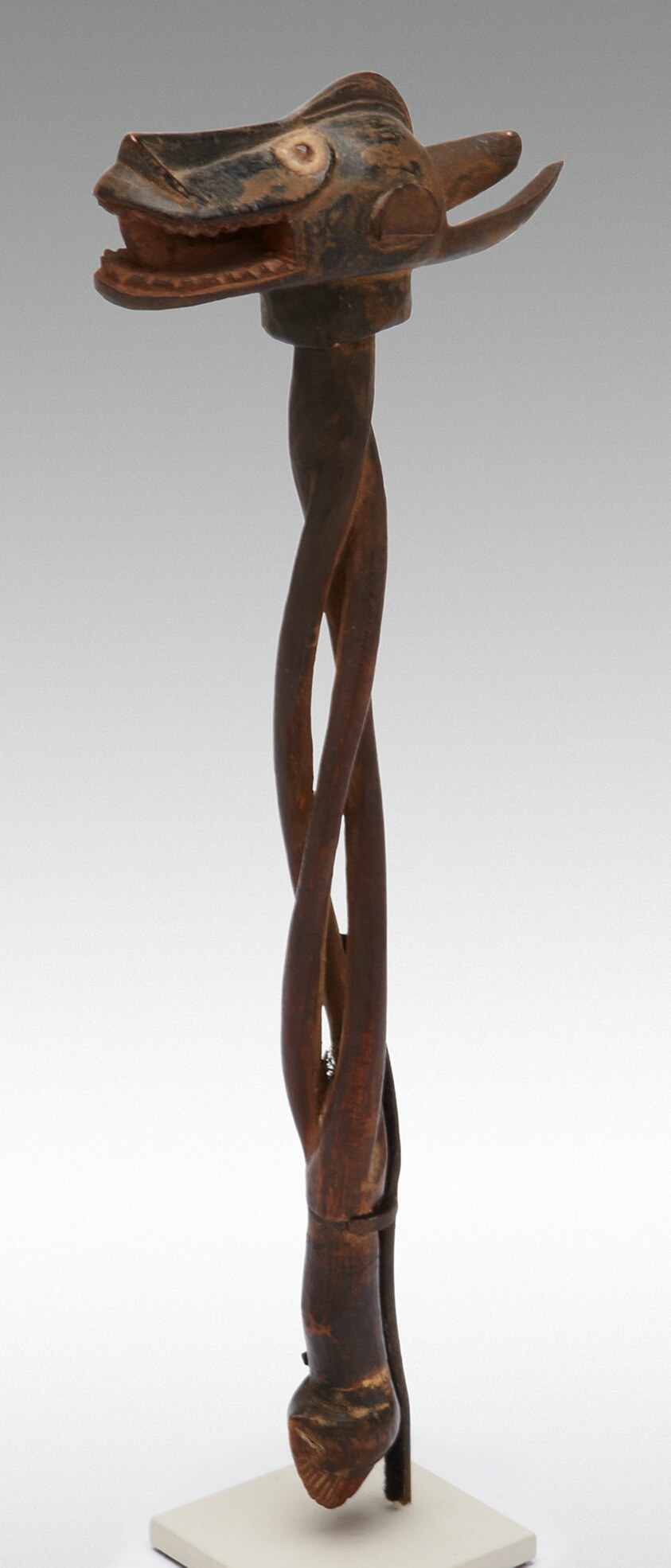
A wooden staff carved with an animal head at the top dominates this vertical composition. The head, rendered in dark wood with kaolin and pigment details, depicts a horned creature with an open mouth and a distinctive eye marked in white. The head tilts forward expressively, its curved horn extending upward and backward. Below the carved head, the staff tapers gradually, carved from a single piece and showing the warm patina of aged wood. The lower section splits into two curved elements that splay outward slightly, suggesting either functional grips or a stylized base. The entire object is spare and elegant, its power concentrated in the expressive head and the strong vertical line of the shaft.
The dancing
This is not a representation of human dancers but an object used in dance. The carved head itself displays dynamic gesture: the forward tilt of the muzzle, the open mouth, and the alert eye position suggest alertness and movement. The splitting of the shaft below creates a sense of openness and spread, as if the object were active in space rather than static.
The dance depicted
This is a Baule dance staff (likely called a *gblin* or similar in Baule language), a ceremonial object carried and manipulated during masked dances and other ritual performances among the Baule people of Côte d'Ivoire. Such staffs were wielded by dancers and leaders within dance processions, their carved heads serving to embody spiritual presences, animal powers, or ancestral forces. The staff would have been held aloft, rotated, and gestured through space as part of the dancer's vocabulary, making it an extension of the body and an active participant in the dance rather than a mere prop. The Baule used such objects in contexts including initiation ceremonies, funeral rites, and seasonal celebrations where dance, sculpture, and performance merged into unified ritual experience.
How it was made
The staff is carved from a single piece of wood, with the head carved three-dimensionally and the shaft shaped from the same material. White kaolin pigment highlights the eye and possibly other facial features, while darker stains from use and age mark the surface. This technique—subtractive carving combined with applied pigment—was standard in West African sculptural practice and allowed for both formal elegance and the accumulation of ceremonial patina over time. The object shows no signs of industrial production; it is the work of a trained hand carver, likely commissioned for use rather than trade.
About this work
A Baule dance staff from 19th-century Côte d'Ivoire, carved with an alert, horned head and a tapering wooden shaft. The object embodies the Baule principle of uniting sculpture and movement: the staff was not merely carried but actively danced, its expressive head serving as a material anchor for spiritual or animal presence. The carving style—restrained, volumetric, with attention to the profile—is consistent with Baule aesthetic principles of the 1870s–1880s. This is a functional ritual object that also stands as sculpture; it belongs in dance history because it was an integral part of the dancer's body and gesture, not separate from it.
How to look at it
Approach this object by imagining it in motion. Notice how the head's forward tilt and alert expression suggest the moment just before or during action—the staff is not inert but seems poised to turn or rise. Look at the eye: the white kaolin circle gives it intensity and presence even in stillness. Hold your own arm up and imagine rotating the shaft slowly; feel how the head's weight would affect the movement, how its horns would cut through space. The split base is worth considering too—it may have been designed to rest against the dancer's body, or to create visual drama when lifted. The object demonstrates that in Baule performance, sculptural form and bodily motion were inseparable.
The artist
Baule carvers of the 19th century were specialized craftspeople whose training began in childhood. The name of this staff's carver is not recorded, as was typical for functional objects made within the Baule carving tradition. However, the confident handling of form, the anatomical precision of the head, and the balanced proportions suggest a maker of considerable skill. Baule carvers worked within a shared aesthetic vocabulary but developed recognizable individual hands; this piece shows the hallmarks of a mature practitioner working in the mid-to-late 19th century.
The period
The late 19th century was a period of intensive European colonial activity in West Africa. The Baule had established themselves in central Côte d'Ivoire by the 1770s and developed a sophisticated tradition of sculptural production that fed both local ritual use and, increasingly, European collecting. The date of 1875 places this staff in the early colonial period, when many such objects entered European collections. In terms of Baule performance practice, the 19th century was when masked dance traditions and staff-based ceremonies were at their full elaboration, before significant disruptions from colonialism and Christian missionary activity began to transform ritual life.
Where it lives
This staff is part of the Arts of Africa collection at the Art Institute of Chicago, where it is catalogued with minimal documentation. The staff likely entered Western collecting through purchase or acquisition during the early colonial period, a time when many Baule objects were leaving their original contexts. Its presence in an American museum reflects the dispersal of African material culture that began in earnest in the late 19th century.
Dance in this work
Questions about this work
How was this staff actually used in dance?
Baule dance staffs were held upright and manipulated by dancers or ceremonial leaders during processions and ritual performances. The dancer would rotate, raise, lower, and gesture with the staff, making it an extension of the arm and body. The carved head—often representing an animal or spirit—would lead the movement, and the dancer's manipulation of the staff was as choreographed and meaningful as the movement of the feet or torso. In some ceremonies, multiple staffs might be carried by members of an initiatory society or age grade, creating visual and spatial patterns in the performance.
What does the horned head represent?
Among the Baule, horned creatures—whether antelope, buffalo, or goat—often embody qualities of power, fertility, leadership, or spiritual force. Without additional documentation about this specific staff's original context and community, we cannot be certain which creature is depicted or what spiritual agency it carried. However, the alert expression and upright posture suggest a powerful or prestigious being, likely one invoked during important communal ceremonies. The white eye marking may have been added for ceremonies to 'activate' the object's spiritual presence.
Is this a unique artwork or a functional object made in multiples?
This is a functional ritual object made for repeated ceremonial use, not a unique artwork in the modern sense. However, Baule carvers brought considerable artistic skill and individual expression to such objects. Each staff would have been commissioned and carved specifically, and carvers developed recognizable styles. This particular example shows the work of a skilled hand, but it was created to be danced with, worn, and possibly carried in procession many times—its value lay in its ritual potency and ceremonial function, not in its status as a singular artistic statement.
Why are there no human dancers shown with the staff?
This is a photograph or documentation of the staff in isolation, now that it resides in a museum collection. In its original context, the staff would always have been paired with a dancer's body and movement. By showing only the object, the photograph treats it as sculpture—frozen and separate. This is one way that African ritual objects have been misunderstood in Western museums: isolated from the bodies, voices, and ceremonies that gave them meaning, they appear to be 'art' rather than functional participants in community life.
More dance artwork





