49 works in this view — arrow keys or swipe to move between them.
Dance in Art
The Dance
Kurt Seligmann American, born Switzerland, 1900-1962
- Medium:
- Oil on glass
- Collection:
- Modern Art
- Source:
- Art Institute of Chicago
- Rights:
- Rights reserved by the holding institution — do not reuse without permission. Source record ↗
- Recorded as:
- AIC — rights reserved
This work shows how Surrealist and modern artists used dance imagery to explore altered consciousness, mythological imagination, and the transgression of rational bodily control. It is a key document of dance's symbolic power in twentieth-century avant-garde art. For dance historians, it demonstrates the enduring appeal of ecstatic and possessed states—rooted in classical and ethnographic sources—as a counterweight to the technical rationalism of theatrical dance.
What you are looking at
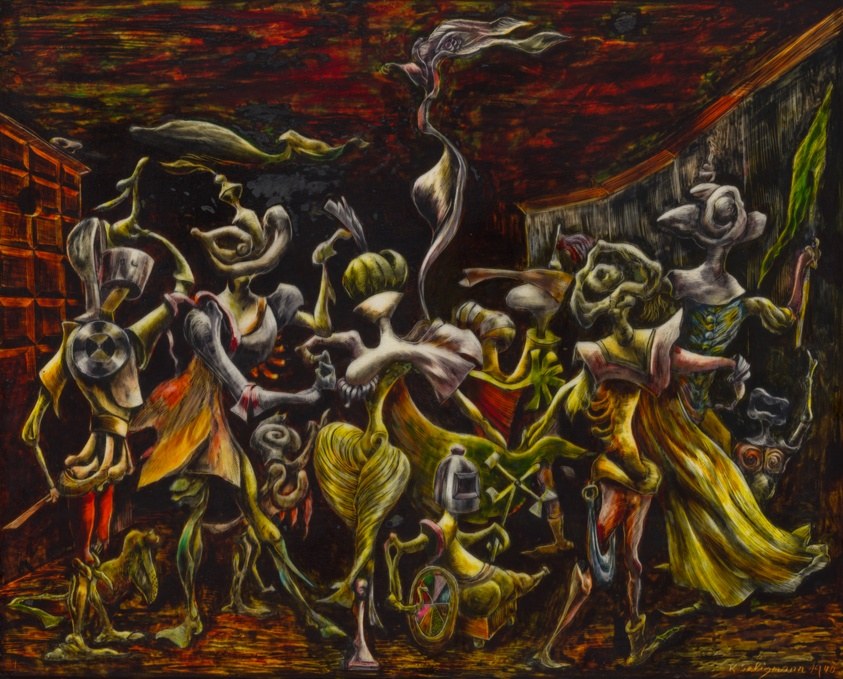
A phantasmagoric gathering of writhing, intertwined figures fills a stage-like space bounded by architectural elements: a red latticed doorway on the left, dark wood paneling on the right. The scene is lit from an infernal glow—the ceiling and walls burn in shades of red, gold, and black, creating an atmosphere of feverish energy. At least eight figures, rendered in pale cream and ochre tones, occupy the composition in various states of contortion and ecstatic movement. Some figures are upright, others bent backward in extreme arcs; several appear to levitate or defy gravity. In the center, a tall serpentine form rises like a charmed snake. The figures wear flowing, translucent draperies in yellow and white that swirl around them. Small objects—a lyre or stringed instrument on the left, what may be wheels or circular forms in the lower center—suggest a classical or mythological setting. The overall effect is of movement seized at its most uninhibited and disorienting moment.
The dancing
The bodies are rendered with elongated, mannered proportions typical of Surrealist figuration. Most figures are in extreme backward bends or asymmetrical contortions; several have their arms raised or swept outward. There is no closed hold or partnered frame; instead, the dancers appear isolated within the composition, each locked in an individual ecstatic or agonized pose. The postures suggest neither technical control nor social dance convention, but rather a state of possession or trance. Feet are barely articulated; the emphasis falls on the torso, spine, and the expressive gesture of the raised or extended arms.
The dance depicted
This work does not depict a recognizable historical or technical dance form. Rather, it appears to visualize a state of dance as altered consciousness or divine possession—closer to sacred or shamanic practice than to ballroom or theatrical convention. The Surrealist treatment and the mythological attributes (the serpent, the lyre, the classical drapery) suggest an evocation of Bacchic or Maenadal frenzy from classical antiquity, or of ecstatic mystical states. The painting seems to be an imaginative or symbolic work exploring dance as a force of transformation and loss of rational control, rather than a document of an actual dance practice.
How it was made
Oil on glass is a demanding and relatively unusual medium, reversing the usual relationship between pigment and support. Paint is applied to the back of a glass panel, requiring the artist to work in reverse and to complete the composition backwards. This technique produces a luminous, jewel-like quality and allows light to pass through the pigment, intensifying color saturation. The technique was used strategically by Seligmann and other Surrealists to create visionary, dreamlike imagery with an almost hallucinatory glow—appropriate here for the incandescent, otherworldly energy of the scene.
About this work
Kurt Seligmann's *The Dance* is a Surrealist invocation of ecstatic movement rendered in oil on glass. The work conjures a mythological or visionary space in which eight or more figures contort their bodies in states of apparent possession or divine frenzy, accompanied by minimal attributes of classical antiquity. Seligmann, a Swiss-born painter and printmaker who was central to the European Surrealist movement before emigrating to America, was fascinated by magic, alchemy, and non-rational states of consciousness. In this 1940 work, dance functions not as a social or technical practice but as a symbol of transcendence, transformation, and the dissolution of the rational self.
The work belongs in a gallery of dance art precisely because it treats dance as a force and a metaphor rather than a form. It reveals how Modernist artists drew on dance—and on the classical association of dance with possession, prophecy, and the divine—to explore the liberation of the body from conscious control. The luminous, jeweled surface created by the oil-on-glass technique reinforces the hallucinatory, visionary character of the imagery.
How to look at it
Attend to the postures of the individual figures: none conform to ballroom frame or classical ballet alignment. Instead, each body twists, arcs, or suspends itself in extreme or impossible contortions. Notice how the artist has denied the figures solid ground; many seem to float or levitate in the infernal space. Observe the role of drapery: the flowing white and yellow fabric does not serve to conceal or refine the body (as in academic art), but instead amplifies gesture and suggests a state of agitation or ecstasy. The serpentine form at center and the classical attributes (lyre, wheels) anchor the scene in mythology while the palette and distortion mark it as visionary rather than documentary. The moment captured is not a step or a position but a state of consciousness.
The artist
Kurt Seligmann (1900–1962) was a Swiss-born painter, printmaker, and occultist who was active in the Surrealist movement in Paris during the 1920s and 1930s before emigrating to New York during World War II. He was known for his interest in alchemy, magic, witchcraft, and non-Western spiritual practices, which he incorporated into his imagery alongside Surrealist techniques of automatism and dream-logic. His work often depicts mythological, occult, or ecstatic scenes populated by hybrid and contorted figures. He worked across multiple media including oil, etching, lithography, and the challenging technique of reverse oil-on-glass painting. Seligmann was respected by both European and American avant-garde circles and continued to develop his visionary practice in New York until his death.
The period
In 1940, European Surrealism was at a turning point: many key figures were fleeing Nazi occupation and exile was scattering the movement across the Atlantic. Seligmann himself was in this phase of displacement. In the same period, American modern dance was establishing itself as a serious theatrical form through figures like Martha Graham and Doris Humphrey, who were exploring emotion, narrative, and the expressive body. Simultaneously, anthropological and ethnographic study of non-Western ritual and dance was intensifying, feeding European and American interest in dance as a vehicle for ecstasy and spiritual states. Surrealism's fascination with the irrational and the unconscious made ecstatic dance an attractive symbol—a mode of experience that bypassed rational language and cerebral control. This work sits at the intersection of modernist formalism, occult philosophy, and the mid-century retrieval of classical mythology as a source of psychological and spiritual meaning.
Where it lives
The work is held in the Modern Art collection at the Art Institute of Chicago. It is recorded as part of the AIC's twentieth-century holdings and represents a significant example of Surrealist painting in an American museum collection.
Dance in this work
Questions about this work
What dance form is this depicting?
None in particular. Seligmann is visualizing dance as an ecstatic or transcendent state—a symbolic evocation of Bacchic frenzy or shamanic possession rather than a technical or social dance form. The extreme contortions and the mythological setting suggest a state of divine or magical transformation.
Why did Seligmann paint on glass?
Oil on glass, a reverse-painting technique, creates a luminous, jewel-like surface because light passes through the pigment. This intensifies color and lends a hallucinatory, visionary quality—ideal for Seligmann's exploration of altered consciousness and the supernatural.
Is this influenced by ethnographic or anthropological sources?
Likely. By the 1930s and 1940s, European artists were increasingly aware of dance in non-Western cultures, particularly ecstatic and possession-based forms. Seligmann's interest in magic and occultism also drew on ethnographic accounts of shamanism and ritual ecstasy. However, the work is a Surrealist invention, not a documentation.
What do the classical attributes—the lyre, the serpent—signify?
They anchor the scene in classical mythology, particularly the cult of Bacchus (Dionysus) and the ecstatic dances of maenads and satyrs. The serpent also evokes alchemy and magic, both of which fascinated Seligmann. Together, they position the dance as a force of transcendence and transgression.
More dance artwork





