49 works in this view — arrow keys or swipe to move between them.
Dance in Art
Grotesque Dance
Max Slevogt German, 1868-1932
- Medium:
- Lithograph on ivory wove paper
- Collection:
- Prints and Drawings
- Source:
- Art Institute of Chicago
- Rights:
- Rights reserved by the holding institution — do not reuse without permission. Source record ↗
- Recorded as:
- AIC — rights reserved
This work represents a distinctly modernist approach to dance imagery, in which the body becomes a vehicle for emotional or psychological expression rather than a demonstration of formal technique. It shows how early 20th-century visual artists, working in media that emphasized gestural immediacy, engaged with dance as a subject for formal and expressive experiment rather than social documentation. The grotesque distortion here anticipates the radical bodily vocabularies of Expressionist dance and avant-garde theater that would follow.
What you are looking at
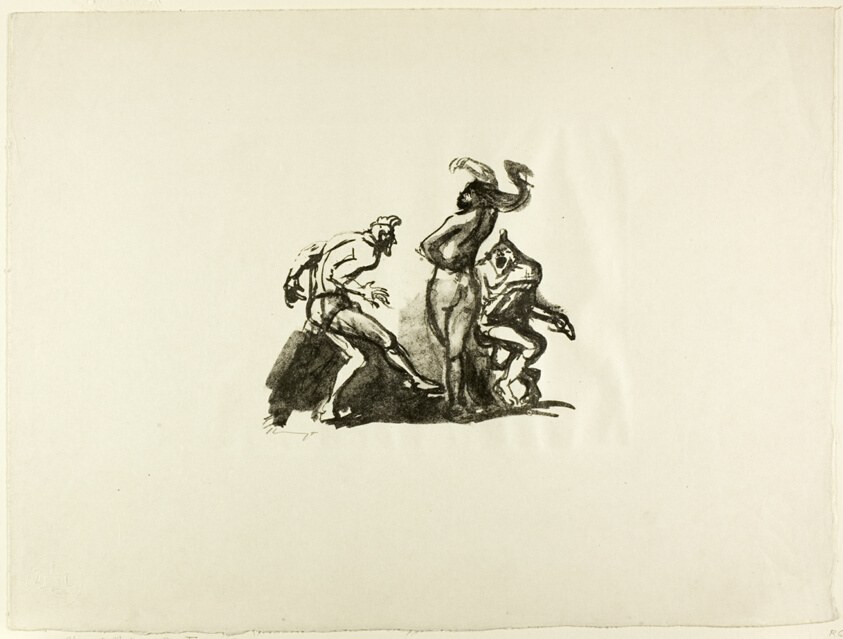
Three grotesquely distorted figures perform an exuberant dance in this lithographic sketch, their bodies contorted into impossible angles that defy anatomical convention. The leftmost figure bends sharply forward at the waist, torso nearly horizontal, while the central figure stands elevated with one arm raised high and the other extended, creating a moment of explosive upward energy. The rightmost dancer mirrors this dynamism with a twisted posture and uplifted gesture. The composition sits against a loosely indicated ground with minimal setting; the artist has concentrated entirely on the energy and deformation of the bodies themselves. The loose, gestural linework and heavy shading create a sense of rapid movement and instability, as if capturing the moment at peak velocity. The overall effect is one of anarchic joy rather than balletic grace.
The dancing
All three figures are rendered with deliberately exaggerated, unnatural proportions and postures. The bodies twist and curve away from vertical alignment; limbs extend at strained angles and joints appear hyperextended. The dancer on the left is nearly folded at the hips with an extended leg; the center dancer pushes upward with both arms in an expansive reach; the right figure maintains a twisted, spiraling stance. The relationships between the three are loosely grouped rather than formally arranged, and there is no evidence of contact or partnership holds—each body moves as if in independent ecstasy. The rendering prioritizes expressive distortion over anatomical accuracy or technical precision.
The dance depicted
This work depicts grotesque or comical dance, likely a caricatural treatment of performance or carnival movement rather than a specific historical dance form. The title 'Grotesque Dance' and the deliberate bodily distortion suggest the artist's interest in exaggeration and deformation as an end in itself, rather than documentation of a known style. The image aligns with early modernist and Expressionist visual culture's embrace of the grotesque—a deliberate rejection of naturalistic representation in favor of psychological or emotional intensity. Who danced such pieces, or whether they represent actual performances, cannot be determined from the image alone; this may be an imaginary or symbolic composition.
How it was made
This is a lithograph executed on ivory wove paper, a medium that allowed Slevogt rapid, expressive mark-making without the constraints of engraving or etching. Lithography's capacity for fluid linework and varying tonal density is evident here—the artist has used bold black lines for the figures' outlines and contours, with heavy shading in the lower left creating volumetric emphasis and anchoring the composition. The loose, almost sketchy quality of the execution suggests either a study or an intentionally improvisational aesthetic. As a lithograph, the work would have been reproducible in multiple impressions, making it a relatively accessible medium for wider distribution than unique prints, though each pulling could vary slightly.
About this work
This 1906 lithograph by German artist Max Slevogt captures three dancers whose bodies have been radically distorted into exaggerated, nearly impossible postures. Rather than depicting a recognizable dance form or style, the work uses bodily deformation as a vehicle for expressive intensity and psychological energy. The grotesque tradition—a deliberate rejection of naturalism in favor of the fantastic, comic, or unsettling—was a defining aesthetic of early modernism, and Slevogt's treatment of the human figure in motion reflects that cultural moment. The work sits at an intersection of dance documentation and artistic abstraction, more interested in conveying the felt intensity of movement than in recording its technical details.
How to look at it
Observe how Slevogt has prioritized the moment of maximum bodily extension and distortion, freezing each figure at the apex of their movement. The viewer should attend to the radical angles of the torsos and limbs—none of the three dancers sits in a naturalistic or stable posture. Notice also the economy of the composition: Slevogt has used minimal setting or context, leaving the distorted bodies as the entire subject. The gestural linework, especially in the shading and outline, conveys a sense of rapid energy; the artist has avoided smooth, controlled contours in favor of sketchy, sometimes broken lines that suggest movement and instability. This is not a moment of rest or balance, but of exuberant, almost violent gesture.
The artist
Max Slevogt (1868–1932) was a prominent German painter, printmaker, and illustrator associated with Impressionism and early Modernism. Known for his loose, gestural handling of paint and his virtuosity in the graphic arts, Slevogt worked across multiple media including oil, watercolor, pastel, and printmaking. His subjects ranged from portraits and landscapes to theatrical and carnival scenes, often marked by dynamic movement and expressive distortion. Slevogt was influenced by contemporary debates about modernist representation and the relationship between naturalism and abstraction; his willingness to deform the human figure in service of emotional intensity reflects broader Expressionist currents in early 20th-century German art.
The period
By 1906, European art was undergoing rapid transformation in response to Post-Impressionism and the emerging Expressionist and Modernist movements. Slevogt's generation was actively questioning academic conventions of representation and exploring expressive distortion as a legitimate artistic tool. In dance, this same period saw the emergence of new forms: Isadora Duncan's barefoot, naturalistic modern dance challenged classical ballet conventions, while Russian Imperial Ballet was reaching its height under the Ballets Russes model (which launched in 1909). The grotesque, the theatrical, and the fantastical were increasingly legitimate subjects for avant-garde artists. Slevogt's print reflects this cultural moment—a time when artists across disciplines were using radical formal innovation to capture intensity and emotion rather than mere appearances.
Where it lives
The work is held in the Prints and Drawings collection at the Art Institute of Chicago, where it is catalogued as a lithograph on ivory wove paper. As a museum print collection holding, it represents the kind of graphic work that was valued in early modernist collecting practices—affordable, reproducible, and formally experimental.
Questions about this work
Is this depicting a real dance?
Probably not a specific historical dance or performance. The title 'Grotesque Dance' and the deliberately distorted anatomy suggest Slevogt was exploring the grotesque as an aesthetic mode rather than documenting an actual movement vocabulary. The work reflects early modernism's embrace of exaggeration and deformation as legitimate artistic tools rather than failures of representation.
Why are the bodies so twisted and strange?
Slevogt has deliberately deformed the figures to create psychological and expressive intensity. This technique was part of Expressionist and early Modernist practice—using radical formal distortion to convey emotion, energy, or an internal state rather than accurate physical appearance. The twisted postures emphasize movement, instability, and intensity over naturalistic grace.
What is a lithograph?
A lithograph is a print made using a stone or metal plate treated with oil and water so that ink adheres to some areas and not others. Lithography allowed artists like Slevogt to work with fluid, gestural linework and create multiple impressions, making the medium ideal for expressive, sketchy work. Each print could be slightly different, giving the medium a spontaneous quality.
How does this fit into dance history?
This work represents how visual artists engaged with dance in the early modernist period—not as documentation of technique but as a subject for formal and expressive experiment. It reflects a moment when dance itself was being radically reinvented (Duncan, Nijinsky, Ballets Russes) and artists were exploring the body as a vehicle for psychological and emotional intensity rather than formal perfection.
More dance artwork





