49 works in this view — arrow keys or swipe to move between them.
Dance in Art
Bacchic Revels
Johann Georg Platzer (Austrian, 1704–1761)
- Medium:
- Oil on copper
- Collection:
- Painting and Sculpture of Europe
- Source:
- Art Institute of Chicago
- Rights:
- Public domain — free to use, share and adapt.
- Recorded as:
- CC0 (Public Domain)
This work demonstrates how European artists understood and visualized ecstatic movement and the body in collective trance—vocabulary that would eventually feed into the aesthetics of Romantic ballet and modern dance. For dance historians, it is evidence of how the classical body was adapted to convey states beyond the ballroom: intoxication, release, and the transgressive pleasure of the Dionysian. It also shows the enduring power of Ovid and classical mythology in shaping European images of movement and desire.
What you are looking at
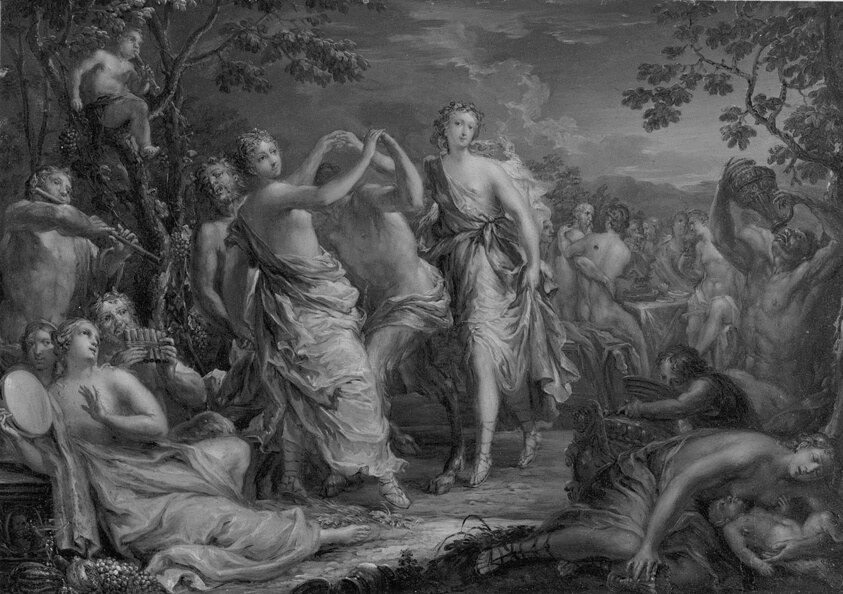
A forest clearing at twilight hosts a gathering of classical figures—nymphs, satyrs, and putti—in a state of revelry. The composition is dense and layered, with figures distributed across the foreground, middle ground, and receding landscape. In the center, a woman in gossamer drapery moves with raised arms in an attitude of abandon or ecstasy, her body arched and one leg bent. Around her, other figures gesture, reach, and turn: some seated on the ground in attitudes of repose or rapture, others standing in animated conversation or movement. The lighting is soft and theatrical, with a pale sky glimpsed through the canopy and darker foliage framing the scene. The entire mood is one of intoxication and pleasure—figures hold vessels (likely wine), lean into one another, and seem caught in a moment of Dionysian excess. This is unmistakably a bacchanal: the pagan festival of Bacchus rendered as a teeming landscape of human and mythological bodies in motion.
The dancing
The central female figure is the focal point of kinetic energy, her torso twisting with arms raised in a V-shape, her weight shifted onto one leg in a pose that suggests spinning or ecstatic movement. Surrounding her, other dancers and revelers display varied attitudes: some with arms outstretched or raised, some bending forward, some reclining. The poses are fluid and asymmetrical rather than balletic or formally ordered. Multiple figures are nude or lightly draped, allowing the artist to depict the full play of musculature and the weight of the body in motion. The grouping is informal—no couples in closed holds, no lines or formations—but rather a clustering of individuals each absorbed in private gestures of pleasure or intoxication. The artist has clearly studied human anatomy and the vocabulary of classical contrapposto, adapting it to convey movement and abandon rather than stillness.
The dance depicted
This is a scene of Bacchic revelry drawn from classical literature and Ovid's *Metamorphoses*—the mythological festival of Bacchus/Dionysus. The figures are not engaged in a codified social dance but rather in ecstatic movement associated with Dionysian rites: spontaneous, orgiastic, and uninhibited. The raised arms, the twisting torsos, the mixture of standing and reclining figures, and the presence of wine vessels and satyrs all point to the maenadic tradition—the wild dancing of Bacchus's female followers. This was a standard subject in European academic art, particularly in the 17th and 18th centuries, and the movement language reflects both classical sculpture and the Mannerist and Baroque traditions of depicting human ecstasy through exaggerated gesture and fluid line. It is not a dance one learns; it is a state of intoxication visualized as movement.
How it was made
Oil on copper panel was a precious and technically demanding medium, especially favored in the 16th and 17th centuries for small, highly finished works. The copper ground is extremely smooth and nonabsorbent, allowing for glazing, fine detail, and luminous color. This format indicates a work made for a wealthy, educated patron—it is intimate in scale but monumental in ambition. The technique allowed Platzer to achieve remarkable tonal subtlety in the drapery and skin, and the small format lends the scene a jewel-like quality. Oil on copper was also commonly used for mythological cabinet paintings—private luxury objects for collectors rather than public decoration.
About this work
Johann Georg Platzer's *Bacchic Revels* (1735) is a Baroque painting of mythological ecstasy rendered in oil on copper—a small, precious panel depicting a forest clearing where nymphs, satyrs, and putti abandon themselves to Dionysian revelry. The work is a virtuoso study in the representation of movement without order: the artist captures the vocabulary of classical dance and sculpture but deploys it to convey intoxication, spontaneity, and pagan abandon rather than the formal, measured gestures of contemporary social or court dance. The composition is dense and energetic, with a central female figure—arms raised, torso twisting—as the anchor of kinetic activity, while surrounding figures in varied attitudes of repose and ecstasy create a sense of collective transport. It belongs in a dance archive not because it depicts a recognizable dance form, but because it is a sustained meditation on how the human body moves when it is moved by pleasure, music, and wine—and because it shows how 18th-century academic artists understood and represented the aesthetics of movement itself.
How to look at it
Attend first to the central female figure and her spiral, twisting pose: the artist has frozen a moment of rotating movement, her arms describing an arc. Notice how her weight is displaced—she is not standing at rest but rather caught mid-gesture, mid-turn. Then look outward to the surrounding figures and notice the variety of attitudes: some are active and reaching, others are collapsing into the ground in a state of abandon. The entire composition works as a study in the different ways the body can move when it is no longer governed by social decorum. Look also at how light and shadow are used to create a sense of depth and of bodies emerging from and receding into darkness—this theatrical lighting suggests that the bacchanal is being staged for our viewing, much as a ballet would be.
The artist
Johann Georg Platzer (1704–1761) was an Austrian painter trained in the Baroque tradition and active during the height of the Rococo period. He specialized in mythological and allegorical subjects, particularly scenes of classical revels and amorous encounters. His small paintings on copper were highly valued by collectors and dealers across Europe. Platzer was known for his ability to render complex multi-figure compositions with anatomical precision and narrative sophistication, and his work was circulated widely through prints and copies.
The period
The 1730s were a moment when European art was transitioning from the formal grandeur of the High Baroque toward the lighter, more playful aesthetics of Rococo. Mythological scenes, particularly those celebrating pleasure, sensuality, and the natural world, were enormously popular among collectors. At the same time, social and theatrical dance were becoming increasingly codified—the vocabulary of Baroque dance was crystallizing into the formal vocabulary of what would become classical ballet. Platzer's *Bacchic Revels* sits at the intersection: it uses the language of classical movement and sculpture to depict something fundamentally opposed to the order and decorum of the ballroom. In this way, it participates in an intellectual tradition (going back to antiquity) of using the Dionysian as a foil to the Apollonian—the wild and the ordered, the natural and the refined.
Where it lives
The work is held by the Art Institute of Chicago as part of its European painting and sculpture collection. Oil on copper was a format typically made for private collectors, and this work likely passed through multiple hands in the European art market before entering an American museum collection.
Questions about this work
Is this a real dance that people performed?
No. This is a mythological scene—a fantasy of ancient Bacchic ritual as imagined by an 18th-century European artist. Bacchic revels were described in classical texts and depicted in Roman art, but Platzer was not documenting a living tradition. However, the *aesthetic* of ecstatic movement he depicts—the raised arms, the twisting torso, the abandonment of formal posture—would have been familiar to him from theatrical dance, gesture, and the study of classical sculpture. He is translating a fantasy of pagan excess into the physical language of his own time.
Why is this in a dance gallery?
Because it is a sustained study in how to represent human movement and the body in motion. The artist has made careful choices about how to depict speed, weight, abandonment, and collective energy. Dance historians and artists can learn from how Platzer solved the problem of representing a body in flux—what pose to freeze, where to place the limbs, how to suggest the direction of movement. It is also historically significant because it shows how European culture used the Dionysian and the orgiastic as a way of thinking about movement outside the constraints of social order.
What does the copper panel mean?
Oil on copper is a luxury format—small, brilliant, and technically demanding. It was used for cabinet paintings: precious objects made for wealthy collectors who could afford to own intimate, highly finished mythological scenes. This was not public art or decoration for a palace, but rather a prized possession for a connoisseur. The format suggests that *Bacchic Revels* was meant to be studied closely and privately, not to be viewed from a distance in a public setting.
How does this compare to Baroque court dance?
Court dance of the 17th and 18th centuries was formal, measured, and governed by strict rules of deportment and position. *Bacchic Revels* depicts the opposite: movement that is spontaneous, asymmetrical, and indulgent. By painting bacchic ecstasy, Platzer was exploring a kind of movement that court culture explicitly rejected—the body moving for pleasure rather than display, for transport rather than control. In this sense, the work is as much a critique of contemporary dance culture as a celebration of mythological freedom.
More dance artwork





