49 works in this view — arrow keys or swipe to move between them.
Dance in Art
Ghost Dance (The Vision of Life)
Ralph Albert Blakelock (American, 1847-1919)
- Medium:
- Oil on canvas
- Collection:
- Arts of the Americas
- Source:
- Art Institute of Chicago
- Rights:
- Public domain — free to use, share and adapt.
- Recorded as:
- CC0 (Public Domain)
This work is historically significant as a document of how non-Native artists of the 1890s—at the height of federal suppression of Native ceremonies—engaged with the Ghost Dance movement in the American imagination. It prioritizes the interior, visionary dimension of the movement over ethnographic spectacle, which is both more respectful and more speculative. For dancers and historians, it raises questions about how movement traditions enter visual art and whether a dance can be depicted through *absence* or atmosphere rather than bodies.
What you are looking at
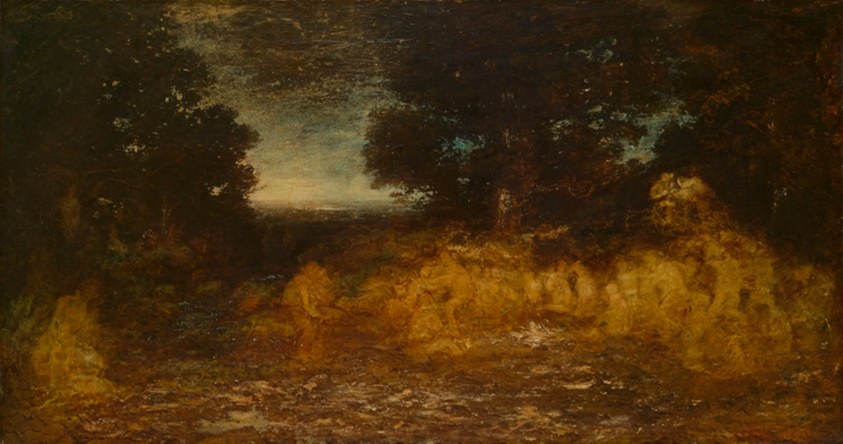
A moonlit forest clearing bathed in cool, ethereal light. Dense dark trees frame both sides of the composition, their silhouettes creating a tunnel of shadow. The ground is rough and uneven, rendered in warm ochres and browns that contrast sharply with the silvery glow suffusing the clearing and sky above. The perspective draws the eye toward a luminous opening in the distant treeline, suggesting a visionary or supernatural space. The title *Ghost Dance (The Vision of Life)* is the only textual indicator we have for interpreting the scene, yet the painting offers no obvious human or dance figures. The handling is atmospheric and Romantic—the landscape itself becomes the subject, with light and shadow creating emotional intensity rather than narrative clarity.
The dancing
No clearly identifiable human figures or dancers are visible in this painting. The composition is entirely landscape-based, with only trees, earth, and atmospheric effects present. If dancers or spirits were intended to populate this scene, they are either obscured by shadow, rendered so faintly as to be imperceptible, or exist in the title's conceptual space rather than the visual one.
The dance depicted
The title invokes the Ghost Dance, a late 19th-century Native American religious and political movement that spread across the Great Plains and beyond, promising a return to ancestral lands and a restoration of traditional life through ritual dance and visionary experience. However, this painting does not depict the dance itself or its participants in any recognizable way. Instead, it appears to represent *the vision* aspect of the movement—the spiritual revelation or trance state that adherents sought through ceremony. The work may be attempting to visualize the interior or otherworldly experience rather than the external choreography, which would align with Blakelock's Romantic interest in mood, spirituality, and the sublime over narrative representation.
How it was made
Oil on canvas, as recorded. Blakelock's technique here is characteristically atmospheric, using heavy impasto and sfumato effects to create luminous, almost hallucinatory effects. The warm and cool tones are modulated across the surface to suggest nocturnal light and emotional resonance. The painting's murky, densely layered surface gives it an archival quality of age and mystery, which may have been deliberate—a means of suggesting the timeless or spectral nature of the subject.
About this work
This 1895 oil by Ralph Albert Blakelock presents a darkened forest landscape titled *Ghost Dance (The Vision of Life)*. Rather than depicting the historical Ghost Dance movement or its practitioners directly, the work appears to engage with the movement conceptually—as a spiritual and visionary phenomenon rather than a choreographed event. Blakelock was a Romantic landscapist known for nocturnal scenes suffused with mood and a sense of the sacred or supernatural; this work sits firmly within that tradition. The painting challenges the viewer to read meaning into landscape itself, treating the forest clearing as a space of revelation or trance—aligned with the Ghost Dance's promise of visionary experience and spiritual transformation.
How to look at it
Approach this painting as a tonal study and mood piece rather than a narrative scene. Attend to how Blakelock uses light—the luminous break in the forest—as the focal point and emotional climax. The clearing reads as a space of revelation, and the surrounding darkness as the pressure of the material world. The handling of the paint itself—thick, worked, almost agitated—conveys spiritual intensity and searching rather than calm observation. The absence of visible figures is the painting's central gesture: the viewer is invited to imagine or intuit the presence and movement that the title names but the canvas withholds.
The artist
Ralph Albert Blakelock (1847–1919) was an American landscape painter and one of the most distinctive figures of late 19th-century U.S. art. He worked primarily in oil, favoring nocturnal and twilight scenes suffused with romantic melancholy and often featuring forests, moonlight, and (in some works) Native American subjects. Blakelock traveled west in the 1870s–80s and was deeply influenced by the landscape and indigenous cultures he encountered. His work is characterized by thick, energetic brushwork, tonal subtlety, and an interest in the spiritual or transcendent aspects of nature. He worked outside mainstream academic circles and faced financial hardship throughout his life; he spent his final years in an asylum. His approach to Native American subjects was sympathetic but, like many contemporaries, often generalized or spiritualized rather than specific.
The period
The Ghost Dance movement emerged in the 1880s among western Nevada Paiutes and spread rapidly to tribes across the West during the 1890s, offering a religious response to colonization, land dispossession, and cultural suppression. The U.S. government viewed it with alarm and suppressed it forcibly, most infamously in the massacre at Wounded Knee in December 1890. By 1895, when Blakelock painted this work, the movement was largely repressed, yet it remained a powerful symbol in the American imagination—of spiritual resistance, of visionary hopes, and of the "vanishing Indian" myth that dominated U.S. culture. In the visual arts, the 1890s saw growing Romantic and Symbolist interest in indigenous spirituality and the sublime, often mediated through European aesthetic traditions rather than genuine engagement with living communities. Blakelock's choice to paint the invisible or interior aspect of the movement rather than depicting ceremonies or participants reflects both the period's spiritualization of Indigeneity and the historical suppression that made such ceremonies invisible to mainstream American viewers.
Where it lives
Held by the Art Institute of Chicago in the Arts of the Americas collection. The work is catalogued with minimal documentation, suggesting it may have been acquired later or without full provenance research.
Questions about this work
Is this painting actually about the Ghost Dance movement?
The title invokes the Ghost Dance and its visionary aspects, and Blakelock was aware of and interested in Native American cultures and spirituality. However, the painting does not depict the dance ceremonies themselves or their participants. Instead, it seems to represent the interior or spiritual experience—the vision—that the movement promised, through the Romantic language of a moonlit, spiritually charged forest.
Why are there no dancers visible?
The absence of clear figures is likely intentional. By the 1890s, the Ghost Dance was legally suppressed and dangerous for practitioners. Painting only the visionary or spiritual dimension, rather than depicting actual ceremonies or communities, allowed Blakelock to honor the movement's spiritual core while working in the abstract Romantic mode he preferred. It also reflects the historical moment: these ceremonies were hidden from dominant culture.
What does Blakelock's style contribute to the meaning?
Blakelock's thick, energetic brushwork and his mastery of nocturnal atmosphere create a sense of psychological intensity and transcendence. The painting feels less like documentary observation and more like a visionary or dream state—which aligns perfectly with the title's emphasis on vision and spirituality. The technique conveys emotion and interiority rather than external facts.
Is this a respectful representation of the Ghost Dance?
It is respectful in its refusal to exoticize or spectacularize. By focusing on the spiritual promise rather than depicting ceremonies or bodies for a non-Native gaze, Blakelock sidesteps some of the ethnographic and voyeuristic conventions of his era. However, the work remains a non-Native artist's interpretation, shaped by Romantic aesthetics rather than grounded in the lived reality of the communities who practiced it.
More dance artwork





