49 works in this view — arrow keys or swipe to move between them.
Dance in Art
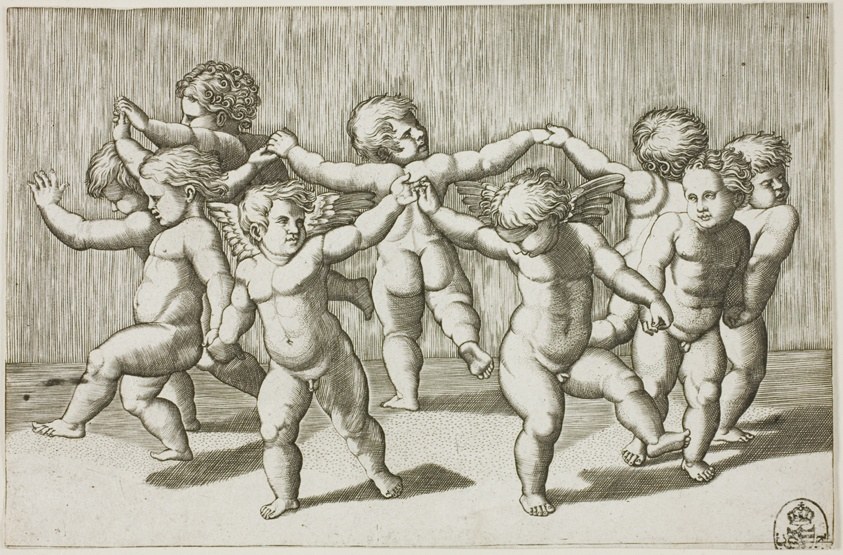
Dance of Cupids
Marcantonio Raimondi Italian, c. 1480-1534
- Medium:
- Engraving printed in black on paper
- Collection:
- Prints and Drawings
- Source:
- Art Institute of Chicago
- Rights:
- Public domain — free to use, share and adapt.
- Recorded as:
- CC0 (Public Domain)
For dance historians and artists, this engraving matters because it captures a Renaissance-era understanding of embodied play and natural movement—a counterpoint to the codified courtly dances developing in the same period. The image shows how leading Renaissance artists represented physical freedom and youthful energy, and it demonstrates the circulation of such ideals through prints that reached artists, dancers, and patrons across Europe.
What you are looking at
Eight plump putti (cherubs) cavort in a shallow stage space defined by a flat ground line and plain background. They are arranged in a loose circle or line, their bodies intersecting and overlapping in a composition of vigorous, playful motion. The figures range from fully nude to partially draped, their flesh rendered with soft modeling; several wear wings. The engraving employs parallel hatching to create volume and shadow, giving the cherubs substantial weight despite their mythological nature. The scene has the character of a freeze-frame from continuous play rather than a formal posed group—some figures gesture outward, others reach toward their neighbours, one appears to be in mid-leap. The medium is black line on paper with fine parallel lines creating tonal depth.
The dancing
The cherubs display open, uninhibited body positions typical of childhood play: raised arms, curved spines, twisted torsos. They engage with one another through gesture and proximity rather than formal partnering—some reach across the group, others appear to address an unseen audience. The poses suggest spontaneous movement rather than learned steps; bodies arc, limbs spread, and weight shifts freely from foot to foot. No two figures occupy the same pose, and the overall composition radiates outward from the centre, creating an effect of dispersed energy rather than unified formation.
The dance depicted
This is not a depiction of a recognisable dance form in the theatrical sense. Rather, it represents the playful movement of putti—a subject with deep roots in Renaissance and Classical art. The figures embody the unbounded physicality of childhood, a state art theory of the period associated with natural grace unconstrained by dance masters' rules. Cupids or putti dancing were conventional subjects in Renaissance and Early Modern decorative schemes, appearing in frescoes, tapestries, and prints. Their movement is celebratory and erotic in intent (as Cupids, they carry associations with love and desire) but depicted without the formal vocabulary of courtly dance. This appears to be an image of pure play rather than any codified dance practice.
How it was made
This is an engraving—a print made by incising lines into a copper plate and inking the incised areas to transfer the image to paper. The technique allowed Raimondi to create rich tonal variations through parallel hatching (close parallel lines of varying density), visible throughout the composition. The fine, controlled lines and the complexity of the composition suggest this was a plate intended for a educated, wealthy audience; engravings required significant skill and were expensive to produce. As a print, this work circulated widely in multiple impressions across Europe, making it far more accessible than a painting would have been, while still addressing a refined audience familiar with Classical subject matter and Renaissance art theory.
About this work
This engraving by Marcantonio Raimondi depicts eight putti engaged in playful, uninhibited movement around a shallow stage space. Raimondi was the supreme printmaker of the Renaissance, and this work exemplifies his mastery of the engraving medium—the control of line, the illusionistic depth created through hatching, the complexity of the overlapping composition. The subject belongs to a long tradition of putti imagery in Renaissance and Early Modern art, where the unbounded physicality of Cupids represented an ideal of natural grace. This particular image crystallises a moment of collective, joyful play that carries erotic connotations befitting figures associated with love and desire. The work exists at the intersection of artistic technique, humanist subject matter, and a theory of movement that valued naturalness over artifice.
How to look at it
Attend first to the interlocking composition: how Raimondi has packed eight distinct figures into a shallow space without confusion, each with its own pose and direction. Notice the variety of arm positions and the ways bodies twist and arc; the artist is interested in showing the full range of movement available to an uninhibited body. Look at the engraving technique itself—the way parallel lines of varying density create the illusion of flesh, shadow, and three-dimensional form on a flat surface. Finally, observe the balance between order and chaos: while the figures overlap and gesture freely, they are arranged with clear formal intention, creating a rhythmic, almost musical composition from their apparent spontaneity.
The artist
Marcantonio Raimondi (c. 1480–1534) was the preeminent printmaker of the Italian Renaissance. He trained as a goldsmith and learned engraving in Bologna before moving to Rome, where he spent most of his career. Raimondi established the engraving as a major medium for the reproduction and dissemination of High Renaissance art, often working after designs by Raphael and other leading artists. His technical mastery—the control of line, the sophisticated use of hatching to create tone and volume, the ability to translate complex compositions into the medium—set standards that defined European printmaking for centuries. He was prolific and influential; his prints reached a wide international audience and shaped how Renaissance art was understood and copied.
The period
In early 16th-century Italy, dance was becoming formalised as an art and social practice. The manuals of dance masters like Guglielmo Ebreo (or Guglielmo da Pesaro) and Domenico da Piacenza had established a vocabulary of steps and positions for courtly dancing, and dance was increasingly valued as a marker of noble status and refinement. At the same time, humanist philosophy and Classical revival were reshaping European culture; the recovery and study of Classical texts, including descriptions of ancient dance and movement, influenced how educated people thought about the body. The figure of the putto—the naked or semi-draped child or cherub—became ubiquitous in Renaissance art partly through this Classical revival (putti appear in Roman art and literature) and partly through Christian iconography (cherubs). Raimondi's image captures a moment when the forms of classical art and the values of Renaissance humanism were being synthesised and disseminated through the new technology of the printing press.
Where it lives
This engraving is held in the Prints and Drawings collection of the Art Institute of Chicago. The work is a print, not a unique object; Raimondi's plate could produce multiple impressions, and examples survive in various collections worldwide. The AIC's holding represents one impression of this widely circulated composition.
Questions about this work
Is this a depiction of an actual Renaissance dance?
No. These are putti (mythological cherubs or Cupids) engaged in playful movement, not dancers performing a codified dance form. The image celebrates physical freedom and natural grace rather than the learned steps of courtly dance. However, it reflects Renaissance ideals about embodied beauty and movement that also informed how dances were taught and valued.
Why are all these putti naked or semi-naked?
Nudity in Renaissance art signified both Classical authority (the recovery of ancient Greek and Roman forms) and innocence. Putti were typically depicted nude or partially draped as a convention of the subject matter itself. The lack of clothing also emphasized the unadorned, 'natural' quality of their movement—a key value in Renaissance aesthetics.
How was this image made and distributed?
Raimondi created this by engraving fine parallel lines into a copper plate; when inked and printed, the plate transferred the image onto paper. Unlike paintings, prints could be produced in multiple copies and shipped across Europe, making them the primary medium for circulating images and ideas among artists, scholars, and patrons. This engraving would have been expensive but far more accessible than a one-off artwork.
Why does a dance collection include a picture of mythological cherubs?
Because it documents how movement, physicality, and the ideals of grace were understood and represented in the Renaissance period. The image embodies a theory of embodied beauty that shaped dance practice and aesthetics; it shows what Renaissance artists and humanists valued in the moving body, and how those values were disseminated through popular prints.
More dance artwork





