49 works in this view — arrow keys or swipe to move between them.
Dance in Art
To the Dance (Apaches)
Léon Gaspard (American, born Vitebsk, Russian Empire, now Belarus, 1882-1964)
- Medium:
- Oil on canvas
- Collection:
- Arts of the Americas
- Source:
- Art Institute of Chicago
- Rights:
- Rights reserved by the holding institution — do not reuse without permission. Source record ↗
- Recorded as:
- AIC — rights reserved
The painting documents an early 20th-century artist's engagement with indigenous American culture at a moment when such subjects circulated widely in galleries and salons, often constructed through romantic and orientalizing frameworks. For historians of dance, it exemplifies how non-European movement—whether ceremonial, ritualistic, or narrative—was often framed as 'dance' in Western art, collapsing distinctions between travel, ritual, spectacle, and choreographed performance.
What you are looking at
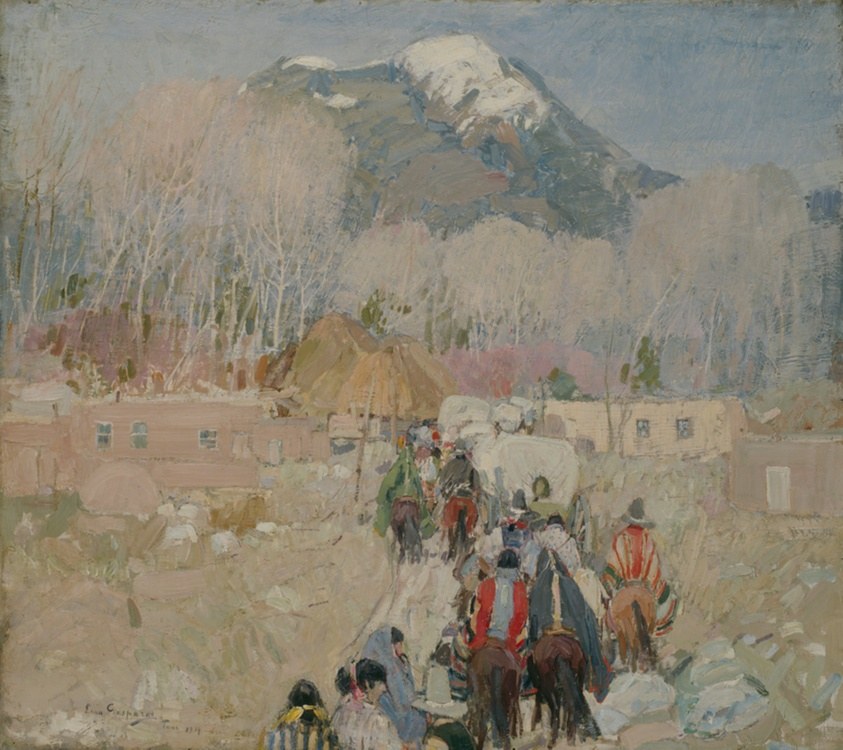
A procession of mounted figures winds through a snowy mountain pass, painted in soft, muted tones of cream, pale blue, and ochre. The composition is dominated by a snow-capped peak rising in the background, its summit brilliant white against a hazy sky. In the middle distance, low adobe or stone buildings cluster beneath tall, bare trees rendered in delicate vertical strokes. The foreground shows figures on horseback—some in bright clothing including red fabrics—moving across snow-covered ground in a loose file formation. The painting employs a characteristic Impressionist approach, with broken brushwork and atmospheric perspective that softens detail at distance. The light appears diffuse and cool, suggesting high altitude and cold. The overall mood is one of movement through a dramatic landscape, captured at a moment of transition or journey.
The dancing
The figures are mounted on horses and appear to be in procession rather than performing coordinated dance. Their bodies sway with the movement of their mounts, and some appear to be wearing ceremonial or elaborate dress—notably the red garments visible on several riders. The horses themselves are the dominant physical forms, with the human figures sitting upright in the saddle. The grouping is loose and strung out rather than closed or partnered; no ballroom hold or folk-dance frame is evident. This is motion through space rather than choreographed movement in place.
The dance depicted
The title "To the Dance (Apaches)" is cryptic and potentially misleading. The image shows what appears to be a mountain journey or ceremonial procession, not a dance scene in the conventional sense. The figures may be traveling to a dance, or the work may use 'Apache' as a cultural reference to capture indigenous ceremonial movement. However, nothing in the visual evidence—mounted figures in procession through snow—depicts dance as typically understood. The work appears to conflate the spectacle and ritual movement of ceremonial travel with dance itself, a common conflation in early 20th-century art depicting non-European cultures.
How it was made
Oil on canvas, executed in Gaspard's characteristic Post-Impressionist style. The technique employs broken color, feathered brushwork, and a limited palette of naturalistic but softened hues. The paint is applied with visible gestural marks that convey atmosphere and light rather than precise detail. This approach was suited to capturing a sense of place and movement while maintaining distance from ethnographic specificity—the Impressionist method allowed the artist to render a scene of cultural practice without documentary exactness, which aligns with early 20th-century attitudes toward representing indigenous peoples.
About this work
This 1919 oil painting by Léon Gaspard presents a procession of mounted figures traversing a snowy mountain landscape, titled as a journey "to the dance." The work sits at the intersection of landscape painting and ethnographic subject matter, using Impressionist technique to render a scene coded as indigenous and ceremonial. The title's equation of journey with dance—or of spectacle with movement—reflects early 20th-century fascinations with indigenous cultures and the tendency to locate 'the primitive' in ritual and ceremonial action. For a dance archive, the work raises questions about how performance, spectacle, and cultural practice were conflated in European art of this period.
How to look at it
The viewer should attend to the relationship between landscape and figure: the mountains dominate, and the human activity is scaled small and distant. Gaspard chose a moment of movement and transition rather than a static gathering, emphasizing journey over spectacle. The soft focus and atmospheric perspective create a sense of remoteness and otherness—the scene is observed from outside, rendered as exotic and distant. Note how the bright red garments of some riders draw the eye but do not dominate; color is used to suggest cultural difference rather than to create drama.
The artist
Léon Gaspard (1882–1964) was born in Vitebsk in the Russian Empire and became known for Orientalist and ethnographic scenes, particularly works depicting Central Asian and Native American subjects. He traveled extensively, including to the American Southwest and Mexico, and worked in an accessible Post-Impressionist idiom that combined observed detail with atmospheric effect. His practice exemplifies early 20th-century salon painting engaged with 'exotic' subject matter, marketed to collectors interested in distant cultures and landscape.
The period
This painting dates to 1919, immediately after World War I, when European interest in non-Western cultures remained high but was shifting from the Orientalism of the late 19th century toward modernist primitivism and ethnographic curiosity. The American Southwest was newly accessible as a tourist and artistic destination following the completion of transcontinental rail. In dance, this period saw increasing interest in 'primitive' movement as a source for artistic renewal, though often filtered through romantic and colonial frameworks. The title's reference to 'Apaches' may invoke the romanticized outlaw culture associated with that people, popular in European entertainment.
Where it lives
The work is held in the Arts of the Americas collection at the Art Institute of Chicago, catalogued as an oil on canvas from 1919. It appears in the museum's public records with minimal curatorial description, reflecting a historical practice of minimal documentation for ethnographic subjects.
Questions about this work
Is this actually a dance scene?
The image shows a procession of mounted figures traversing a mountain landscape. The title suggests it depicts a journey to a dance rather than a dance itself. The conflation of ceremonial movement, travel, and 'dance' in the title reflects early 20th-century European conventions of labeling indigenous spectacle and ritual as 'dance' without distinction from choreographed performance.
Who are the 'Apaches' in the title?
The title invokes Apache peoples of the American Southwest, though the landscape and mounted procession appear stylized rather than documented from life. 'Apache' also carried Parisian associations with outlaw culture and romantic primitivism in early 20th-century entertainment, so the reference may be more symbolic than ethnographically specific.
What is Gaspard's style and reputation?
Gaspard was a Post-Impressionist painter known for ethnographic and landscape scenes, popular in European salons and with collectors of 'exotic' subject matter. His accessible, atmospheric style made scenes of distant cultures appealing to a broad audience without requiring close engagement with specific historical or cultural detail.
More dance artwork





