49 works in this view — arrow keys or swipe to move between them.
Dance in Art
Dance in the Country
Pierre Auguste Renoir French, 1841-1919
- Medium:
- Soft ground etching in brown-gray on ivory laid paper
- Collection:
- Prints and Drawings
- Source:
- Art Institute of Chicago
- Rights:
- Public domain — free to use, share and adapt.
- Recorded as:
- CC0 (Public Domain)
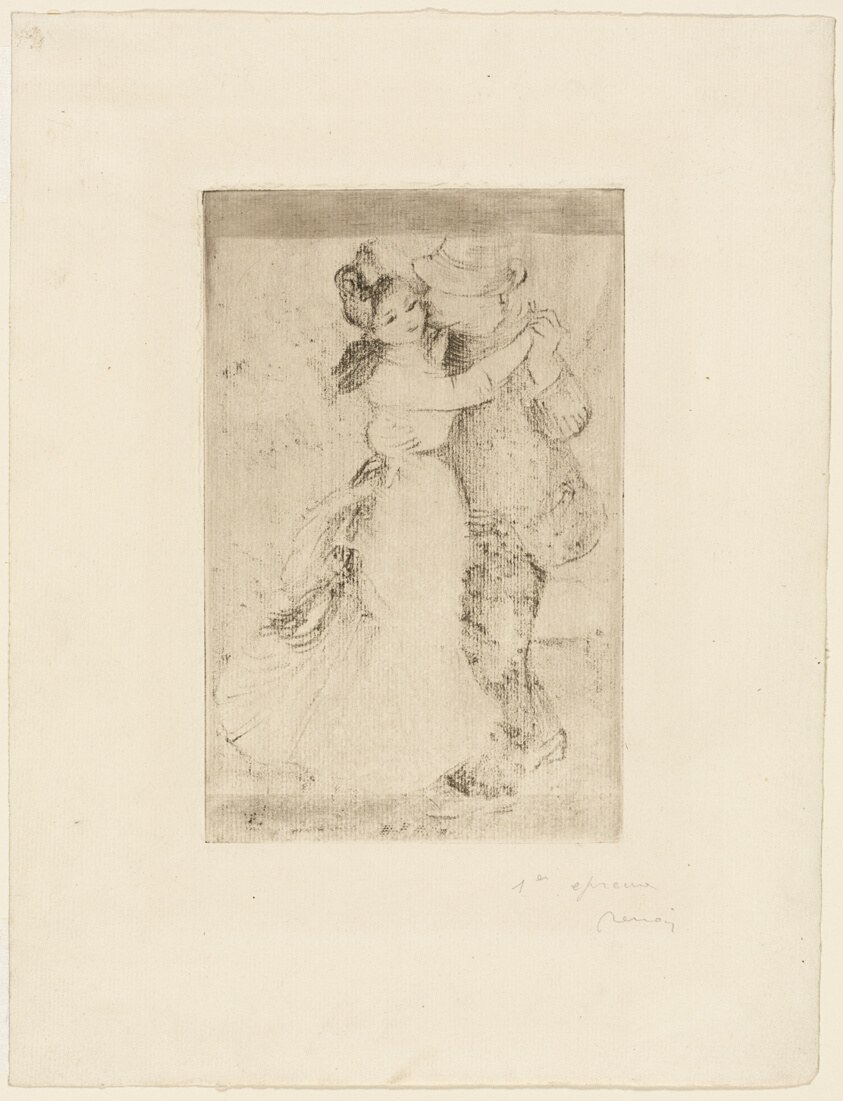
Renoir's etching documents the waltz and country dancing as a social practice rather than as a formal dance form, showing it as part of the modern life and leisure that Impressionists valued as subjects. For dance historians, it captures a moment when couple dancing was becoming a widespread popular activity, not confined to the ballroom or the wealthy. The technical sensitivity of the etching—its soft lines and atmospheric quality—demonstrates how artists of the period used printmaking to record movement and emotion.
What you are looking at
A young couple dances outdoors in a rural setting, rendered in soft ground etching with delicate hatching and tonal gradation. The woman, on the left, wears a hat and fitted dress with a full skirt caught mid-movement; the man on the right holds her in a close embrace, his body angled toward hers. The composition is intimate and informal—there is no ballroom, no orchestra, no spectators. The landscape behind them is loosely indicated, with trees or foliage suggested rather than detailed. The etching technique creates a hazy, dreamy quality; the brown-gray ink sits unevenly on the paper, producing areas of darker tone and lighter ground that give the scene atmospheric depth and a sense of immediacy, as though Renoir has captured a fleeting moment of pleasure in a country dance.
The dancing
The man's left arm is positioned around the woman's waist or back in a close hold; his right arm appears to extend toward her. The woman's body is turned slightly away, her weight appearing to shift as she dances. Both figures lean into each other with an ease and spontaneity that suggests social dancing rather than formal instruction. The woman's skirt billows and catches light, indicating movement and rotation. The positioning suggests a waltz or country dance in closed position, with the couple moving as a single unit rather than in the rigid frame of ballroom competition.
The dance depicted
This depicts a waltz or country dance (the title 'Dance in the Country' supports the latter reading), the most popular couple dances of the late nineteenth century. The setting and intimacy suggest the rustic or village context in which working and country people danced, rather than the formal ballroom. The close embrace and the woman's caught skirt indicate a turning movement typical of waltz, but the informal outdoor setting and lack of ceremony place this firmly in the folk or social tradition. Renoir was interested in leisure and pleasure as modern subjects; this scene captures the Impressionist fascination with contemporary social life, including the dance as a moment of joy and physical connection.
How it was made
This is a soft ground etching, a printmaking technique in which a waxy ground is applied to the copper plate, allowing the artist to draw into it with comparative ease and produce fine, sensitive lines. The resulting print shows considerable tonal variation—areas of darker, denser hatching build form and shadow, while lighter passages suggest light and air. The technique is well suited to capturing the spontaneity and softness Renoir sought; unlike a line engraving, soft ground etching allows for a sketchy, almost drawing-like quality. The irregular inking visible in this impression (the uneven brown-gray tone, the lighter areas of the paper showing through) is characteristic of intaglio printing and adds to the sense of a fleeting moment rather than a finished, polished work.
About this work
This is a soft ground etching by Pierre-Auguste Renoir from 1885, depicting a couple dancing in a rural landscape. It belongs to the artist's engagement with printmaking in the 1880s and reflects the Impressionist interest in capturing light, movement, and contemporary social pleasure. The work romanticizes the waltz or country dance as a moment of unguarded joy, removing it from the ballroom and placing it in nature. For a gallery of dance in art, it is significant as a statement about dance as a modern leisure activity—informal, spontaneous, and available to ordinary people—rather than a formal spectacle.
How to look at it
Attend to the caught moment in the woman's skirt and the angle of the bodies—Renoir has frozen the couple mid-turn, capturing the dynamic of the waltz rather than a static pose. Notice how the etching technique uses tone and line to suggest movement and the play of light across their forms. The lack of detail in the background keeps focus on the couple themselves. The informality of the composition—the couple occupies the center but is not posed or symmetrical—reflects a modern, Impressionist approach to capturing a fleeting, observed moment rather than an idealized dance scene.
The artist
Pierre-Auguste Renoir (1841–1919) was a leading figure in Impressionism, known for paintings of light, color, and social life. He turned to printmaking intermittently throughout his career, producing a small body of etchings and lithographs alongside his paintings. His prints show the same interest in contemporary leisure—dancing, dining, bathing, and socializing—that animated his canvases. Renoir's approach to etching was relatively informal; he used the medium to sketch ideas and capture moments rather than to produce highly finished, commercially distributed editions. This work dates to the mid-1880s, a period when Renoir was reassessing his technique and moving toward a more classical approach, yet his interest in the pleasures of everyday life remained constant.
The period
In the 1880s, the waltz and country dances had become truly popular across Europe and North America, no longer confined to the aristocracy or formal ballrooms. The rise of public dance halls, country inns with music, and the expansion of middle-class leisure time meant that dancing was increasingly a social activity for ordinary people. At the same time, Impressionism and the avant-garde were challenging academic art by taking modern life—including its casual, unguarded moments—as serious subjects. Renoir's decision to depict a couple dancing in the countryside, rather than at a formal ball, reflects this democratization of both dance and art.
Where it lives
This etching is held in the Prints and Drawings collection of the Art Institute of Chicago. It is a historical print from the artist's own time, part of the small body of Renoir's graphic work and likely circulated in limited quantities among collectors interested in Impressionism and modern prints.
Dance in this work
Questions about this work
What is soft ground etching?
A printmaking technique in which the artist draws through a waxy, acid-resistant ground applied to a copper plate. Pressure from a stylus or pencil exposes the metal beneath, which is then etched by acid. The result is a print of fine, often sketchy lines combined with areas of tone created by hatching or multiple passes. Soft ground etching allows greater spontaneity and a more drawing-like quality than traditional line engraving.
Why did Renoir make prints?
Renoir used printmaking as a complementary practice to painting, not as a major source of revenue or primary artistic statement. Prints allowed him to work quickly, to experiment with different subjects and compositions, and to reach a broader audience. His prints often explore the same themes as his paintings—leisure, light, and contemporary social life—but in a more informal, sketchy manner.
What dance is being shown?
The title 'Dance in the Country' and the close couple position suggest a waltz or a country dance (possibly a regional variant of a country reel or quadrille). The informal rural setting and the ease of the embrace point toward a folk or social version of the waltz rather than a formal ballroom version. The spontaneity and the outdoor setting emphasize the dance as a popular leisure activity.
Is this an unusual subject for Renoir?
No. Renoir frequently depicted modern leisure and social life—gatherings, meals, bathing, and dancing. He was drawn to scenes of pleasure and unguarded emotion. Dancing was a recurring motif in his work, appearing in several paintings and prints as a symbol of joy, modernity, and the pleasures available to ordinary people.
More dance artwork





