49 works in this view — arrow keys or swipe to move between them.
Dance in Art
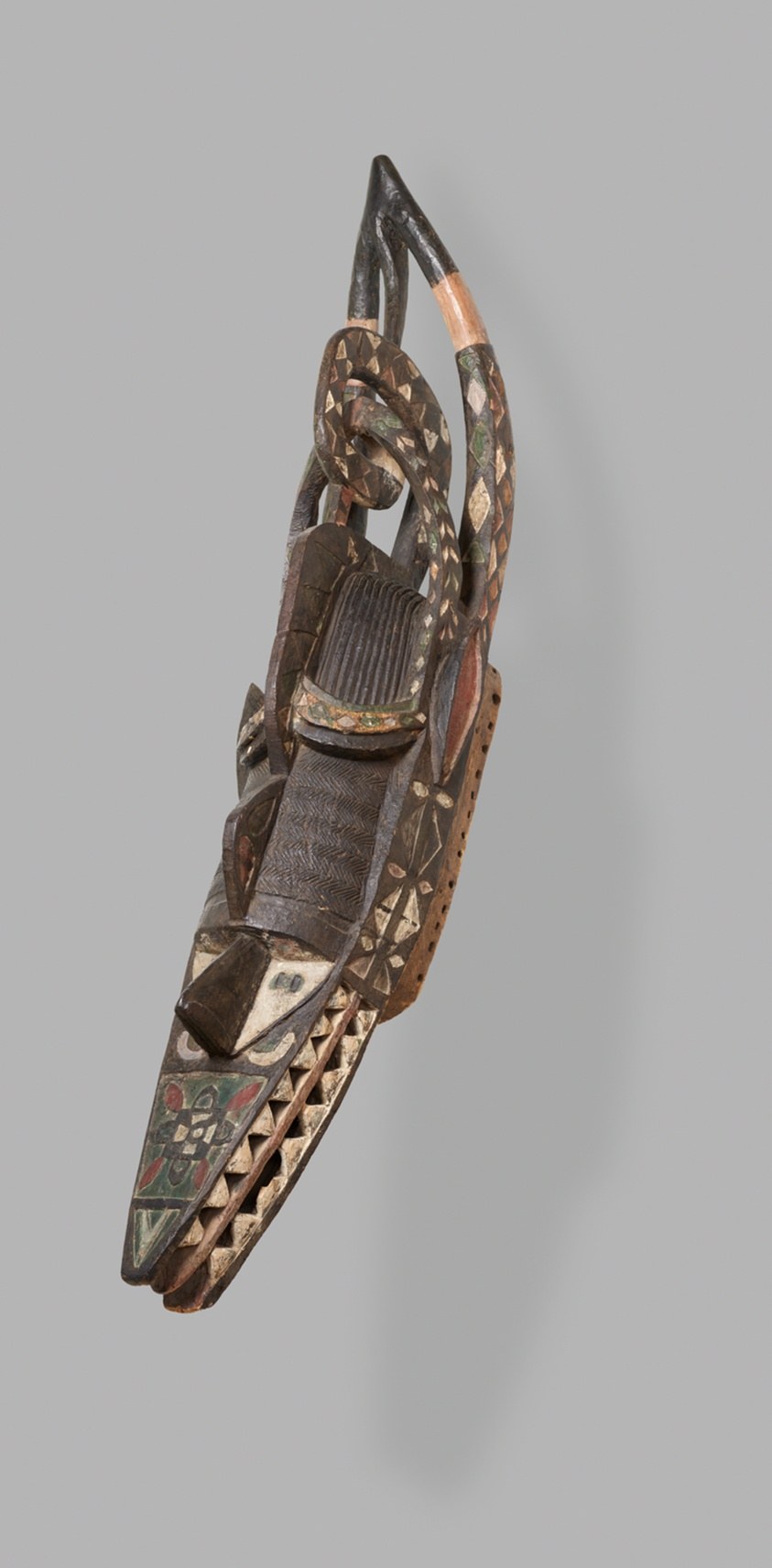
Helmet Mask (Banda or Kumbaduba)
Baga or Nalu Guinea (Conakry) or Guinea-Bissau Coastal West Africa
- Medium:
- Wood and pigment
- Collection:
- Arts of Africa
- Source:
- Art Institute of Chicago
- Rights:
- Rights reserved by the holding institution — do not reuse without permission. Source record ↗
- Recorded as:
- AIC — rights reserved
This object demonstrates that African dance scholarship requires studying the material culture of performance—masks, costumes, instruments—not just movement. The mask's elaborate carving and geometric patterning were not decorative ornament but integral to the work's meaning and to how the dancer's body would have been perceived and remembered. Dancers and dance historians studying non-Western traditions must attend to the sculptural and material dimensions of performance.
What you are looking at
A carved wooden helmet mask rises vertically against a neutral ground, depicting a stylized human head with an elongated face and prominent features rendered in dark wood with inlaid geometric patterns in lighter wood and what appears to be pigment—greens, reds, and earth tones. The mask has a narrow, pointed chin and an open mouth. Rising from the crown are four tall, tapering prongs or extensions that curve slightly outward, each carved with linear grooves and patterning. These upright elements, which may represent hair, horns, or spiritual extensions, dominate the composition's verticality. The face itself is deeply carved with recessed eye sockets and cheekbone definition. Geometric designs—triangles, lines, and checkerboard patterns—cover much of the visible surface. A metal band or wrapping with wood visible beneath encircles what would be the neck area. The overall form is three-dimensional and sculptural, designed to be worn as a headdress rather than a flat mask.
The dancing
This is a sculptural object intended as a worn headdress rather than a representation of human figures in dance. When worn, the wearer's body would occupy the space beneath and behind the mask, with the upright prongs extending upward from their head. The mask's design suggests an imposing, vertical silhouette meant to enlarge and transform the dancer's visual presence. The carved facial features are stylized and abstract rather than naturalistic, emphasizing geometric form over anatomical accuracy.
The dance depicted
This helmet mask belongs to the masking traditions of coastal West African peoples, most likely the Baga or Nalu of Guinea. Such masks were worn by dancers in ceremonial and social contexts, transforming the wearer into a spiritual or social persona. The upright prongs suggest this may represent a Banda or Kumbaduba mask, types associated with initiation rites, social regulation, or the celebration of community events. The mask's imposing vertical form would have made the wearer's movements dramatic and visible from distance. The specific dance steps and body movements would have been determined by the cultural context and the mask's spiritual or social role, with the mask itself functioning as both costume and choreographic element.
How it was made
This is a carved wooden helmet mask with inlaid decorative elements. The base wood has been hollowed and shaped to fit over a wearer's head, then incised with geometric patterns and inlaid with lighter wood (possibly bone or lighter wood species) and pigments in green, red, and ochre. The four vertical prongs are carved as extensions of the crown, each grooved and patterned. The mouth opening would allow the wearer to see and breathe. The materials and hand-carving technique—incised lines, inlay, and pigment application—are consistent with West African sculptural practice. The object's function as a wearable mask means it had to balance sculptural impact with practical usability, requiring skilled wood carving and knowledge of human proportions and balance.
About this work
This carved wooden helmet mask represents the masking traditions of the Baga or Nalu peoples of Guinea and Guinea-Bissau. It dates to the early 20th century and demonstrates the integration of mask, costume, and dance in West African ceremonial and social practice. The mask was designed to be worn during dances, transforming the wearer's visual presence through its imposing vertical form and elaborate carved and inlaid surfaces. Such masks were essential to community rituals, serving spiritual, social, and aesthetic functions. The work belongs in a gallery about dance because the mask is inseparable from movement: it was made to be danced in, its form and weight determining how the wearer moved, and its appearance in performance was the point of its creation.
How to look at it
Imagine this mask worn on a dancer's head: the upright prongs would rise above their shoulders, the face would be at eye level or slightly above, and the wearer's actual body would become invisible or secondary to the mask's presence. The geometric patterns catch light and shadow as the mask moves. The openings for mouth and eyes allow for visibility and expression, though the mask's fixed expression dominates. The height and weight of the prongs would make any movement of the head visible from a distance; the dancer's choreography would likely emphasize vertical and turning motions that would make the prongs swing and catch attention.
The artist
This mask was created by an unknown carver within the Baga or Nalu tradition. West African mask carvers typically learned their craft through apprenticeship and family transmission, with individual variations within established forms and functions. The sophistication of the carving and inlay work suggests an experienced hand, but the work belongs to a collective cultural tradition rather than to an individual artistic signature. Attribution to 'Baga or Nalu' reflects cultural and ethnic origin rather than documented authorship.
The period
This mask dates to approximately 1925, a period when West African masking traditions were still actively practiced in their communities of origin, though colonial rule was altering social structures and contexts for their performance. In European and American art discourse of the 1920s, African sculpture was being 'discovered' and admired by modernist artists, but such masks were rarely understood in their original function as danced objects. The mask entered a Western art collection (the Art Institute of Chicago) in this period, when African art was being extracted from its performance and ritual contexts and displayed as sculpture.
Where it lives
The mask is held in the Arts of Africa collection at the Art Institute of Chicago. It entered the collection as a sculptural artwork rather than as documented performance material, reflecting early 20th-century Western collecting practices that separated African objects from their original contexts.
Dance in this work
Questions about this work
How was a mask like this actually danced?
The wearer would have worn the mask over their head and shoulders, with their body beneath or behind it. The specific movements would have been determined by the mask's function in its community—whether it appeared in initiation rites, social celebrations, or spiritual ceremonies. The mask's weight and vertical form would have influenced movement; turning and head motions would have been particularly striking and visible. The dancer's feet and lower body might have performed complex footwork, but the mask's imposing upper presence would have commanded attention.
What do the upright prongs represent?
The four prongs may represent stylized hair, horns, or spiritual extensions—their meaning would have been understood within the Baga or Nalu cultural context. They serve a formal function: they enlarge the wearer's silhouette vertically and make movement visible from distance. The grooved carving and geometric patterning emphasize their sculptural presence.
Why is this in a dance gallery rather than a sculpture gallery?
Because it was made to be danced in, not to be viewed as stationary sculpture. The mask's form, weight, and visual impact were designed for performance. Separating it from dance is a consequence of how Western museums have historically collected African objects—removing them from their original contexts and recategorizing them according to Western aesthetic categories.
What do the inlaid patterns and colors mean?
The geometric patterns and pigments (greens, reds, ochres) may have had symbolic meaning within the mask's tradition, but without documentation from the Baga or Nalu communities who made and used it, we cannot specify that meaning with certainty. The patterns are visually striking and would have been visible during performance, contributing to the mask's presence.
More dance artwork





