49 works in this view — arrow keys or swipe to move between them.
Dance in Art
Dance at Insane Asylum
George Wesley Bellows American, 1882-1925
- Medium:
- Charcoal, with stumping, pen and black ink, brown crayon, and touches of white chalk on ivory wove paper
- Collection:
- Prints and Drawings
- Source:
- Art Institute of Chicago
- Rights:
- Public domain — free to use, share and adapt.
- Recorded as:
- CC0 (Public Domain)
The drawing documents a historical moment when modernist artists began to find aesthetic interest in the movements of individuals in psychological crisis, and when the boundary between dance, gesture, and symptomatic behavior was beginning to blur. It also raises enduring ethical questions about the representation of vulnerability and institutional life that remain urgent in contemporary dance and performance.
What you are looking at
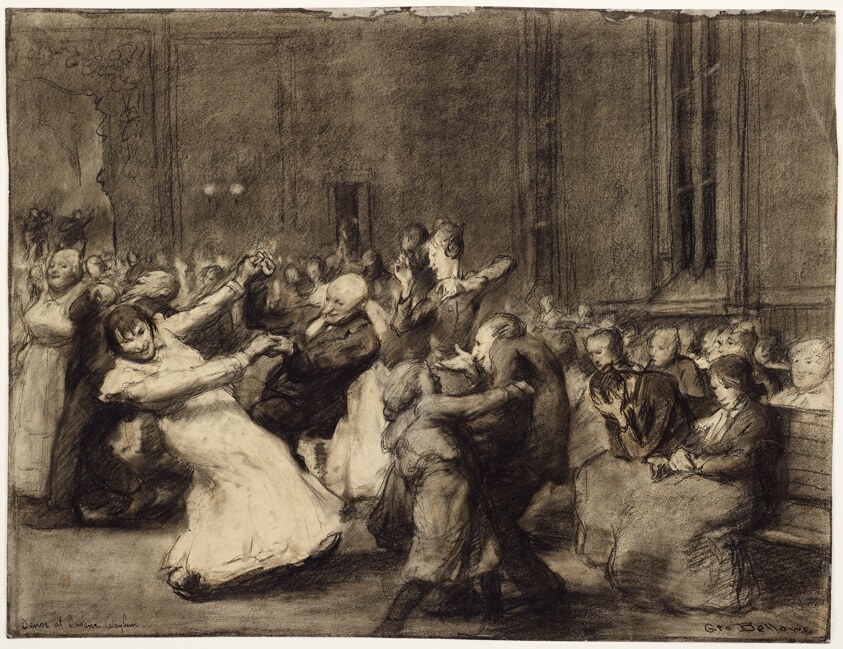
A chaotic dance scene in a large institutional interior—likely a hospital or asylum ward, given the bare stone walls and sparse furnishings. A crowd of figures in various states of undress and agitation fills the space. In the foreground, a woman in a white chemise dances with arms outstretched and body twisted in an exaggerated, uncontrolled posture, her face showing strain or abandon. Around her, other figures—some fully clothed, some partially nude—gesture wildly, embrace, or watch. The composition radiates outward from the central dancing woman, with figures crowding the middle ground and retreating into shadow toward the rear wall. The lighting is dramatic and uneven, creating pools of illumination that isolate individual figures and intensify the sense of psychological disturbance. Bellows has rendered the scene with loose, gestural charcoal work that captures movement and emotional intensity rather than detail.
The dancing
The central female dancer stands with her body in a sharp contrapposto, one arm raised high and the other extended, her torso twisted and vulnerable. Her posture is unschooled and extremal—not a trained technique but a raw expression of movement. Surrounding figures display equally ungoverned gesture: open-mouthed expressions, raised hands, some figures doubled over or in loose contact with others. There is no closed hold, no structured ensemble work—instead, isolated bodies responding to compulsion or emotion rather than dance convention. The bodies press close, overlapping in the shallow space, creating visual congestion that mirrors psychological distress.
The dance depicted
This is not a depiction of a recognizable social or theatrical dance form. Rather, it documents movement—or the appearance of movement—as symptomatic behavior: the uncontrolled gesturing, contorted postures, and expressive release associated with mental illness or emotional crisis in the early 20th century. The work sits at the intersection of medical observation and artistic modernism, treating the body in distress as a subject worthy of serious aesthetic attention. The dance here is involuntary, untaught, and psychologically charged—a radical departure from both academic and popular dance imagery of the period.
How it was made
Charcoal with stumping (blending), pen and black ink, brown crayon, and white chalk on ivory wove paper. The mixed-media approach allows Bellows to move rapidly between definition and atmosphere: charcoal establishes form and shadow, pen adds linear urgency and physiognomic detail, and white chalk creates highlights that suggest movement and emotional intensity. The technique is loose and expressionistic rather than descriptive, built for reproduction and circulation as a print or drawing study. This hybrid approach was common in early 20th-century American printmaking and suggests the work may have been conceived as a study for a larger composition or as a finished work for exhibition and sale.
About this work
George Wesley Bellows, a leading figure in American Realism and the Ashcan School, created this drawing as a document of life at the margins of institutional care. The work presents dance—or what appears to be dance—as a manifestation of psychological disturbance rather than social pleasure or artistic discipline. Bellows was drawn throughout his career to scenes of urban vitality, physicality, and emotional intensity: boxing matches, street crowds, beach scenes. This drawing extends that practice into the territory of medicine and pathology, depicting the human body in motion as a site of both formal interest and human suffering.
The work matters because it relocates dance outside the theater and ballroom into the asylum, treating movements born of mental illness with the same compositional seriousness Bellows applied to other embodied experiences. In doing so, it raises uneasy questions about the distinction between dance and other forms of bodily expression, and about the artist's relationship to suffering and spectacle.
How to look at it
Attend first to the central female figure and the extremity of her posture: the raised arm, the twisted spine, the openness of her body to the space around her. This is not a moment of equilibrium or trained control but of release or disturbance. Notice how Bellows has used the crowding of figures and the uneven lighting to create visual and psychological pressure: there is no calm space in this room, no refuge. The medium—the loose charcoal, the added lines of ink, the highlights of white chalk—fragments and energizes the scene, preventing any single point of rest or stable interpretation. Look at the faces and hands: what emotion or state do they convey, and what is the relationship between those expressions and the movement of the bodies?
The artist
George Wesley Bellows (1882–1925) was an American painter and printmaker associated with the Ashcan School and American Realism. Trained at the New York School of Art under Robert Henri, Bellows developed a practice committed to depicting contemporary urban life in its raw physicality: street crowds, boxing matches, tenements, and public leisure. He worked across media—oil, lithography, drawing—and was particularly prolific as a draftsman. His interest in the body in motion and in scenes of popular gathering made him attentive to subjects others overlooked or considered unworthy of serious art. Though he died in 1925 at age 42, he left a large body of work that established him as a major figure in early American modernism.
The period
The early 1900s saw a growing fascination among modernist artists in the movements and expressions of individuals outside elite culture: the urban poor, performers, athletes, and—increasingly—patients in institutions. The emergence of photography and new reproductive technologies made such imagery more visible and more shareable. Simultaneously, new theories in psychology and medicine were attempting to classify and categorize human movement and emotional expression. Bellows' interest in drawing the asylum aligns with a broader modernist turn toward previously marginal or pathological subjects, while also reflecting early 20th-century anxieties about mental illness, urban overcrowding, and the visibility of suffering in American cities. Dance in this period was becoming increasingly formalized through ballet and ballroom technique, making uncontrolled or expressionistic movement appear more aberrant and more fascinating to artists seeking authenticity or psychological truth.
Where it lives
The work is held in the Prints and Drawings collection of the Art Institute of Chicago, indicating it is classified as a work on paper rather than a painting or sculpture. The catalogue record provides minimal information beyond artist, title, date, and medium, suggesting the work may not have been a high-profile acquisition or that its provenance and exhibition history are not extensively documented in the collection database.
Questions about this work
What is happening in this image? Are these people actually dancing?
The figures are moving in ways that resemble dance—raised arms, twisted bodies, expressions of intensity—but the context and movement quality suggest something other than social or theatrical dance. The setting appears to be an institutional interior (possibly a hospital or asylum), and the postures are uncontrolled and idiosyncratic. Bellows may be depicting involuntary movement, emotional expression, or the therapeutic or recreational activity that occurred in such institutions, raising the question of what counts as dance.
Why did Bellows draw an asylum? What was he interested in?
Bellows was committed to depicting American life in its raw, unfiltered reality. He was drawn to scenes of physical intensity, bodily movement, and emotional expression—boxing matches, street crowds, beach scenes. The asylum offered another site of human physicality and intensity. By depicting it, he elevated a space and a population that were usually invisible or stigmatized in high art, treating institutional life and mental distress as worthy subjects for serious aesthetic attention.
What technique did Bellows use, and why does it matter?
He used charcoal, pen, ink, crayon, and chalk on paper—a mixed-media approach that allowed him to work quickly and expressively. The loose charcoal and added pen lines create visual energy and fragmentation, refusing clarity or stability. This technique was suited to reproduction and exhibition as a drawing or print, and it emphasizes emotional and formal intensity over descriptive detail. The medium itself conveys the urgency and disturbance of the scene.
More dance artwork





