49 works in this view — arrow keys or swipe to move between them.
Dance in Art
Moulin de la Galette
Henri de Toulouse-Lautrec (French, 1864–1901)
- Medium:
- Oil on canvas
- Collection:
- Painting and Sculpture of Europe
- Source:
- Art Institute of Chicago
- Rights:
- Public domain — free to use, share and adapt.
- Recorded as:
- CC0 (Public Domain)
For dancers and historians, this painting is invaluable evidence of how social dance functioned in the modern urban setting—who participated, how they dressed, the informality of the venue, the mix of observation and participation. Toulouse-Lautrec was documenting the very emergence of commercial dance halls as central to urban life, a shift that shaped dance practice for the following century. The work shows that by the 1880s, dance was no longer confined to aristocratic ballrooms or theatrical stages; it had become a mass social practice.
What you are looking at
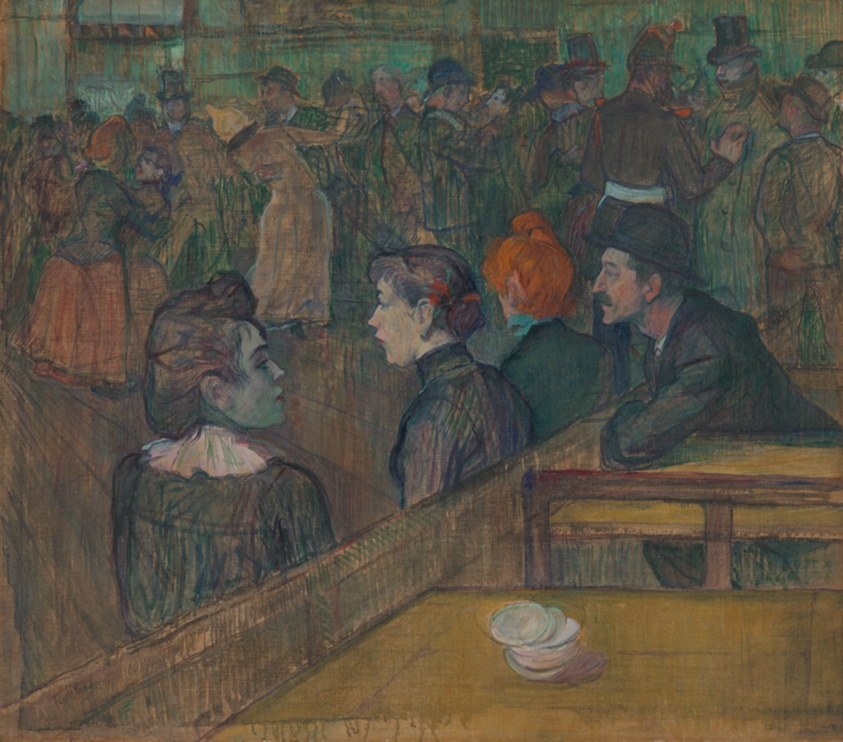
A crowded interior scene captures a moment of social dance at the Moulin de la Galette, the famous open-air dance hall in Montmartre. The composition pulls the viewer into the throng: in the immediate foreground, at the level of a low railing or barrier, three figures are sharply rendered—a woman in profile on the left with her hair up and white collar visible, a red-haired woman in the center, and a man in dark clothing and hat on the right, all appearing to watch or participate in the dancing. Behind them, the space fills with dozens of dancers and onlookers in a haze of muted greens and browns, their forms suggested rather than detailed, creating an impression of movement and gaiety. The lighting is warm and diffused, with a yellowish floor prominent in the foreground and cooler tones receding into the crowd. The scene conveys the informal, mixed-class character of the venue—top hats visible among the crowd signal the presence of bourgeois spectators alongside working-class Parisians.
The dancing
The three foreground figures are depicted in upright, observational postures rather than active dance. The woman on the left is shown in three-quarter profile, her neck and shoulders relaxed. The red-haired woman in the center appears to be looking toward the dancers, her body at ease. The man on the right, wearing a bowler hat and dark jacket, sits or stands with casual attention. None of these three figures display the closed or open holds, extended arms, or weight shifts characteristic of active dancers; they appear to be spectators or participants at rest. The background figures, though rendered impressionistically, show upright stances consistent with the popular social dances of the era, though individual technique is not discernible.
The dance depicted
This depicts social dance of the Gilded Age, likely a mix of the popular dances performed at outdoor pleasure gardens of 1880s Paris: the Galop, Waltz, Polka, and Quadrille were standard at such venues. The painting does not isolate or emphasize a single couple or dance form; instead it captures the social context and spectatorial pleasures of mass dance rather than the technical execution of any particular style. Toulouse-Lautrec was documenting a social phenomenon—the democratization of dance through commercial venues—rather than illustrating a specific choreography. The artist's interest lies in the crowd, the atmosphere, and the ritual of social mixing, not in the mechanics of the dance itself.
How it was made
Oil on canvas, applied with Toulouse-Lautrec's characteristic loose, directional brushwork. The artist uses rapid, broken strokes to suggest the energy and flux of the crowded scene, building form through color and line rather than detailed rendering. The foreground figures are more finished and modeled, while the background dissolves into suggestion—a technique that mimics the viewer's experience of being amid a crowd where nearby faces are clear and distant ones blur. This method was suited to Toulouse-Lautrec's subjects in Montmartre nightlife; it conveys immediacy and the artist's presence within the scene rather than observing from a detached distance.
About this work
Toulouse-Lautrec's *Moulin de la Galette* documents the social dance culture of 1880s Paris, capturing a moment at one of the city's most popular open-air pleasure gardens. Rather than a narrative scene or instructional image, it is an atmospheric record of how ordinary Parisians gathered to dance and socialize across class lines. The painting belongs in a dance history because it is among the most vivid visual evidence of Gilded Age social dance as a lived, mixed-class, urban phenomenon—not as technique or performance, but as a space where bodies moved together. The work shows how art of the period registered dance not primarily as skill but as social spectacle and modern urban leisure.
How to look at it
Attend first to the foreground railing and the three figures beyond it—they anchor you in the space as a spectator rather than a participant. Notice how Toulouse-Lautrec uses the railing to create an interior frame, a compositional device that pulls the viewer into complicity with the scene rather than leaving us outside it. The dissolution of detail into the background crowd is deliberate: it mimics the experience of being amid noise and motion. The warm yellow floor and the muted palette of greens and browns create an interior atmosphere that feels close and lived-in, not staged. The lack of a focal point or central action is also telling—there is no prima ballerina, no moment of climactic movement; instead, the painting asks you to take pleasure in the undifferentiated mass, the rhythm of bodies, the social ritual itself.
The artist
Henri de Toulouse-Lautrec (1864–1901) was a painter and printmaker obsessed with the nightlife and entertainment venues of Montmartre. Though born into the aristocracy, he frequented cabarets, dance halls, and brothels, making them the subjects of his art. His *Moulin de la Galette* paintings, drawings, and prints form part of a larger body of work documenting the performances, performers, and patrons of venues like the Moulin Rouge and Moulin de la Galette. His technique—loose brushwork, bold color, compositional immediacy—was shaped by his subjects: he painted people in motion, in crowds, in moments of unguarded social life. His sympathetic, unsentimental attention to working-class and demimonde culture made him a crucial witness to modern leisure.
The period
The 1880s and 1890s saw the rapid commercialization of urban leisure and the emergence of the dance hall as a democratic social institution. The Moulin de la Galette, operating since the 1870s, was among the first venues to offer affordable, mixed-class dancing outdoors. At the same time, Paris was the capital of theatrical innovation: the Moulin Rouge (opened 1889) brought cabaret and the cancan to international prominence. In fine art, Impressionism and Post-Impressionism were shifting away from historical and allegorical subjects toward scenes of modern life—leisure, entertainment, urban crowds. Dance became a subject of artistic interest precisely because it seemed to embody modernity: crowds, movement, pleasure, and the loosening of social constraint.
Where it lives
The work is held in the Painting and Sculpture of Europe collection, sourced from the Art Institute of Chicago (aic). It is an oil on canvas from 1889, part of Toulouse-Lautrec's sustained engagement with Montmartre entertainment venues in the final decades of the 19th century.
Dance in this work
Questions about this work
What is the Moulin de la Galette?
A famous open-air dance hall in the Montmartre district of Paris, operating from the 1870s onward. It was one of the first venues to offer affordable public dancing to mixed-class crowds, making it a symbol of modern urban leisure. Toulouse-Lautrec documented it repeatedly in paintings, prints, and drawings.
Are the people in the painting actually dancing?
The three foreground figures appear to be spectators or at rest. The background crowd is rendered impressionistically, so individual dancers are not clearly distinguished. The painting is more interested in the social atmosphere and the ritual of gathering than in depicting virtuosity or specific dance technique.
What dances would have been performed at the Moulin de la Galette?
The Waltz, Galop, Polka, Quadrille, and other popular social dances of the Gilded Age. These were ballroom dances adapted for open-air, informal settings. The painting does not specify which dance is occurring, if any, but instead captures the general social dance culture.
Why did Toulouse-Lautrec paint entertainment venues so often?
He was fascinated by modern urban life, by bodies in motion and moment of social pleasure, and by the ways that commercial venues created new forms of social mixing. For Toulouse-Lautrec, the nightlife and dance halls of Montmartre embodied the vitality and freedom of modern Paris. He had privileged access to these spaces and documented them with sympathy and acuity.
More dance artwork





