49 works in this view — arrow keys or swipe to move between them.
Dance in Art
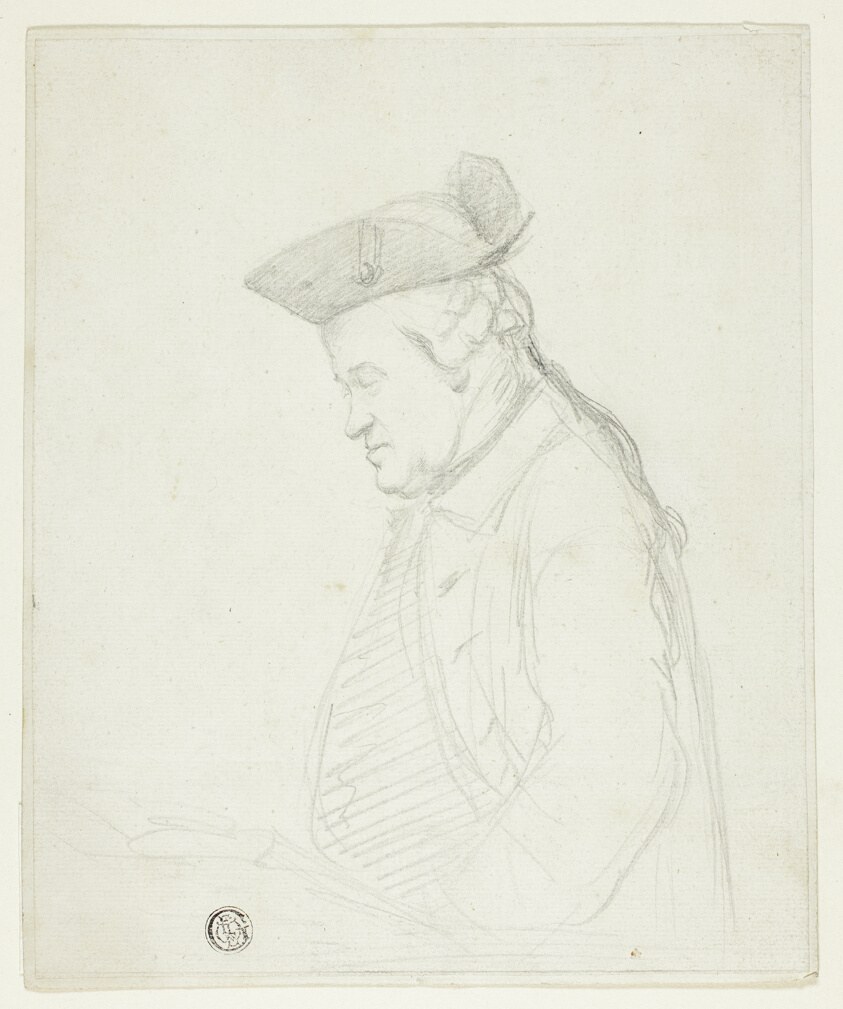
Half-Length Portrait of George Michael Moser
Attributed to George Dance, II (English, 1741-1825) or George Michael Moser (English, c. 1704-1783)
- Medium:
- Graphite on ivory laid paper, laid down on ivory laid paper
- Collection:
- Prints and Drawings
- Source:
- Art Institute of Chicago
- Rights:
- Public domain — free to use, share and adapt.
- Recorded as:
- CC0 (Public Domain)
This work does not depict dance and should not appear in a dance collection. It is a historical portrait—valuable for understanding eighteenth-century artistic training, portraiture conventions, and possibly the identity or status of the sitter, but not for understanding dance history or dance imagery.
What you are looking at
A half-length portrait study of a man shown in profile facing left, rendered in graphite on paper. The figure wears eighteenth-century dress: a coat with visible ribbed or pleated detailing across the chest, and a collar. His hair is pulled back, possibly in a queue or tied arrangement typical of the period. The drawing is executed with delicate, controlled linework, establishing form through hatching and careful modeling of light and shadow. The paper shows age-appropriate discoloration and the work is mounted on a secondary sheet. A collector's mark appears in the lower left corner.
The dancing
The sitter is positioned in three-quarter profile, his head turned slightly away from the viewer. The posture is upright and static, with no suggestion of movement or active gesture. The focus is entirely on physiognomy—the profile of the face, the set of the jaw and nose, the ear—rendered with the precision expected of an eighteenth-century portrait study. There is no bodily engagement characteristic of dance.
The dance depicted
This work does not depict dance. It is a portrait drawing, a study of a male head and shoulders in the manner of academic figure practice or the recording of a specific individual. No dance posture, movement, music-making, or dance context is present.
How it was made
Graphite on ivory laid paper, mounted on a secondary sheet of similar material. The technique is drawing rather than painting or print, allowing for the precise linear control and tonal subtlety visible in the modeling of the face and the crisp definition of the clothing. The laid paper and the collector's mark suggest this was a valued work, likely kept as part of a portfolio or collection. The fineness of execution indicates it was made for study, display among peers, or as a record of a specific individual's appearance.
About this work
This is a portrait study in graphite, not a dance image. It depicts an unknown man in eighteenth-century dress, rendered with careful attention to facial proportion and character. The work demonstrates the conventions of period portraiture and life drawing—disciplines at the heart of artistic training in the 1720s–1780s. While the cataloguing record attributes it to one of two artists (George Dance II, a prominent portraitist, or George Michael Moser, a founding Royal Academician), and assigns it to 1724, the drawing itself reveals only its subject, technique, and period. It belongs in archival records of portraiture and academic practice, not in a gallery of dance.
How to look at it
Observe the precision of the graphite line and the tonal modeling that gives the face volume and character. Notice how the artist used hatching—fine parallel lines—to suggest the texture of fabric and the modeling of the cheek and jaw. The profile view was chosen for its ability to reveal the pure line of the nose, forehead, and chin, the traditional measure of beauty and character in portraiture. The work is a study, not a finished exhibition piece, and its value lies in its accuracy and the directness of observation.
The artist
The work is attributed to George Dance II (English, 1741–1825), a celebrated portraitist and architect, or to George Michael Moser (c. 1704–1783), a painter, sculptor, and founding member of the Royal Academy of Arts. Both were prominent figures in eighteenth-century British art. If by Dance, it would represent his work as a draughtsman during his formative years; if by Moser, it reflects the practice of life drawing and portraiture central to his teaching and reputation. Without further research, the attribution cannot be settled from the image alone.
The period
This drawing dates to the early eighteenth century, a period of formalization in artistic training and the establishment of the Royal Academy of Arts (1768). Portrait drawing from life was a fundamental discipline, taught through careful study of the head, neck, and shoulders. The conventions of three-quarter profile and the emphasis on physiognomic accuracy reflect both Renaissance tradition and Enlightenment interest in character and identity. Dance was not the subject of fine art portraiture in this tradition; individual dancers might be commemorated in theatrical prints or narrative scenes, but not through straightforward portrait studies of this kind.
Where it lives
Held in the Prints and Drawings collection of the Art Institute of Chicago. The work is a graphite drawing on laid paper, mounted on a secondary support, with a collector's mark visible, indicating it was valued and preserved as part of a connoisseur's or institution's holdings.
Questions about this work
Why is a portrait in a dance collection?
It should not be. This is a portrait study with no dance content. It may have been catalogued in error, or the collection database may include all works on paper by certain artists regardless of subject. It is included here to clarify that not all works by early portraitists depict dance or movement.
Who is the sitter?
The catalogue record does not identify the subject. The title suggests it may be George Michael Moser, but without additional documentation, the sitter's identity is uncertain. Portrait drawings of this period often recorded family members, patrons, fellow artists, or students, but identification requires provenance research beyond the image itself.
Why is the date given as 1724?
The catalogue record assigns 1724, but this contradicts the attribution to George Dance II, who was born in 1741. If the work is by Dance, it must date to 1741 or later. If the date 1724 is correct, the work is more likely by Moser or another artist of that generation. This discrepancy should be investigated.
More dance artwork





