49 works in this view — arrow keys or swipe to move between them.
Dance in Art
The Dancing Trees
Alfred Stieglitz American, 1864–1946
- Medium:
- Palladium print
- Collection:
- Photography and Media
- Source:
- Art Institute of Chicago
- Rights:
- Public domain — free to use, share and adapt.
- Recorded as:
- CC0 (Public Domain)
The work demonstrates how modernist artists translated choreographic thinking into visual media. Stieglitz's tree trunks show that the language of dance—rhythm, spatial relationship, weight, counterbalance—could animate any composition, human or otherwise. For dance historians, it is a record of how dance became a metaphor for modernist form itself.
What you are looking at
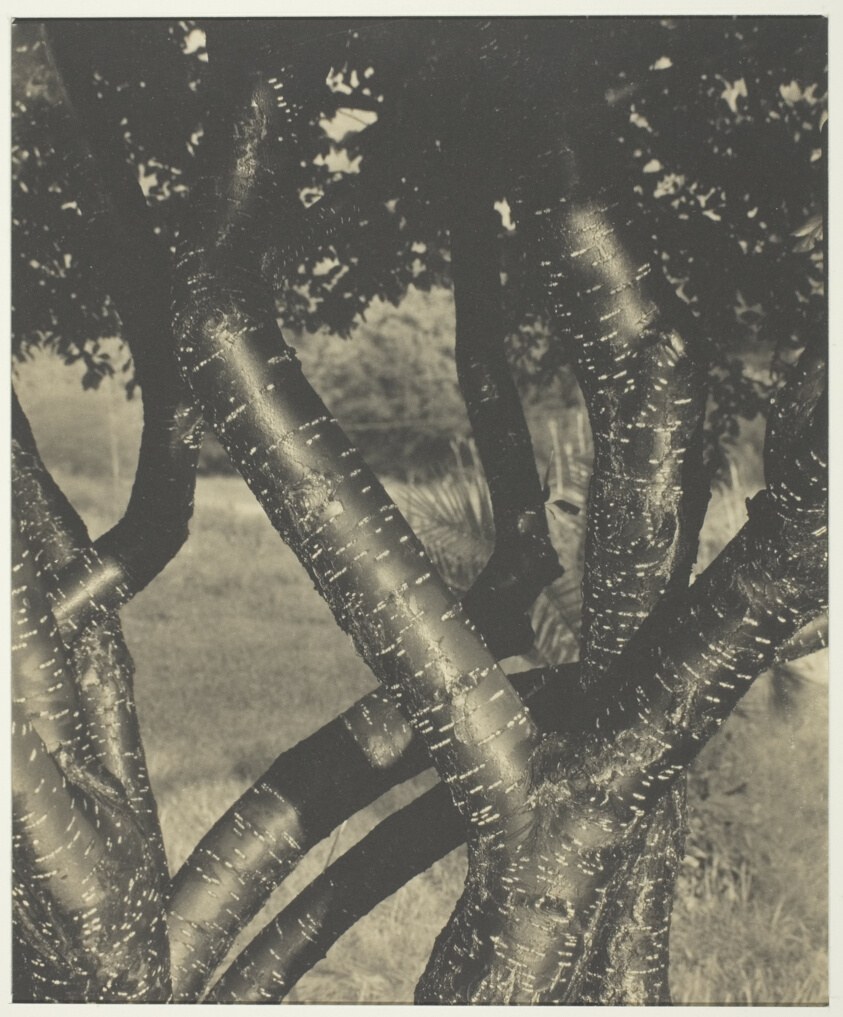
The photograph captures tree trunks at close range, their bark rendered in rich palladium tones that emphasize texture and surface detail. Multiple trunks rise through the frame, their forms interweaving and creating a composition of vertical and diagonal lines. Dappled light filters through foliage above, creating patches of brightness that play across the bark and cast shadows between the trees. The foreground is sharp and tactile; the background dissolves into softer, luminous areas suggesting sky or distant canopy. The framing is intimate and slightly abstracted, inviting the viewer to read the trunks as moving forms rather than static botanical specimens.
The dancing
The trunks themselves become bodies in motion—their curves, spirals, and interwoven forms suggest the counterbalance and spatial relationship of dancing figures. The eye tracks between them as it would follow dancers moving past one another. Light models their volume and creates a sense of weight and presence. There is no literal human figure here, but the visual language of movement—tension, rhythm, and spatial dialogue—animates the composition.
The dance depicted
This is not a representation of literal dance, but an abstraction of dance principles through natural form. Stieglitz's title *The Dancing Trees* signals the metaphorical reading explicitly. The photograph belongs to the modernist impulse to find choreography in nature and abstraction, translating the body's grammar into botanical terms. It reflects early 20th-century interest in form, movement, and rhythm as universal principles transcending medium.
How it was made
A palladium print, a photographic process in which a palladium salt is used to create an image of extraordinary tonal range, permanence, and luminosity. Palladium prints produce warmer, softer tones than platinum prints and were favored by art photographers for their fine gradations of gray and subtle highlights. The process allowed Stieglitz to emphasize surface texture and spatial depth while maintaining image stability—palladium prints have outlasted many other photographic processes. This was an expensive, labor-intensive process suited to fine-art circulation rather than commercial publication, marking this as a work for galleries and collectors.
About this work
Stieglitz's *The Dancing Trees* is a photograph that applies the language of dance to landscape. Shot in close perspective, the interweaving tree trunks are lit and composed to read as moving forms—bodies in spatial dialogue, weighted and counterbalanced. The palladium print process allows Stieglitz to model form with extraordinary subtlety, rendering bark texture and light as expressive materials. Made in 1922, during Stieglitz's years of formal experimentation and abstraction, the work exemplifies his belief that photography could transcend documentation to become pure expression. The title makes the conceit explicit: nature dances, and the photographer's task is to reveal the choreography inherent in form and light.
How to look at it
Attend to the way light models the trunks, creating highlights that read as directional movement and shadow as weight. Notice how the eye moves between the vertical forms—the composition creates a visual rhythm. The close framing removes context and emphasizes surface, texture, and spatial relationship. The photograph asks you to see abstraction in natural form and to read bodily presence into inert matter. The title is essential; without it, the work remains landscape; with it, form becomes gesture.
The artist
Alfred Stieglitz (1864–1946) was an American photographer, editor, and advocate for photography as fine art. He founded the journal *Camera Notes* and later *Camera Work*, which published experimental photography and reproduced works by modern painters. His own practice evolved from soft-focus pictorialism toward sharp-focus modernism. In the 1920s, Stieglitz was producing formally experimental work—close-ups of natural forms, abstractions of clouds, and photographs of his wife Georgia O'Keeffe's body—that prioritized composition, light, and emotional resonance over subject matter. His work was central to establishing photography as a legitimate medium for artistic expression.
The period
In 1922, modernism was consolidating its hold on European and American visual culture. In dance, the Ballets Russes (which had closed during World War I) was reviving and producing avant-garde works; in visual art, abstract and formal experiment dominated advanced practice. Stieglitz's circle included artists and writers committed to formal innovation—the title *The Dancing Trees* aligns with 1920s interest in finding universal principles of composition and rhythm. The palladium print process itself was becoming less common by the 1920s, reserved for art photographers; Stieglitz's choice signals his commitment to craft and permanence over speed and mass reproduction.
Where it lives
The work is held by the Art Institute of Chicago in its Photography and Media collection. As a palladium print from the 1920s, it represents a moment when photography was entering museums and galleries as fine art rather than commercial or documentary medium.
Questions about this work
Why is this called 'The Dancing Trees' if there are no dancers?
Stieglitz used the title to propose a metaphorical reading. The interweaving trunks, lit and composed to emphasize volume and spatial relationship, suggest the counterbalance and rhythm of dancing bodies. The title invites the viewer to see choreography in nature—to recognize that movement, weight, and rhythm are principles that transcend the human body and can animate any form.
What is a palladium print?
A palladium print is a photographic technique using palladium salts to create the image, rather than silver (as in silver gelatin prints) or platinum. Palladium prints produce exceptionally rich, warm tones with a wide range of grays and luminous highlights. They are more stable and longer-lasting than many other photographic processes and were favored by art photographers in the early 20th century for their aesthetic qualities and permanence.
Is this a photograph or a painting?
It is a photograph, but one made using a fine-art photographic process and composed with attention to abstraction and formal principle. Stieglitz was arguing throughout his career that photography could be as expressive and as intentional as painting. The palladium print process, the close framing, and the emphasis on texture and light over documentation mark this as a work of artistic intention rather than simple record-making.
More dance artwork





