49 works in this view — arrow keys or swipe to move between them.
Dance in Art
The Dance
Georges Braque French, 1882-1963
- Medium:
- Etching on cream wove paper
- Collection:
- Prints and Drawings
- Source:
- Art Institute of Chicago
- Rights:
- Rights reserved by the holding institution — do not reuse without permission. Source record ↗
- Recorded as:
- AIC — rights reserved
This work demonstrates how early twentieth-century visual artists used dance not as subject matter but as a formal language—a way of thinking about abstraction, gesture, and the representation of movement in space. Modernist painters and printmakers were avid watchers of dance and often translated what they saw into radically simplified forms; this etching is Braque's contribution to that conversation.
What you are looking at
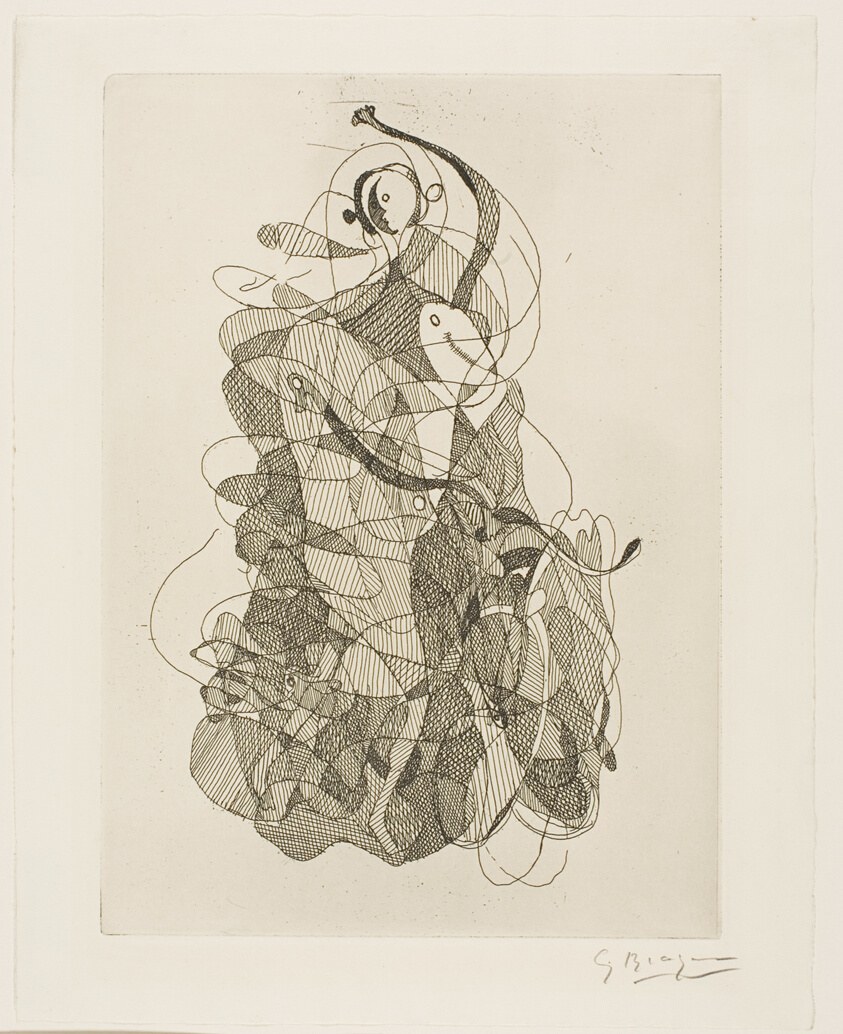
This etching presents a densely composed, abstract figure—or perhaps multiple figures—rendered entirely through careful hatching and cross-hatching in brown ink. The composition is vertically oriented and roughly columnar, with the densest shading concentrated in the lower two-thirds. A small head with a distinct circular eye appears at the top, and the form below consists of overlapping, organic shapes suggesting drapery, limbs, or flowing fabric. Fine parallel lines create volume and shadow across most surfaces, while cross-hatching deepens the tonal range. Dotted or stippled areas add texture throughout. The figure appears to be in motion or gesture—the forms suggest upward reaching or spiraling movement—but the abstraction is emphatic enough that the exact posture resists easy reading. The overall effect is of a body caught mid-gesture, dematerialised into pattern and tone.
The dancing
A single figure, or possibly a group of closely intertwined bodies, occupies the entire composition. The gesture reads as upward-reaching or expansive: an arm or arms extend toward the upper corners, and the general sense is of an open, vertical stretch. The hatching technique prevents clarity about specific limbs or holds, but the weight seems distributed and the posture energetic rather than static. The small head at top suggests the figure is tilted backward or reaching upward.
The dance depicted
This work does not depict recognizable dance vocabulary or a specific dance style. Rather, it appears to be an abstract or modernist representation of dance movement itself—the idea of gesture, extension, and bodily expression translated into pure form and tone. The upward-reaching quality and the sense of extension might suggest a classical dance vocabulary (ballet or modern dance), but the abstraction precludes confident attribution. The work is more interested in the aesthetic principles of dance—the line of the body through space, the dynamics of reach and expansion—than in depicting a particular style or technique.
How it was made
An etching on cream wove paper, executed in brown ink with meticulous parallel and cross-hatching to model form. The technique of line-work rather than wash allows for a kind of linear abstraction—the body is built from accumulated marks rather than mass. Etching was a medium favored by modernists for its expressiveness and precision; the work's circulation would have been limited to print collectors and galleries, placing it in a fine-art context rather than popular illustration. The careful hatching suggests a patient, considered approach to abstraction.
About this work
This 1934 etching by French modernist Georges Braque treats dance not as narrative or portraiture but as a problem of form: how to represent the gesture and extension of the human body in motion through pure pattern and tone. The work belongs to the early twentieth-century avant-garde's fascination with distilling movement into abstract mark-making. As an etching, it circulated among collectors and galleries rather than as public spectacle, and it reflects the period's conviction that dance and visual art shared deep structural principles. For a dance history that acknowledges modernism's debt to choreography—the way artists watched dancers and translated kinetic invention into visual syntax—this work is essential. It shows Braque, best known for Cubism, engaged in a dialogue between static image and mobile body.
How to look at it
Attend to the density and direction of the hatching: lines move generally upward or outward, reinforcing a sense of extension and lift. The small head at top functions almost as an anchor from which the rest of the form unfolds. The tonal range—darker in the lower body, lighter at the edges—suggests a figure caught in mid-gesture, lit from a frontal or diffuse light source. The abstraction requires you to read through pattern to find the body beneath, a process that mirrors the challenge of understanding modernist dance itself: you must surrender literal expectation and tune your eye to rhythm, interval, and suggestion.
The artist
Georges Braque (1882–1963) was a founding figure of Cubism, working alongside Picasso in the early 1900s before developing his own language of fragmented planes and tonal modulation. By the 1930s, he had largely moved beyond strict Cubism into a more lyrical, decorative abstraction. He was deeply engaged with modernist culture in Paris, including the visual experiments of the Ballets Russes and the broader avant-garde conversation about art, movement, and form. This etching dates from the height of his mature period, when his work had become more openly gestural and less concerned with rigid geometric structure.
The period
The early 1930s in Paris were a moment of intense formal experimentation across art and dance. The Ballets Russes had already fundamentally altered how visual artists thought about the stage and the moving body; Cubism itself had taught painters to think in terms of multiple viewpoints and fragmented forms. By 1934, abstraction was becoming a dominant concern, and artists were exploring how to represent movement, gesture, and energy without literal representation. In modernist printmaking, etching was experiencing a minor renaissance as artists rediscovered its capacity for nuance and line-based expression.
Where it lives
The work is held in the Prints and Drawings collection at the Art Institute of Chicago (AIC). It is part of the museum's comprehensive holdings of modernist prints and reflects the AIC's long engagement with early twentieth-century European art and printmaking.
Questions about this work
Is this actually a dance? It looks abstract.
Yes and no. It is not a scene of dancers performing a recognizable style—no ballet or folk form is depicted. Rather, it is Braque's translation of dance *movement* into pure form: the reaching, the extension, the sense of a body in space. For modernist artists, this kind of abstraction was not a rejection of their subjects but a deepening of them. By stripping away costume and setting, Braque isolates what dance actually is: gesture and dynamic extension.
Why did Braque make prints of dancers?
Braque was one of many modernists fascinated by dance as a living, abstract art. The Ballets Russes had shown Paris that movement could be as formally inventive as painting or sculpture. Printmaking allowed Braque to explore these ideas cheaply and to circulate them among fellow artists. Etching, in particular, offered a way to work with line and tone in ways that paralleled his thinking about Cubism and abstraction.
How do I know this is dance and not just an abstract figure?
You cannot know for certain from the image alone—and that ambiguity is part of the work's power. The upward reach, the sense of extension and dynamism, and the historical context (Braque's engagement with the modernist dance world) all support a dance reading. But the work deliberately resists literalism. That refusal to be obvious is itself very modern.
More dance artwork





