49 works in this view — arrow keys or swipe to move between them.
Dance in Art
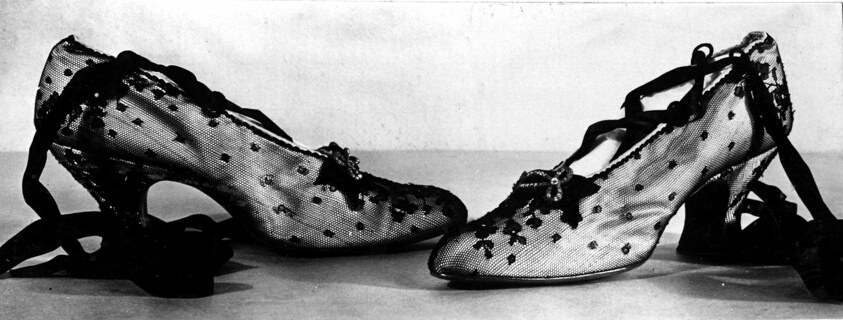
Pair of Tango Shoes
Made by Costa (French, active c. 1914-1919) Paris
- Medium:
- Machine-made lace; backed with silk warp-float faced 7:1 satin weave; silk, warp-float faced 15:1 satin weave with supplementary pile warps foaming cut solid velvet ribbon wrap rhinestone and metal buckle's ribbon ties; silk warp-float faced 7:1 satin weave; silk loops and plain weave edge; leather
- Collection:
- Textiles
- Source:
- Art Institute of Chicago
- Rights:
- Rights reserved by the holding institution — do not reuse without permission. Source record ↗
- Recorded as:
- AIC — rights reserved
Dance history is usually written from written records and images; surviving dance shoes are rare and carry unmediated information about footwear, ornamentation, materials, and the physical demands placed on dancers' bodies. These shoes show that tango dancers in Paris wore expensive, heavily constructed footwear that required significant muscular control and marked them as performers of a specific, high-status dance.
What you are looking at
Two ornate women's dance shoes are displayed in profile against a plain background. Each shoe is constructed from machine-made lace with silk backing and features extensive embellishment: rhinestones and metal buckles catch the light across the uppers, while silk ribbon wraps and ties extend from the heel, creating elaborate trailing elements. The shoes are heeled and narrowly pointed, characteristic of early 20th-century evening wear. The lace is dense and patterned, and the satin surfaces gleam under even lighting. The shoes are positioned as a pair, suggesting they were worn together and are now presented as a unified object—a document of fashionable footwear rather than a functional pair.
The dancing
No human figures are present. The shoes themselves are the subject, and their construction and ornamentation communicate the body they were made for: a dancer or ballroom performer requiring elegant footwear with arch support, a narrow profile, and maximum visual impact under stage or ballroom lighting. The ribbon ties suggest secure fastening and decoration in equal measure. The heel height and toe shape indicate a dancer of some formality and training.
The dance depicted
The catalogue identifies these as tango shoes, and the style supports that attribution. Tango emerged in Buenos Aires in the 1880s–1890s and had reached Paris by the early 1900s, where it became fashionable among elite and theatrical circles. By 1914, when these shoes were made, Paris was a major center of tango performance and instruction. The shoes' construction—heeled, with strong arch support and a narrow vamp—is consistent with the demands of tango dancing, which requires precise footwork, close partnering, and the ability to execute rapid direction changes and decorative flourishes. The elaborate ornamentation reflects tango's status as a prestige dance associated with performance, wealth, and cosmopolitan sophistication.
How it was made
These are not an artwork in the traditional sense but a museum object: a maker's artifact documenting fashion and function. They are constructed from multiple materials—lace, silk satin, leather, rhinestones, and metal—assembled by machine and hand. The cost of materials and labor indicates they were made for a performer or a client of means. Their preservation and acquisition by a textile collection suggests they were recognized as historically significant documents of dance fashion and craft even at the time of their making or shortly after. The materiality itself—the density of lace, the weight of ornamentation—speaks to how dancers of this era moved: these are not lightweight shoes, and they demand technical control and strength.
About this work
This pair of tango shoes made by the Parisian maker Costa in 1914 documents the intersection of fashion, performance, and dance during the height of tango's Parisian vogue. Tango had recently arrived in Europe from Buenos Aires and was transforming ballroom and theatrical practice. The shoes, preserved as a textile object, show how dancers' feet were dressed and how the materiality of costume contributed to the visual spectacle and the kinaesthetic demands of the dance. They are evidence of the technical apparatus of early 20th-century ballroom dance—not incidental to performance but central to it.
The work belongs in a gallery of dance in art because it makes visible what the body required in order to dance tango in 1914. The shoes are not a representation of dance but a tool of it, and their survival and documentation shift how we understand the relationship between costume, craft, and movement.
How to look at it
Attend first to the construction: the density of lace, the placement of rhinestones and metal buckles, the weight and rigidity these materials would impose on the foot. Notice how the heel is shaped and reinforced—this is not a delicate slipper but a working apparatus. The ribbon ties trailing from the heel serve both practical and aesthetic purposes; they secure the shoe and create visual interest when the dancer moves. The shoes' narrowness is striking: they demanded an arched foot and controlled technique. Consider what it would mean to dance tango—sharp turns, close partnering, intricate footwork—in these shoes, and how their visual and physical presence would have changed the dancer's appearance and movement.
The artist
Costa was a Parisian shoemaker active c. 1914–1919, a period when Paris was the center of European fashion and a major site of tango performance and instruction. The maker's name survives on the shoes themselves, identifying Costa as a specialist in fashionable evening and performance footwear.
The period
Tango arrived in Paris from Buenos Aires around 1910 and caused immediate and intense cultural reaction. By 1914, it had become mainstream among both elite ballroom dancers and theatrical performers. Paris was simultaneously the center of European avant-garde art and a stronghold of ballroom tradition, and tango occupied an ambiguous space between high fashion, theater, and the street. The shoes' date—1914—places them at the moment of tango's maximum fashionability in Paris and just before the First World War disrupted European cultural life. Concurrently, developments in women's fashion were widening and shortening skirts, making footwear more visible and more important to the overall silhouette of the dancer.
In the visual arts, the period saw increasing interest in documenting costume and material culture as historical record. Museums began acquiring theater and dance costumes and accessories as evidence of performance practice.
Where it lives
The shoes are held in the Textiles collection of the Art Institute of Chicago, acquired as a historical document of dance fashion. They are catalogued and preserved as a pair, suggesting recognition of their value as evidence of dance practice and as crafted objects.
Dance in this work
Questions about this work
Why are these shoes in an art gallery?
Dance shoes are rarely preserved, and surviving examples document the materials, construction, and design constraints of historical dance practice. These shoes are art-historical evidence: they show what a Parisian tango dancer wore, how they were expected to look, and what physical demands the dance placed on the body. They are also examples of skilled craft—shoemaking for performance is a specialized skill.
What is tango and why did it matter in 1914?
Tango is a ballroom and stage dance that emerged in Buenos Aires in the 1880s–1890s and reached Paris by 1910. By 1914 it was fashionable among elite dancers and performers. It was associated with modernity, sensuality, and cosmopolitan sophistication, and it spread rapidly throughout Europe and the United States. Tango required dancers to wear specialized footwear that supported rapid footwork and close partnering.
What do these shoes tell us about tango dancing?
The weight, construction, and ornamentation of these shoes indicate that tango was a technically demanding, formally dressed dance requiring strong footwork and arch support. The elaborate decoration—rhinestones, metal buckles, lace and ribbon—shows that the dancer's feet were on display and were meant to be visually striking. The shoes are expensive objects, indicating that tango was associated with wealth and leisure.
Who wore these shoes?
The catalogue record does not identify the original wearer. The shoes were made by Costa, a Paris-based shoemaker, and would have been worn by a professional dancer, a wealthy amateur, or a performer in a Parisian theater or ballroom. The size and construction suggest they were made for an adult woman.
More dance artwork





