49 works in this view — arrow keys or swipe to move between them.
Dance in Art
Tango
Elie Nadelman American, born Poland, 1885-1946
- Medium:
- Pen and brown ink and brush and brown watercolor, over graphite, on cream wove paper
- Collection:
- Prints and Drawings
- Source:
- Art Institute of Chicago
- Rights:
- Rights reserved by the holding institution — do not reuse without permission. Source record ↗
- Recorded as:
- AIC — rights reserved
The drawing is a rare modernist experiment in dance imagery from the period when the tango was still new and culturally contested in the West. It demonstrates how avant-garde visual artists responded to contemporary dance not by copying its movements but by abstraction and formal reduction. For historians of both dance and modernism, it reveals the tango's presence in early twentieth-century artistic discourse and shows how a living, vernacular dance could be transformed into a subject for avant-garde visual thinking.
What you are looking at
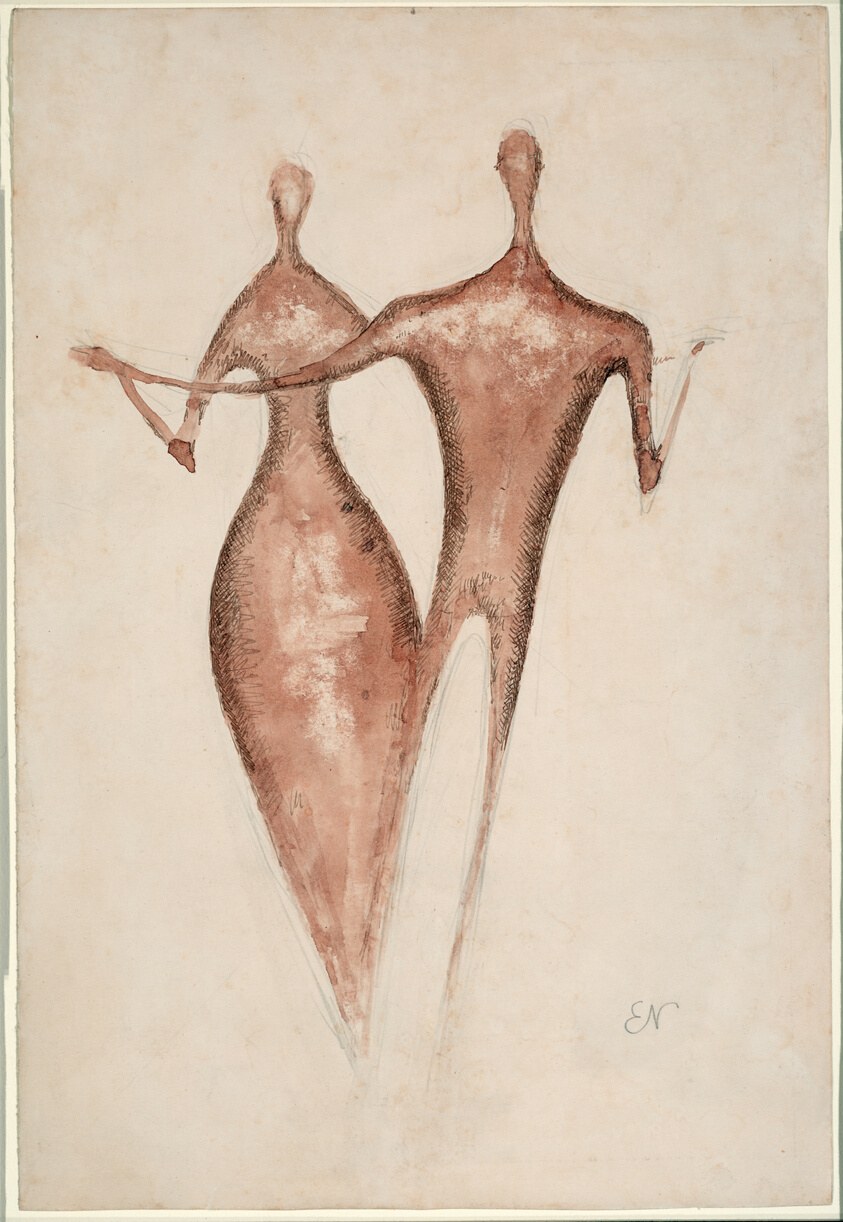
Two stylized figures in elongated, abstracted human form dominate the composition, rendered in warm terracotta and brown tones against a cream background. The figure on the left, viewed frontally, holds its right arm extended outward with hand open in a gesture of offering or display; its left arm is bent. The figure on the right, shown in profile or three-quarter view, mirrors this extended-arm pose with one limb reaching forward. Both have smooth, simplified torsos tapering to a sharp point at the base, and small, rounded heads that seem almost featureless. The bodies are rendered with fine hatching that suggests musculature and volume. The figures appear to be in close proximity but not in physical contact, their poses suggesting a moment of choreographed interaction or presentation. The entire composition is spare and elegant, emphasizing geometric abstraction and the rhythm created by the two bodies and their gestures rather than naturalistic representation.
The dancing
The two figures are conceived as abstracted forms with elongated, flattened bodies rather than anatomically naturalistic dancers. Both display extended, open arm gestures—one arm reaching outward with open palm, the other bent or held inward. The posture suggests a formal, deliberate presentation of the body in space rather than momentary movement; the figures seem to offer themselves to view. The sharp, tapering lower bodies and featureless heads emphasize geometric form over human detail, suggesting that the artist is interested in the vocabulary of gesture and spatial relationship rather than in portraying specific steps or technique.
The dance depicted
The title *Tango* anchors this work to Argentina's most famous dance, but the image departs radically from naturalistic representation. The extended, open arm gestures and the spatial separation of the figures do not match the close embrace characteristic of the Argentine tango as it was danced in the 1910s. Instead, the work appears to be a modernist reduction of the tango—extracting essential ideas about posture, presentation, and geometric relationship while abandoning the specific vocabulary of the dance itself. The figure on the right's extended leg and the deliberate, almost sculptural quality of both bodies suggest that Nadelman was interested in the tango as a subject for formal and compositional experiment rather than as a vehicle for depicting the actual movement. This drawing sits at the intersection of dance imagery and avant-garde abstraction.
How it was made
The work is executed in pen and brown ink with brush and brown watercolor over graphite on cream wove paper—a drawing technique that permits both linear definition and tonal modulation. The fine, controlled hatching visible in the bodies demonstrates careful construction; the medium allows Nadelman to suggest volume and musculature while maintaining the simplified, abstracted forms. Watercolor washes create warm, unified tonality across both figures. This is a finished drawing rather than a sketch, likely intended for exhibition or reproduction. The technique was common for modernist studies of the human form in the 1910s, when artists across Europe were using drawing to explore abstraction and simplification.
About this work
This 1914 drawing by Elie Nadelman takes the Argentine tango as its subject but treats it as a formal problem in abstraction rather than as a dance to be represented. Two elongated, simplified human figures with sharply tapering bodies and minimal heads display open, extended arm gestures in a composition that emphasizes geometry, negative space, and the rhythm of repeated forms. The work belongs to a moment when modernist artists were extracting essential visual ideas from vernacular dance, stripping away narrative and naturalism to reveal underlying structures of movement and form. For Nadelman, who was deeply engaged with both sculpture and dance imagery throughout his career, the tango becomes an occasion to explore how the human body could be simplified, stylized, and arranged in space to create aesthetic rather than literal meaning.
How to look at it
Notice the deliberate artificiality of the forms: no dancer's body actually tapers to a point, and the small, featureless heads seem almost egg-like. The artist has chosen to emphasize the extended arm gestures and the spatial relationship between the two figures rather than the footwork or the specific hold that would identify a tango. The hatching and watercolor washes create a sense of volume and surface, but the overall effect is sculptural rather than naturalistic—these look like formal exercises in the representation of the body rather than a moment captured from a dance floor. Look at how the open palms and extended arms create a sense of offering or display that the title suggests is distinctly tango.
The artist
Elie Nadelman (1885–1946) was a Polish-born sculptor and draftsman who emigrated to the United States and became a central figure in American modernism. He was deeply interested in simplified, stylized form and in the human body as a subject for formal investigation. Throughout his career, Nadelman drew and sculpted dancers, performers, and figures in motion. He collected folk art and vernacular objects and was fascinated by how artists in different media and traditions achieved expressive form through simplification and abstraction. His approach to the figure—whether in marble, bronze, or on paper—emphasizes rhythm, proportion, and the geometry underlying human shape.
The period
The tango arrived in Europe and North America around 1912 and sparked intense cultural debate. By 1914, when this drawing was made, the tango was simultaneously fashionable in ballrooms and condemned as morally suspect. The dance's embrace, hip movement, and association with Argentine working-class culture made it a subject of fascination and anxiety. At the same moment, modernist artists across Europe were exploring abstraction, primitivism, and the reduction of form. Nadelman's drawing sits at the intersection of these currents: the tango as a newly prominent vernacular form, and abstraction as an emerging artistic strategy. Other artists—including painters and sculptors in Paris, Berlin, and Vienna—were also taking dance as a subject for formal experiment during this period.
Where it lives
The work is held in the Prints and Drawings collection of the Art Institute of Chicago, which maintains one of the most significant holdings of works on paper in the United States. This is a finished drawing, not a preparatory sketch, and was likely created as an independent work or as part of Nadelman's larger exploration of figure and abstraction.
Dance in this work
Questions about this work
Is this actually a tango? The figures don't look like they're dancing.
The title identifies it as tango, but Nadelman has abstracted the dance almost beyond recognition. He has kept the extended arm gestures and spatial relationship of the two figures, but simplified the bodies into geometric forms and removed most of the specific vocabulary of the dance—the footwork, the embrace, the rotation. The drawing is more about the formal idea of tango than about representing how the dance was actually performed. This was a common modernist strategy: using a recognized subject as a starting point for abstraction and formal invention.
Who were these figures? Are they real dancers?
There is no evidence that they represent specific dancers. Nadelman has stylized them so thoroughly—featureless heads, tapering bodies, abstracted proportions—that they function as formal studies rather than portraits. The figures are generic; they represent the idea of dancers or bodies in a tango pose rather than particular people.
Why did Nadelman choose the tango as a subject?
The tango was new, modern, and culturally prominent in 1914. It was also formally interesting: the tango's embrace, posture, and hip movement offered visual contrasts and a distinctive silhouette. For Nadelman, who was interested in the human figure as a subject for abstraction and in drawing from contemporary life, the tango represented both artistic opportunity and a chance to engage with a living, vernacular form of culture.
What technique did Nadelman use?
This is a drawing in pen and ink over graphite, with watercolor washes added for tone and warmth. The technique allowed Nadelman to build volume through hatching while maintaining clean, controlled lines. Watercolor permitted subtle tonal variations across the figures. The result is a finished drawing with a sculptural quality—it has the weight and presence of a work of art rather than a sketch or study.
More dance artwork





