49 works in this view — arrow keys or swipe to move between them.
Dance in Art
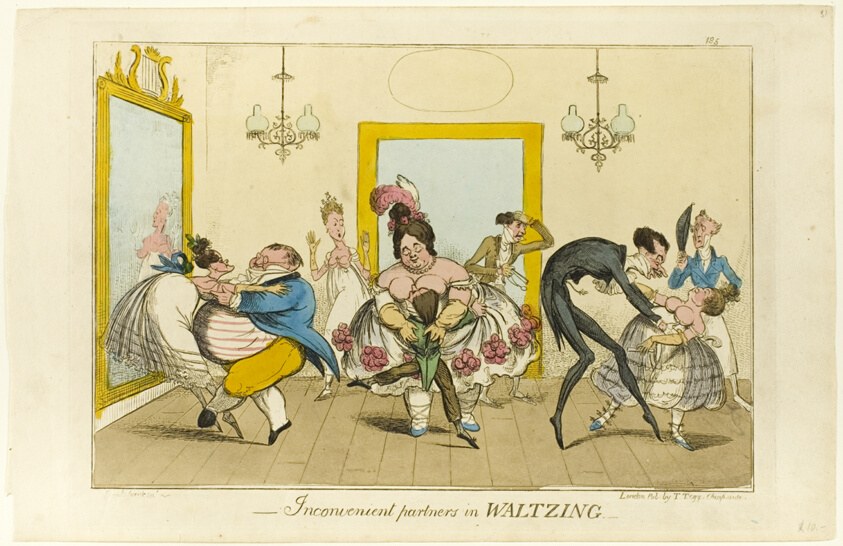
Inconvenient Partners in Waltzing
Isaac Robert Cruikshank (English, 1789-1856) published by Thomas Tegg (English, 1776-1846)
- Medium:
- Hand-colored etching on paper
- Collection:
- Prints and Drawings
- Source:
- Art Institute of Chicago
- Rights:
- Public domain — free to use, share and adapt.
- Recorded as:
- CC0 (Public Domain)
This print captures a specific historical moment—the introduction of the waltz to English ballrooms, when the dance's close partner hold scandalized moralists and its technical demands baffled amateurs. It is also direct visual testimony to how the waltz was actually executed by ordinary people (albeit here rendered as comic disaster) and how the dance was understood as both fashionable and ridiculous. Cruikshank's work is a rare instance of a major satirist taking the dance itself as the subject of humor rather than using dance as mere background for social commentary.
What you are looking at
A crowded ballroom in chaos: couples stumble through a waltz while others collide, embrace awkwardly, or tumble to the floor. The room is rendered in pale ochre and cream, with a gilded mirror on the left and a large gilded frame on the back wall reflecting the disorder. Two hanging chandeliers light the scene. In the foreground, a portly man in blue breeches and yellow stockings lurches forward, supported by a woman in a striped skirt whose hat has fallen askew. At center, a heavy woman in olive green struggles to maintain her footing as her partner pulls her sideways. To the right, a thin man bends backward at an extreme angle, nearly horizontal, while his partner tries to steady him. Behind them, other figures in various states of distress—one woman has collapsed entirely, another couple grapple with each other's limbs. The entire composition is a visual pun on social incompetence: these are not skilled dancers but clumsy, mismatched partners creating comic chaos through their inability to coordinate movement.
The dancing
The dancers show no unified frame or closed hold; instead, bodies are disconnected, off-balance, and frequently collapsing. One couple shows a grotesque backward arch—the man's spine bent nearly in half, his legs rigid, suggesting he has no idea how to lead or support his partner's weight. Another pair clutches each other in desperation rather than control. The woman on the left is nearly prone, her partner hauling her forward by force. No one demonstrates the upright posture, aligned shoulders, or coordinated footwork that a waltz requires; every figure is either too stiff, too slack, or too desperate to maintain the dance. The message is unmistakable: these people have no notion of how to move together.
The dance depicted
This depicts the waltz as it existed in 1817—a still-controversial partner dance that required physical closeness many found scandalous—but treated it as satire of social incompetence. The waltz itself is identifiable by the title, the close pairing of partners, and the ballroom setting, but the print's entire point is that waltzing demands a skill most people do not possess. The exaggerated physicality—the extreme backward bends, the flailing limbs, the collapsed bodies—shows waltzing as a form that exposes the dancer's body to ridicule if performed badly. This was a common theme in satirical prints of the 1810s, when the waltz was still new to English ballrooms and met with moral and aesthetic disapproval.
How it was made
This is a hand-colored etching, a process that allowed for sharp, precise lines defining the figures and the room's architecture, with watercolor washes applied afterward to add local color. The technique permitted the artist to layer detail—the fine cross-hatching in the skirts and coats, the delicate outline of the chandeliers—while the color layer kept the scene light and comedic rather than dark. Etchings were cheaper to produce and distribute than engravings, making them ideal for satirical prints aimed at a broad urban middle-class audience. The hand-coloring means each print varies slightly, and the technique's immediacy suits the improvisational quality of the satire—it feels like a quick, observant sketch rather than a carefully composed history painting.
About this work
This is a satirical print satirizing the waltz at the moment it was becoming fashionable in England. Cruikshank, a prolific cartoonist and social commentator, used the ballroom scene to mock both the dance itself and the pretensions of those attempting to master it. The print's full title, 'Inconvenient Partners in Waltzing,' captures the joke: the waltz pairs strangers or mismatched couples in a hold that requires absolute coordination, and when that coordination fails—as it spectacularly does here—the result is physical comedy. The work sits at the intersection of social satire and dance documentation: it tells us how the waltz was perceived in early-nineteenth-century England (with alarm and ridicule) while also showing us, in comic exaggeration, what the dance actually looked like when performed badly. For a dance historian, it is valuable evidence of how the waltz was danced and how it was received; for a historian of satire and graphic culture, it shows how the ballroom was a rich site for commentary on manners, social aspiration, and the body in public.
How to look at it
Attend first to the extreme exaggeration of the bodies—the backward arch, the collapsed figures, the flailing limbs—which is the print's entire rhetorical strategy. The artist is not documenting actual dancing but using physical impossibility to make his argument: that waltzing, as an alien and demanding form, turns English bodies into grotesques. Look at how few of the couples are facing the same direction or moving in any coordinated way; the chaos is compositional as well as physical. The ballroom itself—the elegant mirror, the chandeliers, the grand frame on the wall—provides a formal setting that makes the dancers' incompetence more absurd. The contrast between the refined architecture and the disordered bodies is where the satire lives.
The artist
Isaac Robert Cruikshank (1789–1856) was an English etcher, engraver, and caricaturist who specialized in social satire, usually published by the printseller Thomas Tegg. He worked in the tradition of James Gillray but with a broader, more domestic focus: his subjects included ballroom manners, domestic disputes, courtship rituals, and urban social types. Cruikshank produced hundreds of prints over a long career, many hand-colored and sold cheaply for immediate consumption by London audiences. His style was energetic and observant, with a gift for capturing the absurdity of human behavior without malice. He was less politically aggressive than Gillray but more interested in the everyday failures of ordinary people to behave with decorum.
The period
The waltz arrived in England from continental Europe in the early 1810s and met immediate resistance from moralists who objected to the proximity of male and female bodies in the dance's closed hold. By 1817, when this print was made, the waltz had become fashionable among younger aristocrats and aspiring middle-class dancers, but it remained controversial and was still being satirized as a sign of continental decadence and English social disorder. At the same moment, ballroom dancing was becoming a major site of social activity and anxiety in English life—the rules of partner selection, physical proximity, and bodily display were being negotiated in real time. Satirical prints like this one were one of the chief ways these anxieties were processed and made public. In visual art, the ballroom scene was becoming a standard genre in its own right, appearing in watercolors, prints, and later in paintings by artists including Thomas Rowlandson and Cruikshank's own contemporaries.
Where it lives
The work is held in the Prints and Drawings collection of the Art Institute of Chicago. It is one of thousands of satirical prints produced by Cruikshank and published by Tegg in this period, and it represents the ephemeral graphic culture of Regency London—objects made to be bought, viewed, and discarded rather than preserved as art.
Dance in this work
Questions about this work
Was the waltz really this difficult when it first appeared in England?
No—this is satirical exaggeration. The waltz required practice and coordination, but skilled dancers performed it gracefully. The print exaggerates incompetence for comic effect. However, the print does suggest that many amateur dancers found the close partner hold and the rotational footwork challenging, and that this challenge was a source of social anxiety and humor.
Why did the waltz cause so much scandal?
The waltz involved a close, sustained hold between partners—closer than any other ballroom dance of the time. Moralists objected to this physical proximity, particularly between unmarried couples, as it was seen as overly intimate and sexually suggestive. The dance also arrived from continental Europe, and conservative critics viewed it as a sign of foreign decadence.
Who is the artist, and why did they make so many satirical prints?
Isaac Robert Cruikshank was a prolific etcher and caricaturist working for the printseller Thomas Tegg. Satirical prints were a major industry in London; they sold cheaply, circulated widely, and allowed artists and publishers to comment on current social trends. Cruikshank's focus on domestic social life rather than politics was part of a broader shift in satire away from strictly political commentary toward observations of everyday manners and behavior.
Is this an original drawing, or was it reproduced?
This is an etching, a printmaking technique. Cruikshank made the design on a copper plate, which was then inked and printed many times. Each print was then hand-colored with watercolor. It was always intended to be a multiple, not a unique work. Hundreds of copies could be made from a single plate, which made prints affordable for ordinary urban buyers.
More dance artwork





