49 works in this view — arrow keys or swipe to move between them.
Dance in Art
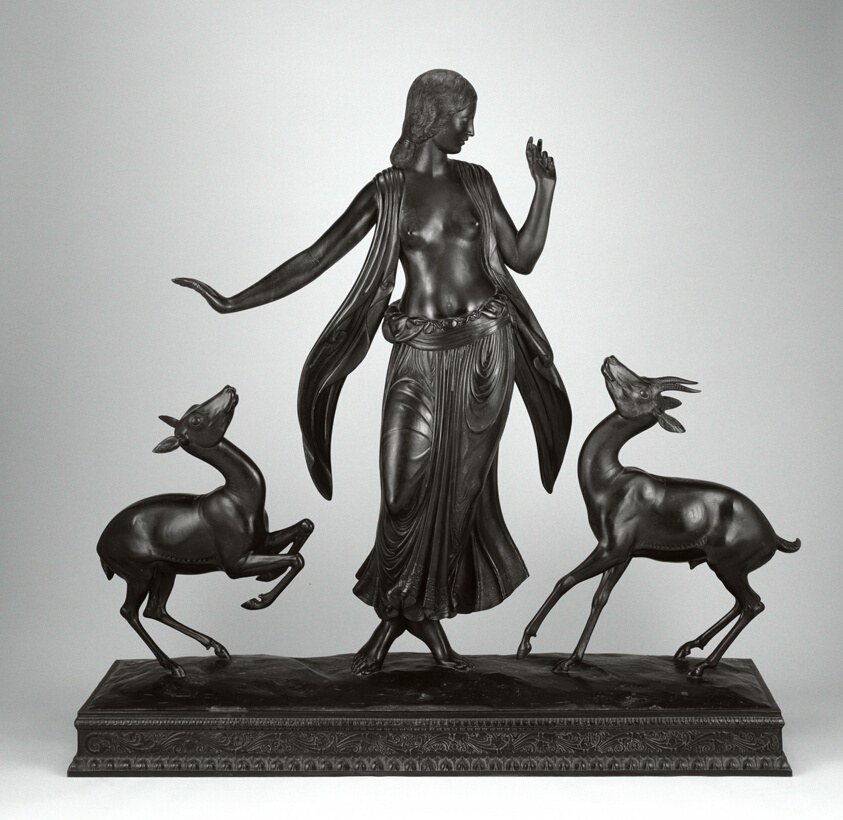
Dancer and Gazelles
Paul Manship (American, 1885–1966)
- Medium:
- Bronze
- Collection:
- Arts of the Americas
- Source:
- Art Institute of Chicago
- Rights:
- Rights reserved by the holding institution — do not reuse without permission. Source record ↗
- Recorded as:
- AIC — rights reserved
For dance historians, this work exemplifies how early 20th-century sculptors—even those working in a conservative neoclassical idiom—engaged with the aesthetics of movement, balance, and the body. Manship's attention to the subtle torsion of the torso, the play of drapery, and the counterpoint between human and animal forms shows how concepts of grace and motion pervaded the fine arts. The work illustrates the continuity between classical sculptural ideals and the modern dancer's body.
What you are looking at
A bronze sculptural group depicts a seminude female figure in classical drapery, positioned centrally with her body turned in profile to the viewer's right. She wears a draped garment that leaves her upper torso bare and falls in elegant folds to her feet; a second length of fabric sweeps across her back like a cloak or stole. Her right arm is raised in a gesture of command or benediction, while her left arm extends downward and outward. Flanking her on either side are two graceful gazelles or deer in a walking pose, their heads alert and their bodies in dynamic contrapposto. The animals' raised front legs suggest movement. The entire group stands on a rectangular plinth with decorative molding and a classical egg-and-dart border beneath. The bronze has been finished to a rich dark patina. The composition is symmetrical and frontal in its primary viewing angle, though the central figure's profile orientation creates a sense of turning movement.
The dancing
The female figure stands in a classical contrapposto stance with her weight on one leg, creating an S-curve through her torso. Her raised right arm, with palm open and fingers spread, suggests either a dance gesture of invitation or a commanding mythological presence; her lowered left arm trails at her side in a graceful arc. The two animals frame her symmetrically, neither quite in repose nor in rapid flight, their front hooves lifted in a poised walk that mirrors the tensioned elegance of the human figure above. The scale relationship—woman and animals at eye level—suggests companionship rather than dominion, despite the woman's elevated gesture.
The dance depicted
The work does not depict recognizable social or theatrical dance. Instead, it represents a mythological or allegorical subject—likely a classical figure associated with nature or wild creatures, such as Artemis or a similar divine presence. The raised-arm gesture and the animal companions suggest a moment from classical imagery rather than a codified dance style. The formal classical contrapposto and the woman's elevated pose draw on traditions of Greco-Roman sculpture and neoclassical revival, conventions that permeate early 20th-century American sculpture. If dance is present, it is implicit in the carefully composed grace and balance of the pose rather than in any active choreographic movement.
How it was made
This is a bronze sculpture, cast by the lost-wax or sand-casting process typical of early 20th-century fine art practice. The detail in the drapery—the parallel pleats, the swagged fabric, the delicate fingers—and the anatomical refinement of the human and animal forms indicate skilled modeling followed by high-quality casting. Bronze allows a smooth, unified finish and deep patina that emphasizes form. The work's formal finish and scale suggest it was commissioned for exhibition or a public or private collection, indicating a serious artistic practice and well-funded patronage.
About this work
This bronze group represents a classical or mythological female figure in the company of two gazelles, posed in a moment of elegance and formal balance. Created by Paul Manship in 1916, it embodies the aesthetic principles of American Neoclassical sculpture in the early 20th century—a style that drew heavily on Greco-Roman prototypes while maintaining contemporary craftsmanship and refined taste. The work sits at the intersection of narrative sculpture and formal abstraction: it tells a mythological story but suspends that story in a timeless pose of perfect balance and proportion.
While not a representation of social or theatrical dance, the sculpture merits inclusion in a dance collection for its engagement with the human body in motion, its study of balance and flow through drapery and limb, and its place in the aesthetic conversations of its era about grace, femininity, and the classical body. The formal gesture and the animal companions evoke a narrative world in which movement and gesture carry significance.
How to look at it
Approach this sculpture from multiple viewpoints, beginning with the frontal view that emphasizes the symmetry of the composition and the commanding gesture. Then circle it to experience the profile of the central figure and the layering of the drapery. Notice the artist's choices about proportion: the woman's elongated limbs and the slender, alert posture of the gazelles create an overall impression of refinement and restraint. Observe how the raised arm creates an apex to the composition, drawing the eye upward, while the trailing drapery and the gazelles' lowered heads create a gentle downward movement. The moment frozen is one of poised grace rather than active motion—a studied equilibrium that was Manship's signature.
The artist
Paul Manship (1885–1966) was a leading American sculptor of the early 20th century, trained at the Pennsylvania Academy of Fine Arts and known for a refined neoclassical style that synthesized Greco-Roman precedent with modern materials and sensibility. He achieved considerable commercial and critical success, receiving major commissions for public sculpture and architectural ornament. His work embodies the Beaux-Arts tradition and the classical revival that dominated American sculpture before modernism. Manship excelled at animal subjects and mythological narratives, and his skill at modeling drapery and capturing dynamic equilibrium made him one of the most sought-after sculptors of his generation.
The period
In 1916, American sculpture was dominated by neoclassical and Beaux-Arts ideals. The early 20th century saw a vigorous continuation of 19th-century academic tradition, even as modernism was beginning to challenge it in painting and drawing. Manship's work represents the height of this tradition—refined, technically brilliant, and deeply learned in classical sources. Simultaneously, modern dance was undergoing profound change: Isadora Duncan and Ruth St. Denis were pioneering new forms of expressionistic and narrative dance that departed from classical ballet. The gap between Manship's formal classicism and the dance revolution of the era is striking; yet both movements engaged with the idealized body, grace, and the expression of narrative through bodily form.
Where it lives
The work is held in the Arts of the Americas collection at the Art Institute of Chicago. This is a major institutional holding, indicating that the sculpture has been recognized as significant to the American artistic canon and has been available for scholarly and public study.
Questions about this work
Is this a depiction of an actual dance?
No. The work represents a classical or mythological scene, likely inspired by Greco-Roman sources, rather than a social or theatrical dance. However, the sculpture engages deeply with principles of bodily grace, balance, and the aesthetics of movement that are central to dance. For that reason, it belongs in a collection devoted to the representation of dance in art.
What is the significance of the gazelles?
In classical mythology, wild animals often accompany divine or allegorical figures—particularly goddesses of nature or hunting. The gazelles may represent Artemis or a similar figure, or they may signify innocence, grace, and the natural world. Their poised, alert posture mirrors and reinforces the refined elegance of the human figure.
Why was Manship such an important sculptor?
Manship was one of the most technically accomplished and commercially successful American sculptors of the early 20th century. His ability to synthesize classical forms with contemporary materials and sensibility made him influential among collectors, architects, and the public. He demonstrated that neoclassical form could remain vital and appealing well into the modern era.
How was this bronze made?
The work was almost certainly created using either the lost-wax casting process or sand casting, both standard methods in early 20th-century sculpture studios. The artist modeled the work in clay, a mold was made, and molten bronze was poured into it. The resulting cast was then finished and patinated by hand to achieve the rich dark surface visible today.
More dance artwork





