49 works in this view — arrow keys or swipe to move between them.
Dance in Art
Mirror Dancer
Milton Avery American, 1885–1965
- Medium:
- Gouache on black wove paper
- Collection:
- Prints and Drawings
- Source:
- Art Institute of Chicago
- Rights:
- Rights reserved by the holding institution — do not reuse without permission. Source record ↗
- Recorded as:
- AIC — rights reserved
The work documents modernism's fascination with dance as a subject for radical formal experiment, and Avery's particular approach to color and figure in the 1920s–30s. It is a record of how American artists of that period absorbed European avant-garde interest in ballet and theatrical modernism while developing distinctly American approaches to color and composition.
What you are looking at
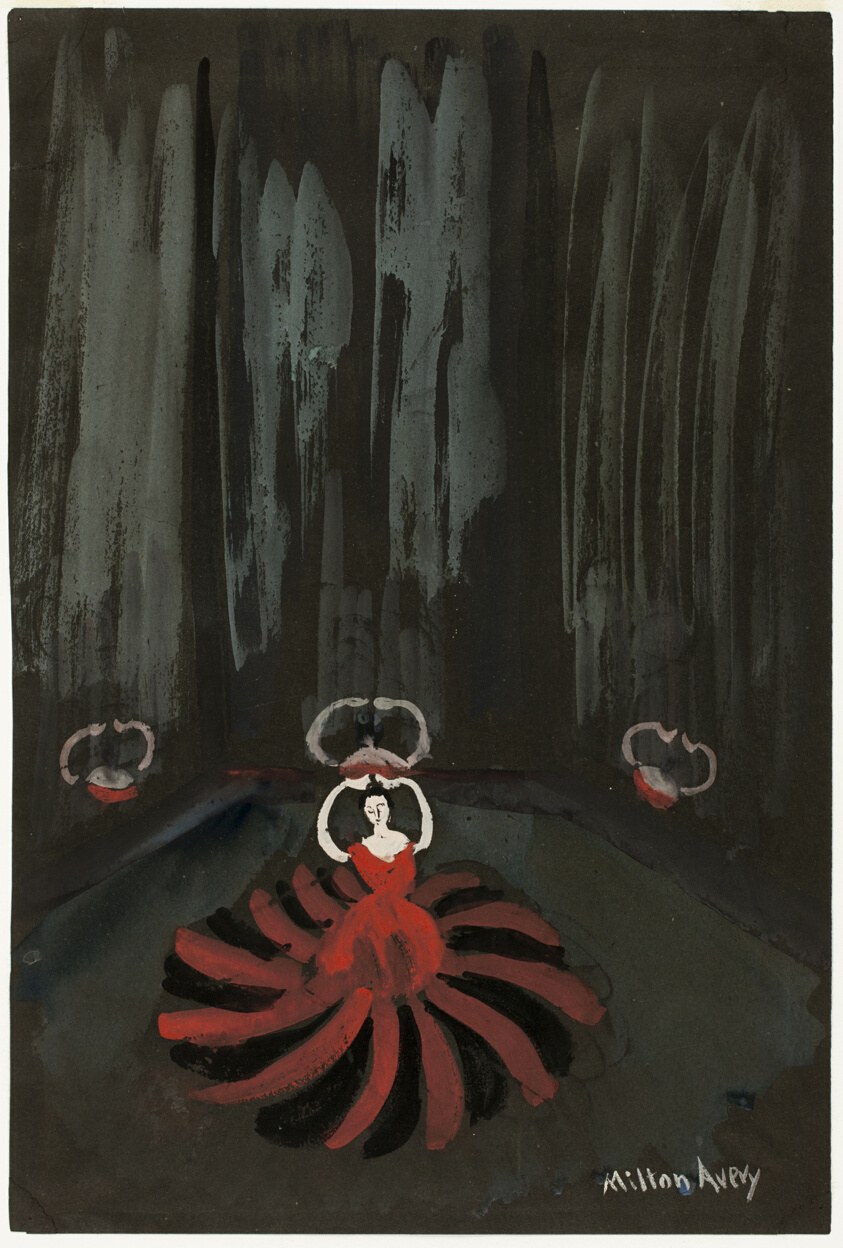
A solitary figure in a brilliant red gown dominates the composition, positioned in the lower center of the frame against a cavernous dark space. The dancer wears a voluminous skirt with sharp, angular pleats or panels radiating outward in a starburst pattern—a silhouette suggesting extreme rotation or the frozen moment of rapid turning. The figure's pale face and dark hair are framed by a distinctive ornamental headdress or collar in white and rust tones, rendered with Art Deco severity. The setting is monumental and austere: towering vertical forms—possibly columns or icicle-like stalks—rise in pale gray and white from the dark background, creating a cathedral-like or otherworldly space. Three small decorative emblems appear symmetrically placed in the shadows: two flanking the dancer at mid-height and one above, resembling ornate circular or shield-like forms. The overall mood is one of isolation and formal intensity, the dancer lit as if by a single source, her vivid costume the only warm note in a cold, architectural void.
The dancing
The dancer stands with upright posture, facing forward toward the viewer with minimal arm gesture—hands appear to be positioned at or near the body. The body itself is nearly motionless in the frontal plane, but the extreme flair of the skirt suggests either a moment captured mid-rotation or a costume designed to suggest perpetual motion through static form. There is no closed or open hold with a partner; this is a solo figure. The posture is formal and controlled rather than naturalistic, with the geometric severity of the costume taking precedence over anatomical expression of the body beneath.
The dance depicted
This appears to be a stylized representation of a solo female dancer in theatrical dress, but the specific dance form is difficult to identify with confidence. The formal, hieratic quality—upright posture, frontal presentation, geometric costume—and the monumental architectural setting suggest either historical court or theatrical contexts. The angular, radiating skirt construction is inconsistent with classical ballet vocabulary and reads more like a modernist or Art Deco reimagining of dance costume. The work may represent a contemporary theatrical or pageantry piece rather than an identifiable historical dance style, or it may stylize folk or ceremonial forms through a 1920s aesthetic lens.
How it was made
This is a gouache painting on black wove paper, a technique that allowed Avery to build luminous, saturated color against a dark ground—the red seems to glow from within. Gouache's opacity permitted him to lay down bright pigments with confidence over the dark paper without the transparency of watercolor. The technique was economical and portable, suited to studies and works on paper; the small scale and intimacy of the medium contrasts sharply with the monumental spatial ambitions of the composition. The black paper itself becomes a compositional element, unifying the background and emphasizing the isolation of the brilliantly colored figure.
About this work
A study in geometric abstraction and theatrical form from the American modernist painter Milton Avery, this work presents a solitary female dancer in a radically simplified, architecturalized space. Rather than capturing naturalistic movement or a recognizable dance style, Avery uses the figure of the dancer—and especially her spectacular, radiation-patterned skirt—as a vehicle for exploring modernist composition, the expressive power of color, and the relationship between human form and abstract space. The work sits at the intersection of figurative painting and abstraction, of theatrical interest and formal innovation, treating the dancer's body not as a vehicle for narrative or authentic movement but as a pure compositional element, a bright geometric shape against darkness.
How to look at it
Attend first to the costume, particularly the shocking geometry of the skirt—those sharp, radiating pleats or panels form the visual and compositional center. This is not a realistic representation of how fabric moves; it is a modernist abstraction of the idea of a spinning dancer, translated into pure form and vivid color. Notice how the pale vertical forms in the background echo and amplify the dancer's verticality, making her part of an architectural whole. The ornamental forms floating in the shadows are worth examining closely: they may be emblems, heraldic devices, or purely formal echoes. Finally, observe how the black paper is not merely negative space but an active compositional element that makes the red seem to levitate.
The artist
Milton Avery (1885–1965) was an American modernist painter known for his lyrical use of color and flattened, simplified forms. Though he worked in landscape and still life, Avery maintained a lifelong interest in the figure, often treating it as an occasion for exploring color relationships and compositional balance rather than anatomical accuracy or psychological depth. His approach—decorative without being merely ornamental—influenced later American abstract painters including Mark Rothko. Avery moved between representational and increasingly abstract work, and his paintings on paper, including this gouache, often served as a laboratory for formal experiments later developed in larger oils.
The period
This work dates to the early 20th century, a moment when dance held intense fascination for modernist visual artists across Europe and America. The Ballets Russes, Diaghilev's company, had revolutionized both dance practice and artistic collaboration; artists including Picasso and Matisse designed for the company, and the visual culture of ballet permeated avant-garde circles. In the United States, artists like Avery engaged with these developments while developing distinctly American modernist vocabularies. The geometric abstraction and flattened space visible here reflect broader trends in 1920s–30s modernism: Cubism's influence, the decorative modernism of Art Deco, and the growing abstraction of figuration across the visual arts.
Where it lives
The work is held in the Prints and Drawings collection of the Art Institute of Chicago, catalogued as a gouache on black wove paper. As a work on paper in a museum prints and drawings department, it represents the kind of study or independent work that often served as laboratory for modernist experiment.
Questions about this work
Is this ballet?
Not in any traditional sense. While the solitary female dancer and theatrical setting invoke the world of early 20th-century ballet modernism, the work does not depict any recognizable ballet vocabulary or narrative. Avery has abstracted and geometricized the idea of a dancer into a formal composition.
What are those symbols around the figure?
They remain ambiguous—they could be heraldic devices, decorative emblems, architectural ornaments, or purely formal echoes placed for compositional balance. The Art Deco language of the period often used such formal symbols to suggest luxury and modernity.
Why is she alone in such a large space?
The scale of the architecture relative to the figure emphasizes her isolation and monumentality simultaneously. This composition reflects modernist interest in the individual figure as a subject of formal and expressive intensity, stripped of narrative or social context.
What makes the skirt look like that?
It is rendered as a perfect radiating starburst—either the moment frozen mid-spin, or Avery's abstraction of the idea of rotation into pure geometric form. The sharp pleats and the vivid red make it read as a formal shape first and a piece of fabric second.
More dance artwork





