49 works in this view — arrow keys or swipe to move between them.
Dance in Art
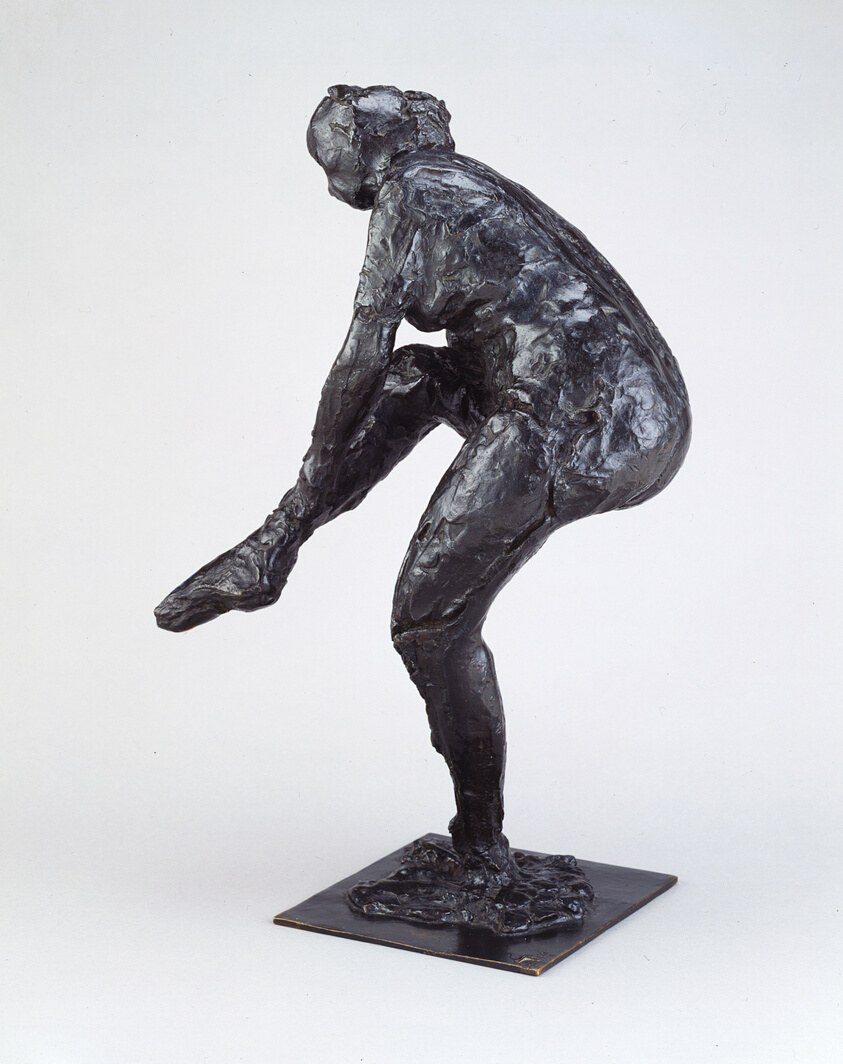
Dancer Putting on Her Stockings
Edgar Degas (French, 1834–1917)
- Medium:
- Bronze
- Collection:
- Painting and Sculpture of Europe
- Source:
- Art Institute of Chicago
- Rights:
- Rights reserved by the holding institution — do not reuse without permission. Source record ↗
- Recorded as:
- AIC — rights reserved
For dancers and those who study dance seriously, this work is crucial because it refuses the myth of effortless grace. It shows instead how bodies actually move when they are not being watched, and it dignifies that private moment as worthy of fine art. Degas's commitment to observing real dancers in real situations—rather than inventing them—helped establish that the daily life and labor of performers was as worthy of serious artistic attention as any historical or religious subject.
What you are looking at
A bronze figure of a young woman in a moment of private preparation, caught between standing and sitting as she adjusts her stockings. She is nude except for the garment she is attending to, her body twisted slightly as she bends forward and to one side, one leg extended and the other bent beneath her. The sculpture is mounted on a flat rectangular base. The figure is modeled with anatomical precision: we can read the tension in her torso, the strain in her arms as she reaches down, the weight distributed unevenly across her legs. The surface has the characteristic texture of a cast bronze, with visible tool marks and the patina that comes from age. There is no setting beyond the base; the work is purely figurative, isolating this single private moment from any context.
The dancing
A single female figure, nude, in a complex contrapposto position that is neither fully standing nor fully seated. Her right leg is extended forward with the foot flexed, while her left leg is bent beneath her body. Both arms reach downward toward her legs, the left arm more active in the gesture of pulling or adjusting fabric at the ankle or calf. Her spine curves forward in a gentle arc, her head tilted down to attend to the task. The pose demonstrates an understanding of how the body actually moves in an ungraceful, intimate moment—there is no balletic elongation here, only the honest mechanics of dressing.
The dance depicted
This work does not depict dance, though it represents a body in motion and with awareness of its own form. The gesture is that of private preparation, the kind of moment a dancer might experience before or after performance, but the sculpture itself captures a mundane domestic act rather than an artistic movement. The title specifies stockings, a garment worn in late 19th-century life and dance practice alike, but the work is not about dance technique or choreography.
How it was made
This is a bronze cast, a medium that allows for fine modeling of anatomy and surface texture while conferring permanence on what would otherwise be a fragile moment. The casting process—likely from a wax original—preserves the immediacy of sculptural gesture. Bronze's ability to hold fine detail makes visible the exact tension of muscles and the precise angle of joints, while its dark patina and reflective surface give the figure a sense of presence and weight that drawing could not achieve.
About this work
Edgar Degas's 'Dancer Putting on Her Stockings' is a bronze sculpture of a young woman in the act of dressing, a moment of unglamorous self-care rendered with the anatomical precision and psychological acuity Degas brought to all his studies of the female body. The work is part of Degas's larger project of observing dancers and performers in contexts far removed from the stage—in rehearsal, at rest, in the privacy of their own preparations. This sculpture, cast in bronze, transforms a fleeting domestic gesture into a meditation on the body's honest relationship with itself and with clothing. It belongs in a gallery about dance because dancers themselves recognize in it the unidealized physicality of their own lives, the moments before and after the performance when the body is simply itself.
How to look at it
Pay attention to the precise moment Degas has chosen: not a moment of display or performance, but a moment of necessity and concentration. The woman is focused on her task, unaware of being watched (though of course she is the object of the sculpture's entire attention). Notice how the pose is ungainly but utterly convincing—there is no pretense to grace here. Look at how the weight of the body is distributed across the legs, and how the spine bends to accommodate the reach of the arms. This is what Degas meant by truth to nature: not the idealized body of classical sculpture, but the actual body in the actual world, doing actual things.
The artist
Edgar Degas (1834–1917) was a French painter and sculptor who made the study of dancers and performance a central concern of his practice. Unlike many of his Impressionist contemporaries, Degas was drawn to the bodily discipline of the dance and the theater, and he spent decades observing dancers at the Paris Opéra, in rehearsal studios, and in private moments. He worked in pastel, oil, drawing, and sculpture, often creating multiple versions of a composition in different media. His sculptures, many of which were cast in bronze only after his death, show the same keen attention to anatomy and movement that define his paintings and pastels. Degas's dancers are never merely decorative; they are workers whose bodies bear the marks of their labor.
The period
In the late 19th century, the figure of the dancer—especially the young female dancer—had become a subject of intense artistic and social interest in Paris. The can-can and other popular dances were feeding into fin-de-siècle culture, while the Paris Opéra ballet maintained a more classical tradition. Degas came of age in a moment when artists were increasingly interested in capturing modern life in all its unidealized particularity, and dancers offered a perfect subject: they were contemporary, they involved the body in ways that challenged academic conventions, and their work was visible to anyone who could afford a ticket. In sculpture, the 19th century had seen a revival of interest in the human figure after decades of historical and allegorical subjects, and small bronzes of dancers and bathers were becoming fashionable among collectors.
Where it lives
This work is held in the Painting and Sculpture of Europe collection at the Art Institute of Chicago. The sculpture was likely cast from a wax or clay original in the decades after Degas's death, as was common practice with his sculptural works. The AIC source indicates this is part of their European holdings.
Questions about this work
Is this work about ballet?
No—it is not a depiction of dance or ballet technique. However, it shows a dancer (or at least a young woman) in a private moment of preparation, the kind of moment that was central to Degas's artistic vision. For Degas, dancers were interesting not only when they were dancing, but when they were resting, dressing, and simply being themselves. This work is about the body and labor, themes that run through his entire treatment of dance subjects.
Why did Degas make sculptures if he was a painter?
Degas used sculpture as a way to think about the body in three dimensions and to explore poses and movements more fully than drawing or painting allowed. Many of his sculptures were never publicly shown during his lifetime; they were tools for his practice rather than finished works for exhibition. The bronzes we know today are casts made after his death, which is why they have become more visible to modern viewers.
When was this cast in bronze?
The catalogue record indicates the work dates to 1900, but Degas often worked on ideas over many years, and this particular bronze may have been cast later, possibly after his death in 1917, as was typical for his sculptural works. The exact date of casting is not specified in the available record.
Are there other versions of this pose?
Degas returned to similar subjects many times—the theme of a woman putting on her stockings appears in paintings, pastels, and drawings as well as sculpture. He was interested in exploring the same gesture through different media and from different angles, each offering different insights into the subject.
More dance artwork





