49 works in this view — arrow keys or swipe to move between them.
Dance in Art
The Morris Dancers
Israhel van Meckenem the Younger German, c. 1440/45-1503
- Medium:
- Engraving in black on ivory laid paper
- Collection:
- Prints and Drawings
- Source:
- Art Institute of Chicago
- Rights:
- Public domain — free to use, share and adapt.
- Recorded as:
- CC0 (Public Domain)
This image documents a form of popular entertainment and physical culture that has left few records. It shows us the costume, gestural vocabulary, and social setting of carnival and street performance in the period when formal court dance was developing; understanding such images helps us see the full spectrum of movement culture and the distance between official and popular performance. For anyone tracing the social history of entertainment, costume, or the body in public space, this print is direct visual evidence.
What you are looking at
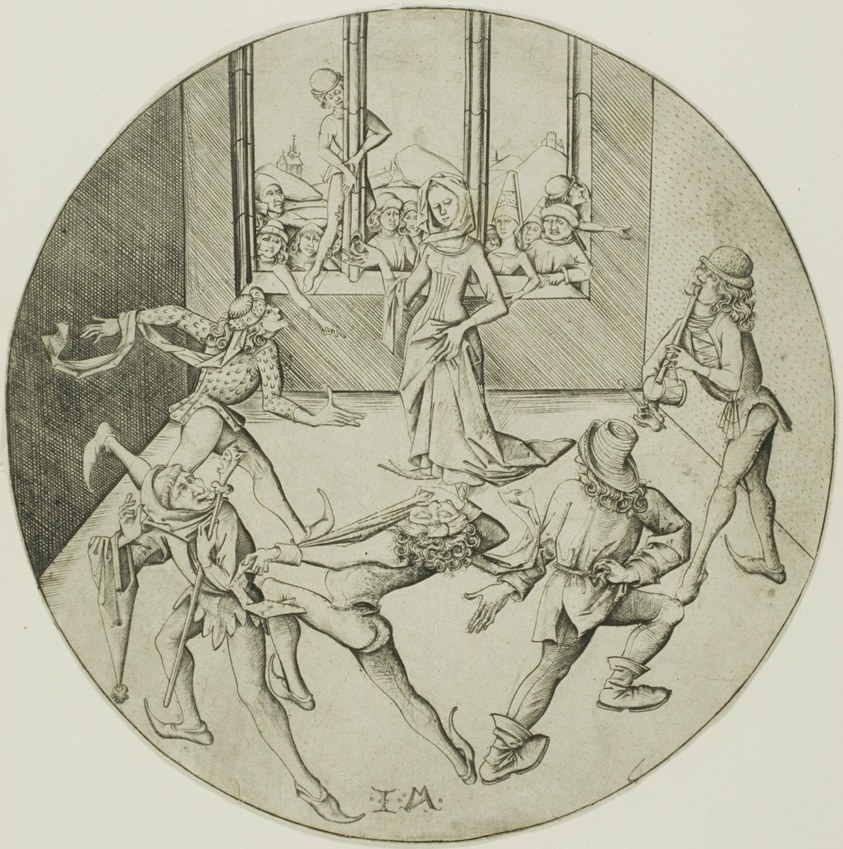
A lively outdoor entertainment scene set before a columned building, rendered in fine engraving. In the foreground, a group of energetic figures in varied costume dance and caper in loose formation across an open space. On the left, a semi-nude male figure in a feathered or fantastical costume leaps dynamically, while others in the center wear close-fitting hose and short doublets—the dress of jesters or entertainers. To the right, additional figures in similar garb gesticulate and move. In the background, framed by tall architectural columns, an audience of seated and standing onlookers watches from an elevated platform or loggia, their faces turned toward the performers. The composition has the energy of carnival or festival entertainment, with strong emphasis on movement and individual bodily expression rather than coordinated group formation. The engraving technique is precise and controlled, with fine hatching defining shadow and form, and the circular format (a tondo) gives the scene an intimate, framed quality despite its public setting.
The dancing
The performers move in an open, individualistic manner with no closed holds or formal partnering. Bodies are caught in various moments of leap, stride, and gestural abandon—weight shifts dynamically through the legs, arms are raised and extended expressively rather than held in a structured frame. The figures wear the close-fitting costume of medieval jesters or entertainers: short doublets, hose, and distinctive hats. One foreground figure is rendered nearly nude with fantastical drapery, suggesting a figure of grotesque or comic license. There is no evidence of synchronized footwork or the formal positions of court dance; instead, the gestural vocabulary emphasizes individual expressiveness and physical extremity.
The dance depicted
This engraving documents a form of open-air carnival or festival entertainment, likely depicting the street performances and buffoonery associated with urban festivals and courtly mockery traditions of the fifteenth century. The title 'Morris Dancers' may refer to a general category of outdoor jesters and performers rather than the specific English Morris dance tradition—the costume and setting are distinctly continental European. The performers show the physical exuberance, comic grotesquerie, and absence of formal structure characteristic of such street spectacles. No codified dance form is evident; instead, the work captures a mode of entertainment based on physical comedy, transformation of the body, and the freedom of the performer from courtly restraint.
How it was made
This is an engraving on paper executed with fine parallel lines (hatching) to build tone and shadow. Engraving was a printmaking technique requiring a copper plate incised with a burin, allowing multiple impressions to be pulled. The circular format (tondo) and the delicate, controlled linework suggest a work of considerable technical refinement and intended for circulation among educated patrons. The precision of the technique allows Meckenem to render minute details of costume, facial expression, and bodily gesture with clarity. As a print, this work would have reached a much wider audience than a painting, making it an important record of popular entertainment and costume practice in the period.
About this work
This engraving by Israhel van Meckenem the Younger documents a scene of open-air entertainment and carnival spectacle in fifteenth-century Europe. It captures the energy, costume, and social context of street performance and festive buffoonery—a form of dance and physical entertainment that existed at the margins of official courtly culture. The work records not a formal dance with choreographed steps, but rather the tradition of the entertainer, the jester, and the performer operating in public space under license to transgress social norms through bodily exuberance and comic transformation.
As an engraving, it circulated widely and served as visual documentation of popular culture and performance practice. It shows us how entertainers dressed, how they moved, and how they were perceived by audiences. The precision of the medium allows the artist to record the individualized gestures and comic intensity of performance—a window into a mode of cultural expression that rarely left other traces.
How to look at it
Attend to the variety of poses and the absence of any repeated or synchronized movement—each figure occupies a different moment and attitude, creating the effect of spontaneity and individual expression. Notice the costume details: the close-fitting hose, the short doublets, the distinctive hats, and the one nearly-nude figure with fantastical drapery, all signaling the status of these figures as entertainers operating under license to break social rules. The architectural setting and the audience in the background establish this as a public performance in a space of some consequence. The engraver has chosen to capture the moment of maximum exuberance and physical extremity rather than a static pose, and the circular frame contains all this energy within a defined space—a technique that emphasizes the containment of carnival within a bounded event.
The artist
Israhel van Meckenem the Younger (c. 1440/45–1503) was one of the most prolific and innovative German engravers of the fifteenth century. He trained in the tradition of the Master E.S. and pioneered techniques of reproductive and original engraving on copper. His workshop in Bocholt produced thousands of prints covering religious subjects, domestic life, fashion, and popular entertainment. Meckenem's engravings circulated across northern Europe and served as models and reference material; he was deeply engaged in documenting contemporary life, costume, and social practice. His interest in human gesture and movement is evident across his oeuvre, and his images of entertainers, dancers, and performers provide rare documentary evidence of late medieval popular culture.
The period
In the fifteenth century, the development of engraving as a technique coincided with growing urban prosperity, the expansion of courtly culture, and increasing interest in recording contemporary life and manners. At the same time, the formal vocabulary of court dance—the basse danse, the galliard, the pavane—was becoming codified and documented in dancing manuals. Outside the court, street performance, carnival, and festival entertainment flourished in urban centers, often involving acrobatics, juggling, music, and exuberant physical comedy. These popular forms existed in creative tension with courtly refinement; they were sometimes condemned by moralists, sometimes patronized and incorporated into courtly festivals. Prints like this one by Meckenem documented this popular culture for educated audiences and served as records of costume, gesture, and social practice across the period.
Where it lives
This engraving is held in the Prints and Drawings collection of the Art Institute of Chicago. As a work from the period of print's early expansion, it represents both the technical achievement of the medium and the documentary impulse of late medieval printmakers to record contemporary life and social practice. It circulated widely in its time and survives in multiple impressions.
Dance in this work
Questions about this work
Is this really 'Morris dancing'?
The title may be a later designation. The costume, setting, and style are consistent with fifteenth-century German carnival and street performance, not the English Morris tradition as we know it. The term may refer more generally to the tradition of traveling performers and jesters. What we see is a form of open-air entertainment and physical comedy performed in a public or semi-public space.
How do we know these are dancers rather than just acrobats or performers?
The distinction between dance and acrobatics in this period is not always clear-cut. These figures are moving rhythmically and expressively in a social context defined as entertainment. The work is titled a dance and documents physical performance; whether we call it dance or not depends partly on how broadly we define dance. The key point is that this is movement culture outside the courtly traditions.
What does the building in the background tell us?
The colonnade suggests a place of some architectural and social importance—a city hall, a courtyard, or a public building. This locates the performance in civic or courtly space rather than a street, suggesting these entertainers have been hired for a festival or celebration and are performing before an audience of status.
Why did Meckenem engrave scenes of popular entertainment?
Prints were valuable documents and objects of exchange. Engravers recorded contemporary life—costume, gesture, social practice—both as records and as designs that could be copied or adapted. Popular entertainment was visually compelling and commercially viable subject matter that appealed to educated buyers interested in the manners and life of their time.
More dance artwork





