49 works in this view — arrow keys or swipe to move between them.
Dance in Art
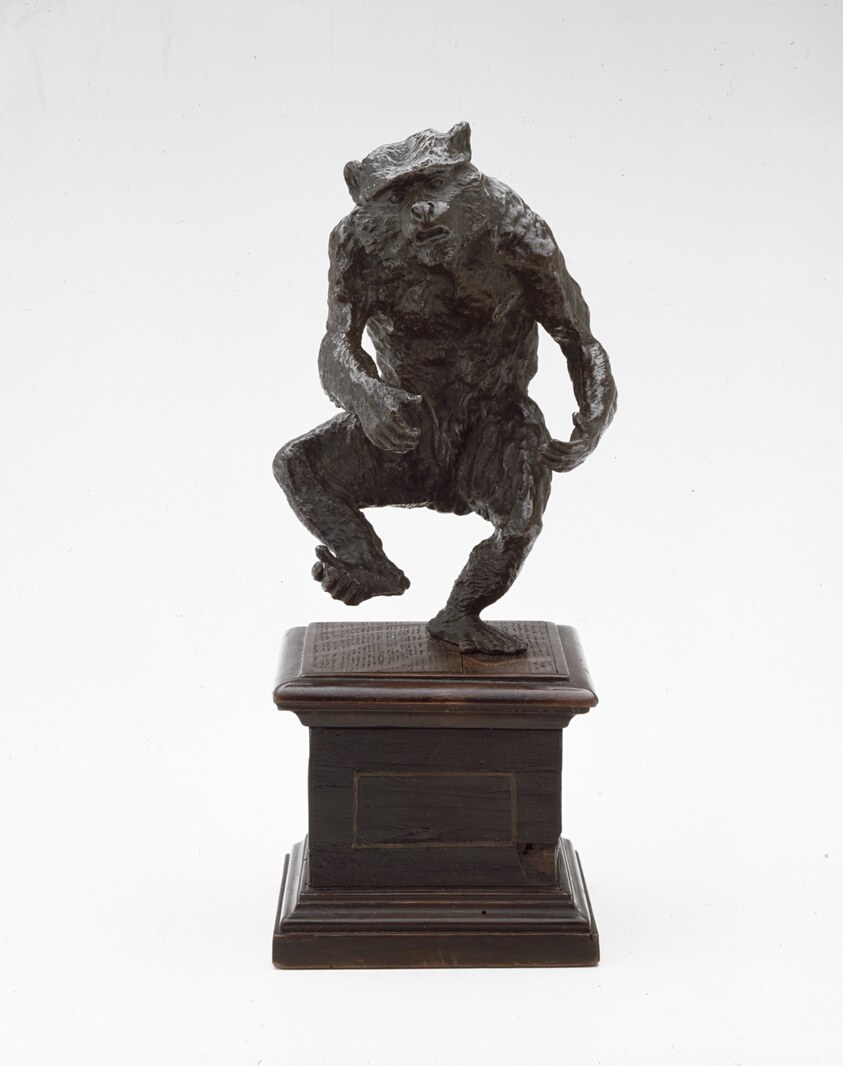
Dancing Monkey
Christophe Fratin (French, 1801–1864) Cast by Quesnel Foundry (French, active 19th century)
- Medium:
- Bronze
- Collection:
- Painting and Sculpture of Europe
- Source:
- Art Institute of Chicago
- Rights:
- Public domain — free to use, share and adapt.
- Recorded as:
- CC0 (Public Domain)
The work documents a moment when artists and collectors were fascinated by animal movement as a subject worthy of the same formal attention as human performance. By casting an animal in a pose that echoes human dance and theatrical expression, Fratin bridges natural history and aesthetic performance—a concern central to 19th-century art and thought. The sculpture reveals how deeply the language of dance and gesture had penetrated European visual culture even when the subject was not human.
What you are looking at
A bronze statuette of a monkey rendered in anthropomorphic posture, captured mid-movement on a wooden plinth. The creature stands in a dynamic, weight-shifted pose with one leg bent and the other extended, the torso twisted with arms animated in expressive gesture. The musculature is articulate—sinews visible across the chest and limbs—and the head is thrown back with mouth open, suggesting vocalization or laughter. The fur is rendered with fine detail, creating surface texture across the body. The figure occupies the full height of the composition, isolated against a neutral background, mounted on a simple rectangular base of dark wood with decorative molding.
The dancing
A single monkey figure occupies a contrapposto stance that borrows from human dance posture: weight is centered but the body spirals, with the hips canted forward and the shoulders rotated back. One arm is bent and raised near the chest in an expressive gesture; the other hangs more loosely. The legs support an asymmetrical weight distribution that reads as mid-movement rather than static. The head is elevated and turned, mouth open, suggesting exuberance or vocalisation rather than the closed, composed expression of a resting figure.
The dance depicted
This is not a depiction of a human dancer, but rather a representation of animal movement through the formal language of dance sculpture. The monkey's posture—the spiral of the torso, the gesture of the arms, the dynamic weight shift—adopts the visual vocabulary of theatrical performance. In the 19th century, such anthropomorphic animal sculptures often functioned as caricature or satirical comment on human manners and entertainment, reflecting the fascination with both Romantic-era expressive movement and the era's interest in natural history and comparative anatomy. The work thus sits at the intersection of animal study and human dance gesture, without depicting any specific dance tradition.
How it was made
This is a bronze cast, produced by the Quesnel Foundry—a major French bronzier of the 19th century—from a sculpture by Christophe Fratin, known for his animal subject matter. Bronze casting allowed for fine surface detail: the texture of fur, the musculature beneath, the precise delineation of facial features and gesture. The casting process permitted multiple copies to be made, and such works entered bourgeois and collector homes as decorative sculpture. The technique was labour-intensive, implying an affluent audience, and bronze's permanence and prestige made it the material of choice for serious sculptural statements about movement and anatomy.
About this work
This is a bronze statuette of a monkey in dynamic, expressive posture, cast in the mid-19th century by a foundry specializing in animal subjects. The work belongs to a tradition of Romantic-era animal sculpture that rendered movement through anatomically precise modeling and employed the visual grammar of human dance and theatre to convey animal vitality and character. The monkey is not performing a recognizable dance, but its body language—the spiraling torso, raised arm, weight shift, and open-mouthed expression—draws on the formal vocabulary of human gesture and performance to create an image of animate energy and expression.
How to look at it
Observe the pose as a whole: the twist of the spine, the asymmetry of weight, the expressiveness of the raised arm and open mouth. This is not a static portrait but a moment of animation—the sculptor has chosen to freeze a gesture mid-unfolding. Compare the posture to the formal language of human dance sculpture from the same era; note how the animal is rendered with the dignity and formal attention to movement that might be lavished on a human dancer. The detail of musculature and fur also signals the artist's investment in anatomical truth, even as the pose is thoroughly theatrical.
The artist
Christophe Fratin (1801–1864) was a French sculptor specializing in animal subjects, working during the height of the Romantic movement's fascination with wildlife and natural expression. He was prolific in bronze casting, and his works were widely collected by the bourgeoisie as decorative sculpture. Fratin's practice exemplified a broader 19th-century trend of treating animal anatomy and movement with sculptural seriousness, influenced by advances in natural history and a cultural appetite for images of vital, expressive physicality.
The period
The 1830s saw the full flourishing of Romantic sculpture across Europe, characterized by an interest in movement, emotion, and the natural world. This was the era of Théodore Géricault's dynamic equine studies and the broader turn toward depicting energy and vitality in bronze and marble. In dance, the 1830s were the golden age of Romantic ballet—*La Sylphide* premiered in 1832—which emphasized weightlessness, expressivity, and transcendence from the material body. Fratin's anthropomorphic monkey, rendered in an expressive pose that borrows from theatrical vocabulary, sits within this cultural moment when movement—whether human or animal—had become a primary subject for artistic representation.
Where it lives
The work is held in the Painting and Sculpture of Europe collection at the Art Institute of Chicago, sourced from that institution's records. It is a cast bronze, one of potentially multiple examples produced by the Quesnel Foundry, which manufactured such pieces for sale to collectors and institutions.
Questions about this work
Is this a dance sculpture?
Not in the strict sense—it does not depict a human dancer or a known dance tradition. However, it employs the visual language of dance and performance to render animal movement. The monkey's posture, gesture, and expression are rendered as theatrical and expressive rather than purely naturalistic, making it a work that sits at the boundary between natural history study and performance art.
Why would a 19th-century artist make a sculpture of a dancing monkey?
The 1830s Romantic era celebrated vitality, expression, and the natural world. Representing an animal in an expressive, dynamic pose allowed artists to explore movement and emotion while simultaneously commenting on human manners and entertainment—often satirically. Such works also reflected the era's intense interest in comparative anatomy and the study of motion across species.
Who was Christophe Fratin?
Fratin (1801–1864) was a French sculptor renowned for his bronze animal sculptures. His works were widely collected by 19th-century bourgeois patrons as decorative pieces. He was part of a broader European tradition of treating animal anatomy and movement as worthy subjects for serious sculptural attention.
More dance artwork





